

TCAs Side Effects Risk Assessment Tool
Personal Risk Assessment
This tool estimates your risk of experiencing serious side effects from tricyclic antidepressants based on your health profile. Results are for informational purposes only and should not replace medical advice.
Tricyclic antidepressants (TCAs) like amitriptyline and
Why TCAs Are Still Used Today
TCAs were developed in the 1950s, long before Prozac or Zoloft existed. They work by blocking the reuptake of serotonin and norepinephrine, two brain chemicals tied to mood and pain signaling. But unlike newer antidepressants, they also mess with other systems in your body - especially those controlled by acetylcholine, histamine, and adrenaline. That’s why they help with pain and sleep, but also cause dry mouth, dizziness, and heart rhythm changes.
Today, TCAs are rarely the first choice for depression. The American Psychiatric Association recommends them only after two or more other antidepressants have failed. But they’re still widely prescribed for off-label uses: diabetic nerve pain, fibromyalgia, chronic headaches, and even bedwetting in children. Amitriptyline alone gets over 12 million prescriptions a year in the U.S., mostly for pain, not depression.
Common Side Effects: What Most People Experience
Almost everyone who takes a TCA will feel at least one of these common side effects - and many will feel several.
- Dry mouth: This is the #1 complaint. Up to 30% of people on amitriptyline report constant cottonmouth. It’s not just annoying - it leads to tooth decay, gum disease, and mouth infections. Many users go through multiple bottles of saliva substitutes each month.
- Blurred vision: About 15-20% of users see things as foggy or out of focus. It usually clears up after a few weeks, but for some, it sticks around long enough to make driving unsafe.
- Constipation: TCAs slow down your gut. One in five people struggle with severe constipation. Left untreated, it can lead to bowel blockages - a medical emergency.
- Urinary retention: Especially in men with enlarged prostates, TCAs can make it hard or impossible to urinate. Some patients end up needing a catheter.
- Dizziness when standing: Known as orthostatic hypotension, this happens when your blood pressure drops suddenly after sitting or lying down. It causes lightheadedness and increases fall risk, especially in older adults.
- Fast heartbeat: Resting heart rate can jump by 10-20 beats per minute. For people with heart disease, this is dangerous.
- Extreme drowsiness: Amitriptyline is notorious for this. Up to 40% of users feel so sleepy they can’t drive or work. Nortriptyline is slightly better - around 25% report drowsiness.
More Serious Risks: What Doctors Warn About
Beyond the annoying side effects, TCAs carry real, life-threatening risks that can’t be ignored.
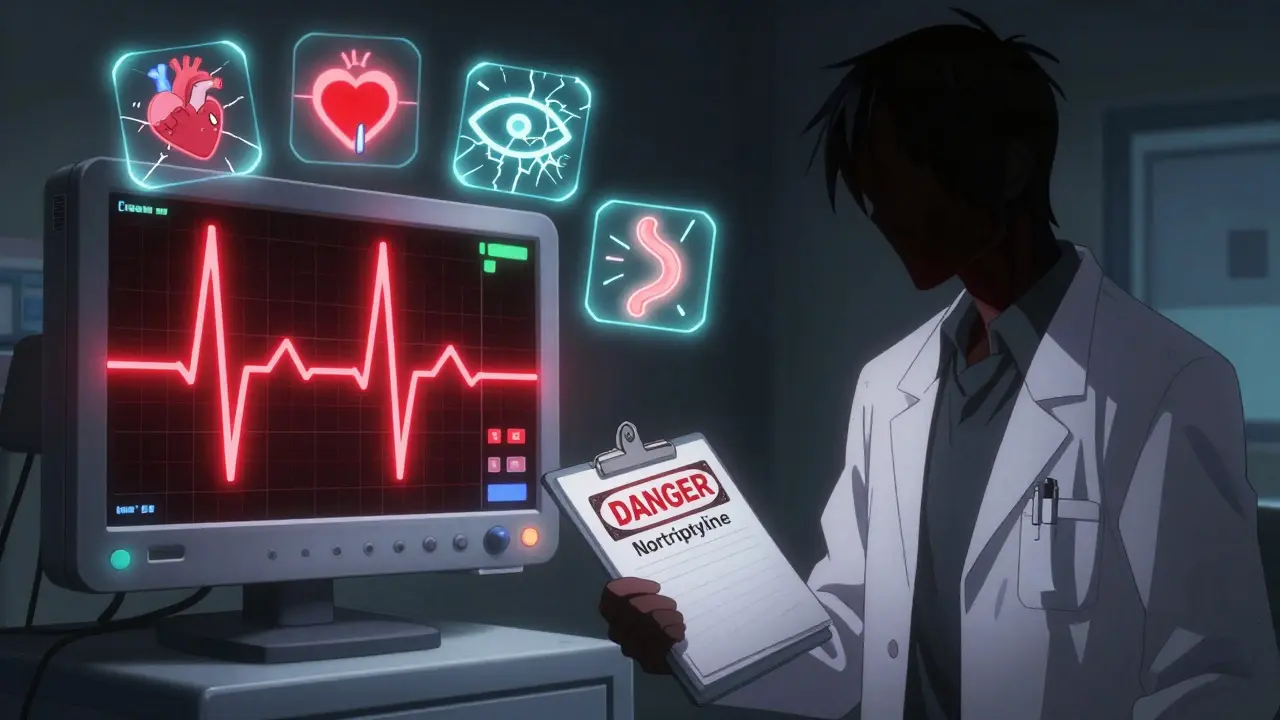
Heart problems are the biggest concern. TCAs can lengthen the QT interval on an ECG - a sign your heart’s electrical cycle is off. Amitriptyline can stretch it by 20-40 milliseconds. That raises the risk of dangerous arrhythmias, including ventricular fibrillation, which can kill you suddenly. A 2019 Lancet study found TCAs increase cardiovascular event risk by 35% compared to SSRIs.
Overdose is deadly. TCAs have one of the narrowest safety margins of any psychiatric drug. Taking just double the prescribed dose can be fatal. Signs of overdose include confusion, seizures, extremely low blood pressure, and a widened QRS complex on an ECG. Emergency rooms see TCA overdoses every week - and they’re among the deadliest.
Cognitive decline is especially risky for older adults. About 25% of people over 65 on TCAs report confusion. Fifteen percent become disoriented. The Beers Criteria - a guide doctors use to avoid risky drugs in seniors - explicitly says to avoid amitriptyline and other high-anticholinergic TCAs. Studies show a 70% higher risk of falls and a 50% higher risk of dementia-like symptoms in elderly users.
Amitriptyline vs. Nortriptyline: Which Has Fewer Side Effects?
Not all TCAs are the same. Amitriptyline and nortriptyline are often compared because they’re both used for pain and depression - but they’re very different in how they affect your body.
| Side Effect | Amitriptyline | Nortriptyline |
|---|---|---|
| Anticholinergic effects (dry mouth, constipation) | High | Moderate |
| Sedation | Very high (up to 40%) | Moderate (~25%) |
| Cardiac risk (QT prolongation) | Significant | Mild to moderate |
| Weight gain | Common (10-15 lbs in 6 months) | Less common |
| Best for | Severe pain, insomnia, treatment-resistant depression | Older adults, patients with heart concerns |
Nortriptyline is a metabolite of amitriptyline - meaning your body turns amitriptyline into nortriptyline anyway. But when you take nortriptyline directly, you avoid the worst of the anticholinergic effects. Many patients switch from amitriptyline to nortriptyline when side effects become unbearable. It’s not side-effect-free, but it’s often the better choice for older adults or people with heart issues.
Who Should Avoid TCAs Altogether?
Some people simply shouldn’t take TCAs - the risks outweigh any possible benefit.
- People with recent heart attack, heart failure, or uncontrolled arrhythmias
- Anyone with glaucoma (TCAs can raise eye pressure)
- Patients with urinary retention or enlarged prostate
- Adults over 65 - especially those with memory problems or a history of falls
- People taking other drugs that prolong QT interval (like certain antibiotics or antifungals)
- Those with a history of suicide attempts - TCAs are lethal in overdose
The FDA and multiple medical societies now warn against using TCAs in elderly patients unless absolutely necessary. The 2023 Beers Criteria update lists amitriptyline as a “potentially inappropriate medication” for seniors.
How to Use TCAs Safely
If your doctor recommends a TCA, here’s how to minimize harm:
- Start low: Begin with 10-25 mg at bedtime. This reduces drowsiness and lets your body adjust.
- Go slow: Increase the dose by 10-25 mg every 1-2 weeks. Don’t rush to higher doses.
- Get an ECG: Before starting, and again if your dose goes above 100 mg, get a heart rhythm check.
- Watch for dizziness: Stand up slowly. Sit on the edge of the bed for 30 seconds before standing.
- Brush and floss daily: Use sugar-free gum or saliva sprays to fight dry mouth. See a dentist every 6 months.
- Don’t quit cold turkey: Stopping suddenly can cause electric shock sensations, nausea, and anxiety. Taper over 4-6 weeks.
- Track your symptoms: Keep a journal of side effects. If you’re too tired to work, or your heart races constantly, tell your doctor.
Alternatives to Consider
Before committing to a TCA, ask about other options:
- SSRIs and SNRIs (like sertraline, duloxetine): Better tolerated, safer in overdose, but less effective for some types of nerve pain.
- Gabapentin or pregabalin: First-line for neuropathic pain, fewer systemic side effects.
- Mirtazapine: Helps with sleep and appetite, less anticholinergic burden than TCAs.
- Ketamine or esketamine: Emerging for treatment-resistant depression - but expensive and requires clinic visits.
Some doctors now combine low-dose amitriptyline (10-25 mg) with an SSRI. This can boost effectiveness while reducing side effects - a strategy gaining traction in clinical practice.
Real People, Real Experiences
On patient forums, stories are split between relief and regret.
One Reddit user, ‘ChronicPainWarrior,’ wrote: ‘Amitriptyline cut my nerve pain in half - but I had to switch to nortriptyline because I was drinking a liter of water every hour just to keep from choking. I still got two cavities.’
Another, ‘MigraineSurvivor,’ said: ‘After 10 years of 15 migraines a month, amitriptyline brought me down to 3. The weight gain sucked - I gained 12 pounds - but I finally slept through the night.’
On Drugs.com, amitriptyline has a 6.2/10 rating. Nearly 40% of reviewers say side effects ruined their experience. Common complaints: brain fog, sexual dysfunction, and trouble urinating.
But for those who’ve tried everything else, TCAs can be the last lifeline.
The Bottom Line
Tricyclic antidepressants aren’t broken - they’re just old. They work where newer drugs don’t. But they’re like a sledgehammer: powerful, but messy. If you’re considering one, ask yourself: Is this the only option left? Can I handle the dry mouth, the dizziness, the risk to my heart? Are there safer alternatives I haven’t tried yet?
For many, the answer is yes - and they find relief that changes their life. For others, the side effects are too much. There’s no universal answer. What matters is knowing the risks, tracking your body’s response, and never staying on a TCA longer than needed without regular check-ins with your doctor.
TCAs aren’t going away. But they’re no longer the go-to. They’re the backup plan - and if you’re using one, you deserve to know exactly what you’re signing up for.
Are tricyclic antidepressants still prescribed today?
Yes, but rarely as a first choice. TCAs like amitriptyline and nortriptyline are now mostly used for treatment-resistant depression, chronic nerve pain, migraines, or bedwetting - especially when newer drugs like SSRIs haven’t worked. They make up only 5-7% of all antidepressant prescriptions in the U.S., down from 30% in the 1990s.
Which TCA has the fewest side effects?
Nortriptyline and desipramine (secondary amine TCAs) generally have fewer side effects than amitriptyline or imipramine (tertiary amines). They’re less likely to cause dry mouth, drowsiness, or heart rhythm issues. For older adults or people with heart conditions, nortriptyline is often the preferred TCA.
Can TCAs cause heart problems?
Yes. TCAs can prolong the QT interval on an ECG, increasing the risk of dangerous heart rhythms like ventricular fibrillation. Amitriptyline is especially linked to this. People with existing heart disease, a history of heart attack, or irregular heartbeats should avoid TCAs unless closely monitored by a cardiologist.
Why are TCAs risky for older adults?
TCAs have strong anticholinergic effects that worsen memory, cause confusion, and increase fall risk. Studies show a 70% higher chance of falling and a 50% higher risk of cognitive decline in seniors taking amitriptyline. The Beers Criteria explicitly advises against using TCAs in patients over 65.
How long does it take for TCAs to work?
It usually takes 2 to 4 weeks for TCAs to show full effects for depression or pain. Many people stop too early because they don’t feel better right away. Don’t give up before the 4-week mark unless side effects are unbearable.
Can I drink alcohol while taking a TCA?
No. Alcohol increases drowsiness, dizziness, and the risk of low blood pressure. It also raises the chance of overdose. Even one drink can be dangerous when combined with a TCA.
What happens if I stop taking a TCA suddenly?
Stopping abruptly can cause withdrawal symptoms like electric shock sensations, nausea, anxiety, insomnia, and dizziness. Always taper off slowly over 4-6 weeks under your doctor’s supervision.
Are TCAs addictive?
No, TCAs are not addictive in the way opioids or benzodiazepines are. But your body can become dependent on them. Stopping suddenly causes withdrawal, which is why tapering is essential. They don’t cause cravings or euphoria.
How much do TCAs cost?
Generic amitriptyline and nortriptyline cost between $4 and $40 per month in the U.S., depending on dosage and pharmacy. They’re among the cheapest antidepressants available, which is part of why they’re still used despite their side effects.
Is there a safer way to use TCAs?
Yes. Start with the lowest possible dose, take it at night to reduce daytime drowsiness, monitor your heart with regular ECGs, avoid alcohol and other sedatives, and use saliva substitutes for dry mouth. Some doctors now combine low-dose TCAs with SSRIs to get the benefits with fewer side effects.
Author

Sumler Luu
December 26, 2025 AT 07:41My doctor pushed amitriptyline for my fibromyalgia, and I almost didn’t survive the first week. Dry mouth so bad I needed a humidifier in bed. Blurred vision made me quit driving for a month. But after 3 months, my pain dropped 60%. I switched to nortriptyline after reading this post - way better. Still dry, but I can actually remember my kids’ names now.
Sophia Daniels
December 28, 2025 AT 06:06Oh honey, if you’re taking TCAs and you’re not sobbing in the bathroom because your tongue feels like sandpaper, you’re doing it wrong. 😭 I’ve been on amitriptyline since 2018 and I’ve lost 3 molars, 2 friendships, and my will to live - but my nerve pain? Gone. So yeah, I’ll take the dementia and the constipation if it means I can sit down without screaming. #TCAWarrior
Nikki Brown
December 28, 2025 AT 09:02People who take TCAs without a cardiac workup are playing Russian roulette with their hearts. 🚨 I’m a nurse, and I’ve seen three overdose cases in the last year - all from people who thought ‘it’s just an antidepressant.’ No, it’s not. It’s a cardiac poison with a side of sleep. If your doctor prescribes this without an ECG, find a new doctor. Period.
Peter sullen
December 28, 2025 AT 20:52It is imperative to underscore that the pharmacokinetic profile of tertiary-amine TCAs, particularly amitriptyline, exhibits a significantly higher affinity for muscarinic acetylcholine receptors, thereby precipitating a constellation of anticholinergic adverse effects. In contrast, secondary-amine metabolites such as nortriptyline demonstrate a more favorable receptor selectivity index, thereby reducing the incidence of cognitive impairment and orthostatic hypotension. Consequently, clinical guidelines recommend nortriptyline as a preferred agent in geriatric populations.
Steven Destiny
December 29, 2025 AT 01:11Stop being weak. If you can’t handle a little dry mouth and dizziness, you’re not ready to fight chronic pain. I’ve been on 150mg of amitriptyline for 7 years. I lost 20 lbs, my heart races, and I can’t sleep without a 10-hour nap - but I can finally walk to my mailbox. You want relief? You pay the price. No one handed me a gold star for surviving this. I earned it.
Fabio Raphael
December 29, 2025 AT 04:46I’ve been on nortriptyline for 4 months for migraines. The drowsiness is real, but manageable. What no one talks about is how it makes you feel emotionally flat - like you’re watching life through thick glass. I don’t cry at movies anymore. I don’t laugh like I used to. Is that the trade-off? I’m not sure. But I’m still here. And I’m grateful.
Becky Baker
December 29, 2025 AT 05:38Why are we even talking about this? Everyone knows SSRIs are the future. TCAs are like dial-up internet in a 5G world. My aunt took it for depression and ended up in the ER because she couldn’t pee. Like… what? We got apps for this now. Just use CBD or therapy or something.
Rajni Jain
December 31, 2025 AT 04:29i took nortriptyline for 6 months for my neuropathy… it helped a lot but my brain felt like cotton. i started yoga and meditating and slowly reduced the dose. now i take 10mg and feel okay. dont rush off it, but dont stay on it forever either. your body knows what it needs 💛
Natasha Sandra
January 1, 2026 AT 06:40Just want to say… if you’re on TCAs and you’re not using sugar-free gum, a water bottle, and a toothbrush like your life depends on it… you’re doing it wrong. 😅 I’ve gone through 12 tubes of Biotene this year. My dentist says I’m a ‘TCA poster child.’ But hey - I can sleep through the night now. 🙌 #TCAHustle
Erwin Asilom
January 2, 2026 AT 00:36The data is clear: TCAs are not obsolete, but they require rigorous monitoring. A baseline ECG, quarterly QT interval assessments, and a comprehensive anticholinergic burden review are non-negotiable. For patients with refractory conditions, the risk-benefit ratio may still favor use - but only under structured, multidisciplinary care.
sakshi nagpal
January 3, 2026 AT 02:17As someone who has seen both sides - my mother on TCAs, and my own experience with SSRIs - I believe the issue isn’t the drug, but the lack of patient education. If we informed people about dry mouth management, hydration, and slow titration, many side effects could be mitigated. We need more dialogue, not fear.
Sandeep Jain
January 4, 2026 AT 18:01my doc gave me amitriptyline for back pain and i thought i was gonna die. dry mouth, dizzy, heart pounding. i cried for 3 days. but after 2 weeks, i could stand up without screaming. now i take 25mg and drink 3 liters of water a day. it’s not perfect… but it’s my life. 🫂