
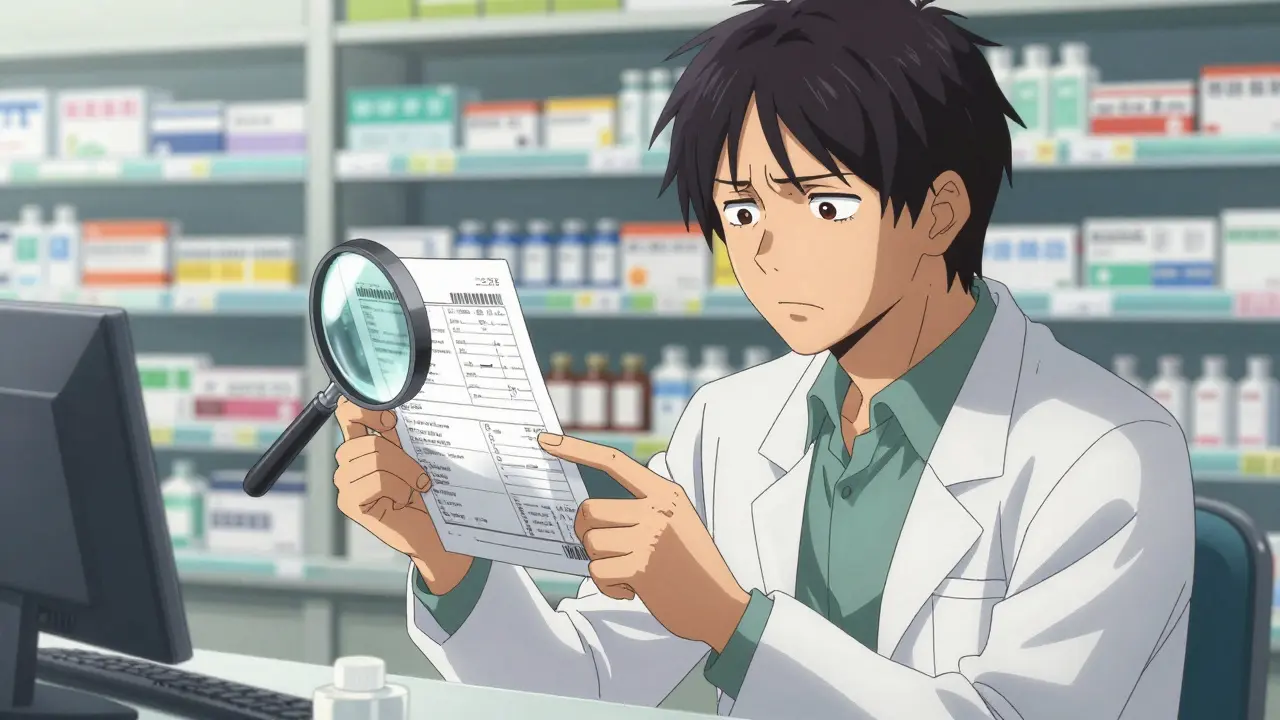
Every year, over 4.9 billion prescriptions are filled in the U.S. That’s nearly 15 million prescriptions a day. And yet, 1.3 million medication errors still happen annually-many because someone didn’t understand what was on their prescription label. You picked up your medicine, signed the receipt, and walked out. But did you really check what you were given?
What’s on your prescription label, really?
Your prescription label isn’t just a sticker. It’s a legal document. By law, it must include nine key pieces of information: your full name, the prescriber’s name, the drug’s brand and generic name, strength, dosage form (like tablet or liquid), quantity, directions for use, number of refills, and the pharmacy’s contact info. That’s the bare minimum. Many labels also include expiration dates, storage instructions, and warnings.But here’s the problem: labels vary wildly between pharmacies. One might use big bold text. Another hides critical info in tiny font on the back. A 2021 study found only 42% of U.S. patients correctly understood their labels. In Germany, where labels are standardized, that number jumped to 63%. You shouldn’t have to be a detective just to take your medicine safely.
Ask these 7 questions before you leave the pharmacy
1. Is this the right medicine for me? Look at the name. Is it spelled right? Does it match what your doctor told you? Sometimes, pharmacies mix up similar-sounding drugs-like hydroxyzine (for anxiety) and hydrocodone (an opioid). One letter changes everything. Ask: “Is this the same drug my doctor prescribed?” If it’s a new medication, ask: “What’s this supposed to treat?” 2. What’s the correct dose and schedule? Directions like “take one by mouth daily” sound simple. But what does “daily” mean? Morning? Night? With food? Some pills must be taken on an empty stomach. Others can’t be taken with dairy. Ask: “Should I take this at the same time every day?” and “What happens if I miss a dose?” 3. Is this the right strength? A 10 mg tablet is not the same as a 20 mg tablet. If your old prescription was 5 mg and now it’s 10 mg, that’s a big jump. Ask: “Why is this dose different from what I took before?” Never assume the strength is the same just because the pill looks similar. 4. How should I store this? Most meds go in a cabinet. But 15% need refrigeration. If your insulin, certain antibiotics, or eye drops aren’t kept cold, they can lose effectiveness. One patient in a 2023 Consumer Reports survey kept their blood pressure med at room temperature for two weeks-because the storage note was printed in 6-point font on the back. Ask: “Does this need to be refrigerated? Can I leave it in my car?” 5. What are the side effects I should watch for? The label might list 15 side effects. You don’t need to memorize them all. Ask: “What are the top 2 or 3 things I should call you about right away?” For example: If you’re on an opioid, you need to know if trouble breathing, extreme drowsiness, or confusion means you need emergency help. For blood thinners, unusual bruising or bleeding matters. 6. Can I take this with my other meds or food? Mixing drugs can be dangerous. Grapefruit juice can wreck the effect of some statins. Calcium supplements can block antibiotics like ciprofloxacin. Even over-the-counter painkillers like ibuprofen can interfere with blood pressure meds. Ask: “What should I avoid eating, drinking, or taking while on this?” Don’t assume your pharmacist knows every pill you’re on-bring a list. 7. How many refills are left, and when do I need to reorder? Some prescriptions run out faster than you think. Others require prior authorization from your insurance. If you’re out of refills and your insurance won’t cover it, you might not be able to get more until your doctor renews it. Ask: “Do I need a new prescription after this bottle? Can you help me check if my insurance will cover the next refill?”
Special cases: High-risk meds need extra checks
The FDA requires special Medication Guides for 107 high-risk drugs. These include opioids, blood thinners, diabetes meds, antidepressants, and isotretinoin (for acne). These guides are separate papers you should get with your prescription. Don’t skip reading them. They explain serious risks like suicidal thoughts, liver damage, or birth defects.If you’re on one of these, ask: “Do I have the Medication Guide for this?” and “What’s the biggest danger I need to know?” For example, estrogen products can increase stroke risk. Opioids can cause fatal breathing problems if mixed with alcohol or sleep aids. These aren’t hypotheticals-they’re real, documented dangers.
What if the label is hard to read?
You’re not alone. Over 7.6 million Americans over 45 have vision problems. 80 million adults struggle with health literacy. Pharmacies are required by law to help. Ask for:- Large-print labels-92% of U.S. pharmacies offer them at no extra cost.
- Verbal confirmation-Ask the pharmacist to read the label out loud with you. Then, repeat the instructions back to them. This simple step cuts errors by up to 58%.
- Translation services-If you’re not fluent in English, you have a legal right to an interpreter. The Affordable Care Act requires it for pharmacies that take federal funds.
Some pharmacies now offer QR codes that link to video instructions. Scan it with your phone and watch someone demonstrate how to take the pill, when to take it, and what to avoid. In 2022, pharmacies using QR codes saw a 31% drop in medication errors. Ask: “Do you have a video or app to explain this?”

Why this matters more than you think
A 2023 study by the American Association of Colleges of Pharmacy found that patients who asked questions about their labels reduced adverse drug events by 47%. That’s nearly half the number of hospital visits, ER trips, and dangerous reactions caused by simple misunderstandings.Think about it: You wouldn’t drive a car without checking the fuel gauge or brake lights. Your body is your most important machine. Your prescription label is your manual. If you don’t understand it, you’re flying blind.
Independent pharmacies score higher in patient satisfaction than big chains. Why? They spend more time explaining. At Kroger, one patient avoided taking an antibiotic with dairy after the pharmacist walked them through the label. At CVS and Walgreens, complaints about small print and confusing wording are common. You deserve better.
What’s changing-and what you should know
The FDA is pushing for change. By 2026, all high-risk prescriptions must have scannable QR codes linking to up-to-date safety info. New labeling systems are being tested that adapt text size and language based on your health literacy level. Some pharmacies are even using augmented reality-point your phone at the bottle and see dosage instructions floating above it.But you don’t have to wait for tech to fix this. The tools are already here: large print, interpreters, verbal checks, QR codes. You just have to ask.
Next time you pick up a prescription, don’t just grab it. Pause. Look. Ask. It takes two minutes. But it could save your life.
What should I do if I find a mistake on my prescription label?
Stop. Don’t take the medicine. Call the pharmacy immediately. Show them the label and your doctor’s original prescription if you have it. Pharmacies are required to correct errors at no cost. If they refuse or delay, ask to speak to the pharmacist-in-charge. You can also report the error to the FDA’s MedWatch program online or by phone. Never ignore a mismatched name, wrong dose, or confusing instructions.
Can I get my prescription label in a different language?
Yes. Under the Affordable Care Act, pharmacies that accept federal funding (including Medicare and Medicaid) must provide translation services at no cost. You can ask for a printed label in Spanish, Mandarin, Vietnamese, or over 350 other languages spoken in U.S. homes. Many pharmacies also offer phone interpreters. Don’t assume the pharmacist speaks your language-ask directly: “Can I get this label in [language]?”
Why does my label say something different than my doctor told me?
Doctors sometimes write prescriptions with shorthand, and pharmacists translate them into standard labeling. But if the directions, dose, or drug name don’t match what your doctor said, it’s not a translation error-it’s a mistake. For example, if your doctor said “take one tablet twice a day” but the label says “three times,” call the pharmacy and ask them to verify with your doctor’s office. Always double-check. It’s your safety.
What if I can’t read the label at all?
You have rights. Ask for a large-print version, a verbal explanation, or a digital version via email or text. Many pharmacies now offer QR codes that link to audio instructions. You can also ask a family member or friend to help you read it-but never rely on someone else’s memory. Always confirm the details with the pharmacist yourself. The FDA’s Medication Check-Up program offers free label reviews at over 8,400 pharmacies nationwide.
How do I know if my medicine has expired?
Look for the expiration date printed on the label or bottle. It’s usually listed as MM/YYYY. If the date has passed, don’t take it-even if it looks fine. Some meds, like insulin or liquid antibiotics, lose potency quickly after expiration. Others, like aspirin, can become less effective or even harmful. When in doubt, return it to the pharmacy. They’ll dispose of it safely and give you a new one if needed.
Can I get a copy of my prescription label for my records?
Yes. You’re entitled to a copy of your prescription label and Medication Guide. Ask the pharmacist for a printed copy or an emailed PDF. Keep it with your other medical records. This helps you track changes over time, especially if you see multiple doctors or switch pharmacies. Some apps like MyTherapy or Medisafe let you scan and store your labels digitally-just make sure the info matches what’s on the physical label.
What should I do if I accidentally take the wrong dose?
Don’t panic, but act fast. Call your pharmacist or doctor right away. If you took too much of a high-risk drug like an opioid, blood thinner, or heart medication, call 911 or go to the ER. Keep the bottle with you so medical staff can see exactly what you took. Even if you feel fine, some reactions happen hours later. Always report the mistake-even if you think it’s minor. It helps prevent future errors.
Author

Kevin Kennett
January 29, 2026 AT 03:01Bro, I once took a pill that looked like my old one but was double the dose. Didn't check the label. Ended up in the ER with my heart racing like a jackhammer. Pharmacies treat you like a vending machine. You got to ask. Always. No shame. Your life isn't a guess game.
Jess Bevis
January 30, 2026 AT 06:52Ask. Always ask. Simple.
Howard Esakov
January 31, 2026 AT 17:14Wow. A whole article about… reading labels? 😍 I mean, really? We’re at the point where adults need a fucking pamphlet to understand ‘take one pill daily’? I guess that’s what happens when you let the masses operate complex biological machinery. 🤦♂️
Kathy Scaman
February 1, 2026 AT 21:49I love how my local pharmacy just hands me the bottle like it’s a bag of chips. But last time I asked the pharmacist to read it out loud? She paused, looked at me like I’d asked for a unicorn, then did it. Turns out I’d been taking my blood pressure med at night instead of morning. Whoops. 🙃
Rhiannon Bosse
February 3, 2026 AT 15:01Okay but have you noticed how ALL the big chain pharmacies have the same tiny font on the back? Coincidence? Or is Big Pharma secretly funding the font design? 😏 I swear, the FDA knows this is a weaponized design flaw. They’re letting people die so insurance companies save a dime on refill calls. I’ve got receipts. I’ve got screenshots. I’ve got the name of the guy who designed the 6-point font. And he’s got a beach house in Belize.
Brittany Fiddes
February 5, 2026 AT 07:15Oh please. In the UK, we don’t need to beg for basic clarity. Our labels are clean, standardized, and written by actual professionals - not some overworked pharmacy tech who’s on their 14th shift this week. America’s healthcare system is a circus. You’re lucky if you even get a label that’s in English. 🇬🇧✨
Amber Daugs
February 6, 2026 AT 06:02People are so lazy these days. If you can’t read a label, maybe you shouldn’t be taking medicine at all. I mean, really. Do you also need someone to tell you how to tie your shoes? This isn’t rocket science - it’s basic responsibility. If you’re too clueless to ask, don’t blame the pharmacist when you overdose. 🙄
Ambrose Curtis
February 7, 2026 AT 20:33lol i used to think i was fine until i took my antbiotic with milk and my stomach went full warzone. turned out the label had a tiny note on the back about ‘avoid dairy’ - in 5pt font. i asked my pharmacist next time and she gave me a printout in bold and even drew a little 🚫🥛. now i always ask. no shame. if you’re not asking, you’re just rolling the dice. also, qr codes are fire. scan it, watch the video, boom - you’re smarter than 80% of people in the waiting room.