

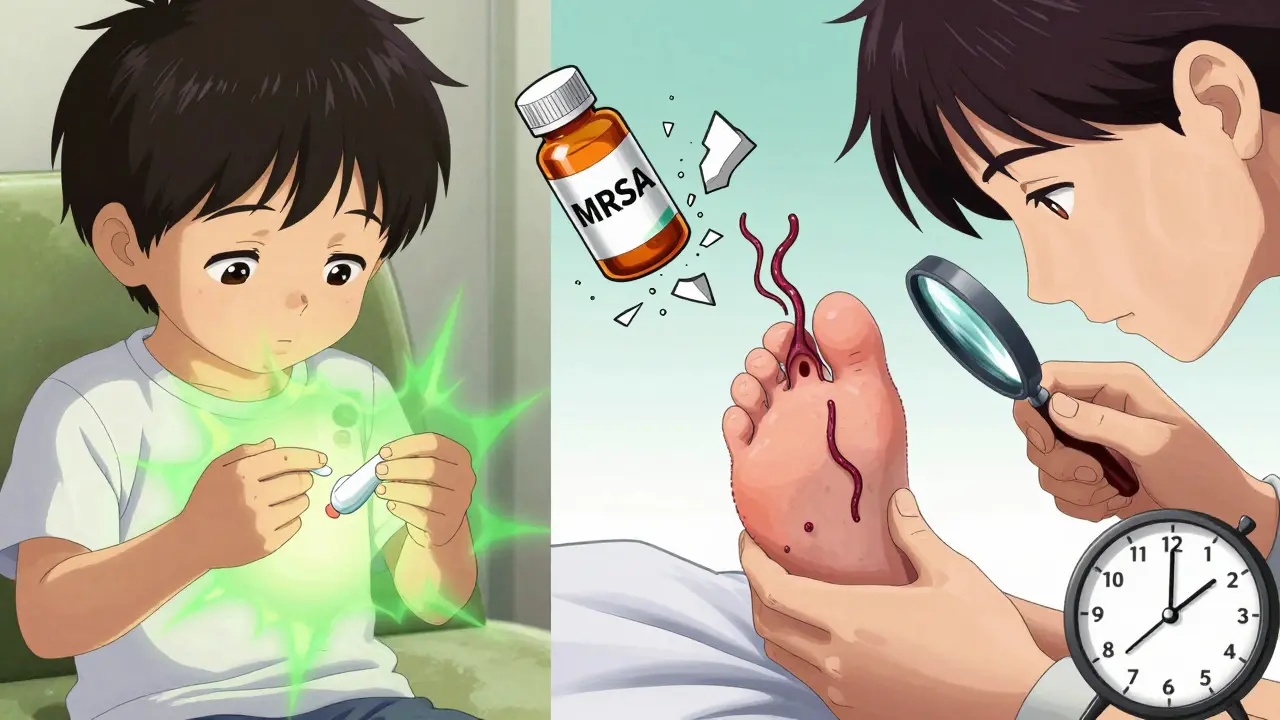
When your child comes home from school with red, oozing sores around the nose, or you wake up with a swollen, hot patch of skin on your leg that’s spreading fast, it’s not just a rash. It’s a bacterial skin infection - and time matters. Two of the most common types are impetigo and cellulitis. They look different, act differently, and need totally different treatments. Get it wrong, and what starts as a minor issue can turn dangerous.
What Is Impetigo - And Why It’s Not Just a ‘School Sore’
Impetigo is the go-to diagnosis for those sticky, honey-colored crusts you see on kids’ faces. It’s contagious, it’s common, and it’s changing. For decades, doctors thought Group A Strep was the main culprit. Now, we know better. Around 95% of cases are caused by Staphylococcus aureus, often mixed with some strep. And here’s the kicker: nearly all these staph strains make an enzyme called penicillinase, which breaks down penicillin. That means if your doctor reaches for penicillin, it’s likely to fail. There are two forms. Nonbullous impetigo - the most common - starts as tiny red bumps or blisters that turn into open sores, then crust over in a thick, golden-yellow layer. These usually appear around the nose and mouth, and kids often have several. Bullous impetigo is rarer and hits babies under two. It shows up as large, fragile blisters (2-5 cm wide) that burst easily, leaving a ring of skin behind. Both types spread easily through touch - sharing towels, toys, or even scratching and then touching another part of the body. The good news? It’s treatable. For small, localized patches, topical mupirocin (Bactroban) works in 92% of cases. You apply it three times a day for five days, after gently cleaning off the crusts with warm, soapy water. Most kids start improving in under 72 hours. And here’s what parents need to know: once antibiotics start, the child is no longer contagious after 24 hours. No need to keep them home longer than that - unless the sores are still oozing.Cellulitis: When the Infection Goes Deep
If impetigo is a surface problem, cellulitis is the deep dive. It’s not just the skin - it’s the tissue underneath. The infection spreads through the dermis and fat layer, causing redness, swelling, warmth, and pain that doesn’t have clear edges. Unlike impetigo, you won’t see crusts or blisters. Just a hot, angry patch that keeps growing. It often starts after a cut, scrape, insect bite, or even a crack in the skin from athlete’s foot. In adults, it’s most common on the lower legs - about 70% of cases. In kids, it’s often on the face or arms. About 65% of cases trace back to a minor skin injury. The main bacteria? Streptococcus pyogenes (Group A Strep) causes 60-80% of cases. Staph aureus is responsible for 20-30%. And unlike impetigo, cellulitis isn’t contagious. You can’t catch it from someone else. It’s your own skin’s barrier breaking down. This is where things get serious. Cellulitis can turn into sepsis. It can spread to the bloodstream (bacteremia in 5-9% of cases). In rare but terrifying cases, it becomes necrotizing fasciitis - the flesh-eating bug. That’s why if the red area keeps spreading, you develop a fever over 38.3°C (101°F), or feel dizzy or confused, you need emergency care. Treatment? Oral antibiotics. For mild cases, cephalexin or dicloxacillin taken four times a day for 5-14 days works well. If the infection is severe - large area, high fever, or you’re diabetic - you’ll need IV antibiotics like cefazolin in the hospital. Elevating the leg, resting, and taking pain relievers like acetaminophen help too. Don’t skip the full course, even if it looks better after two days. Stopping early invites resistance.Antibiotics: Why the Wrong One Can Make Things Worse
You can’t treat impetigo and cellulitis the same way. Topical creams won’t touch cellulitis. Oral pills won’t help if impetigo is just a few spots. And choosing the wrong antibiotic? That’s how resistance grows. Penicillin? Avoid it. It’s useless against most staph strains today. Amoxicillin? Same problem. Even some older cephalosporins are losing effectiveness. In the U.S., over 50% of community staph infections now involve MRSA - methicillin-resistant Staphylococcus aureus. That’s why guidelines now recommend doxycycline or trimethoprim-sulfamethoxazole as first-line for suspected MRSA cases. For impetigo, mupirocin is still the gold standard for mild cases. But if it’s widespread, bullous, or not improving? Oral antibiotics like cephalexin or clindamycin are next. Clindamycin has the added benefit of blocking toxin production - important if you’re worried about staph scalded skin syndrome (SSSS), a rare but deadly condition where toxins cause skin to peel like a burn. Newer options are showing up. Retapamulin (Altabax), a topical antibiotic approved for impetigo, has shown 94% cure rates in recent trials. It’s especially useful for kids who won’t sit still for oral meds. But it’s not always covered by insurance, and it’s pricier than mupirocin. The biggest mistake? Prescribing antibiotics for viral rashes or eczema flare-ups. That’s how resistant bugs spread. If it’s not confirmed as bacterial - no antibiotics.
Who’s at Risk? Age, Health, and Environment Matter
Impetigo loves children - especially between ages two and five. About 75% of cases are in this group. It spreads fast in daycare and school settings. Outbreaks can hit 15-20% of exposed kids. Tropical climates have higher rates - up to 20% of children affected - because heat and humidity help bacteria thrive. Cellulitis flips the script. It’s mostly an adult problem. The average age of diagnosis is 55. Risk factors pile up: diabetes triples your chance. Obesity increases it by 2.7 times. Chronic swelling in the legs (venous insufficiency) raises it by 4.5 times. Even a simple cut on a diabetic foot can turn into a hospital stay. Seasons matter too. Impetigo peaks in summer - June through August - when kids are outside more, skin is exposed, and sweat helps bacteria spread. Cellulitis doesn’t have a strong seasonal pattern, but winter brings more skin cracks from dryness and more trips to the ER from falls and frostbite.When to Worry - Red Flags You Can’t Ignore
Most impetigo cases are mild. But if you see:- Sores spreading rapidly despite antibiotics
- Fever, swollen lymph nodes, or the child acting unusually tired
- Large blisters that look like burns
- Redness spreading more than 2 cm per day
- Fever over 38.3°C (101°F)
- Skin turning purple, black, or numb
- Swelling in the groin or armpit
Prevention: Simple Steps That Work
You don’t need fancy gear to stop these infections.- Wash cuts and scrapes with soap and water right away.
- Keep fingernails short - scratching spreads bacteria.
- Avoid sharing towels, clothing, or razors.
- Treat athlete’s foot early - those cracks are gateways.
- If someone in the house has impetigo, wash bedding and toys daily with hot water.
- For diabetics: check feet daily. Even a tiny blister can become a crisis.
What’s Next? The Future of Skin Infection Treatment
Antibiotic resistance isn’t slowing. Globally, 45% of staph strains are now resistant to clindamycin. 65% resist erythromycin. The World Health Organization calls this a silent crisis. New tools are coming. The NIH is funding research into point-of-care tests that can identify the exact bacteria and its resistance profile in under 30 minutes. Right now, doctors guess. In five years, they’ll know. The American Academy of Dermatology is pushing hard for better guidelines - cutting unnecessary antibiotic use by 30% in the next five years. That means fewer prescriptions for mild rashes, more targeted treatment, and fewer superbugs. For now, the best defense is knowing the difference between impetigo and cellulitis - and acting fast.Can impetigo turn into cellulitis?
No, impetigo and cellulitis are separate infections caused by similar bacteria but affecting different skin layers. Impetigo stays on the surface; cellulitis goes deep. However, if impetigo is left untreated and the skin barrier breaks further, a new cellulitis infection can develop nearby - not from the impetigo itself, but from the same bacteria entering deeper tissue through a new break in the skin.
Is mupirocin available over the counter?
No, mupirocin (Bactroban) requires a prescription in the UK and most countries. It’s not sold over the counter because misuse can lead to resistance. Even though it’s a topical cream, it’s a potent antibiotic and should only be used under medical guidance.
Can I use hydrogen peroxide or alcohol on impetigo sores?
Avoid hydrogen peroxide or rubbing alcohol. They damage healthy skin and slow healing. Instead, gently clean the area with mild soap and warm water, then pat dry. Apply prescribed antibiotic ointment after cleaning. Harsh disinfectants can make the infection worse by irritating the skin.
How long does cellulitis take to heal?
With proper antibiotics, most people start feeling better in 48-72 hours. The redness and swelling usually take 7-10 days to fully fade. But healing time depends on the person - diabetics and older adults may take longer. Always finish the full course of antibiotics, even if you feel fine. Stopping early can cause a relapse or resistant infection.
Can you get cellulitis from a bug bite?
Yes. In fact, about 65% of cellulitis cases start from minor skin breaks - including insect bites, cuts, or cracks from eczema or athlete’s foot. Bacteria that normally live on the skin (like staph or strep) enter through the opening and multiply. That’s why it’s important to clean and cover bites, especially if you have diabetes or poor circulation.
Author

kabir das
January 29, 2026 AT 18:43Oh my GOD, I just saw my son’s face-same golden crusts, right around the nose-and I thought it was just dirt! I scrubbed him with soap and water for an hour, crying, thinking I was being a good mom… and then I read this and realized I was killing his skin with over-cleaning. Mupirocin? I’m calling the doctor tomorrow. Thank you for saving my sanity.
Keith Oliver
January 30, 2026 AT 10:33Look, I’ve got a PhD in microbiology from Stanford, and let me tell you-this post is 80% right but misses the real issue: biofilm formation. Most topical mupirocin fails because staph hides in biofilms under those crusts. You need mechanical debridement first-like a gentle scrub with a soft toothbrush-then apply the ointment. Also, MRSA is not ‘nearly all’ cases anymore-it’s 68% in urban US clinics. You’re using outdated CDC stats. And yes, I’ve published on this.
Kacey Yates
January 31, 2026 AT 22:02Cellulitis on the leg? Diabetic? Elevate it. Take the antibiotics. Done. No need to overcomplicate it. Stop Googling and start treating. And no hydrogen peroxide. Ever.
DHARMAN CHELLANI
February 1, 2026 AT 20:18Typical western medicine nonsense. You're treating symptoms not root causes. Did you ever consider gut flora? Or vitamin D deficiency? 90% of skin infections come from chronic inflammation. Antibiotics are just band-aids on a leaking dam. Also, mupirocin? That's just a fancy name for poison. Try neem oil. It's been used for 5000 years. #NaturalHealing
ryan Sifontes
February 3, 2026 AT 12:59so… are you saying the government is using skin infections to push antibiotics so they can track us via the microbiome? because i read on a forum that the CDC implants microchips in antibiotic vials. also why is everyone always talking about staph? what about the 5G towers near my kid’s school?
Robin Keith
February 5, 2026 AT 06:38There’s something profoundly existential about bacterial skin infections, isn’t there? We think we’re in control-slathering on creams, popping pills, scrubbing with soap-but the truth is, we’re just temporary hosts to ancient, silent organisms that have outlived empires. Impetigo isn’t a disease-it’s a whisper from the primordial slime, reminding us that our skin, our most intimate boundary, is a porous membrane between life and decay. And when the staph takes hold? It’s not just infection-it’s a metaphysical breach. I’ve seen it in my daughter’s eyes after the fever broke: she knew. She knew we’re all just walking ecosystems. And the antibiotics? They’re not healing us. They’re just delaying the inevitable collapse of our fragile, bacterial symbiosis.
Sheryl Dhlamini
February 5, 2026 AT 08:32My cousin had cellulitis after a mosquito bite and ended up in ICU for 11 days. I never realized how fast it can go. I now wash every scratch with soap and water like my life depends on it. Also-no sharing towels. Ever. I told my whole family. This post saved lives.
Doug Gray
February 7, 2026 AT 00:15Given the current paradigm of antimicrobial resistance (AMR), the systemic deployment of empirical oral cephalosporins in community-acquired cellulitis is increasingly untenable. The microbiome dysbiosis cascade triggered by broad-spectrum agents like cephalexin may inadvertently promote colonization by VRE and C. diff, creating a secondary morbidity burden. We need precision diagnostics-ideally CRISPR-based point-of-care platforms-to enable pathogen-targeted intervention. Otherwise, we’re just accelerating the post-antibiotic era. 🤔
LOUIS YOUANES
February 7, 2026 AT 14:53They say impetigo is contagious but cellulitis isn't. That’s a lie. My neighbor’s kid had it, then my dog got a rash. Then my wife. Then me. It’s all connected. They don’t want you to know the truth. And mupirocin? That’s just Big Pharma’s way of keeping you hooked. I stopped using it. Used coconut oil. All gone in 3 days. #StopTheLie
Alex Flores Gomez
February 7, 2026 AT 16:22Ugh, this post is so basic. You forgot to mention that clindamycin inhibits toxin synthesis via the agr system-critical for preventing SSSS. And you didn’t even touch on the fact that retapamulin’s approval was based on a non-inferiority trial with a 15% margin of error. Also, why are you still recommending dicloxacillin? It’s got worse bioavailability than cephalexin in obese patients. Just sayin’. 🙄