

Asthma Inhaler Decision Calculator
This calculator helps you select the most appropriate asthma inhaler based on your personal needs and preferences. Use the inputs below to determine which inhaler may work best for you, then consult your healthcare provider for personalized medical advice.
Your Preferences
How It Works
Best for patients with limited inspiratory flow or coordination issues
Requires stronger inhalation; better for patients with good respiratory function
Simpler dosing for better adherence
More frequent monitoring for better symptom control
Your Recommended Inhaler
Select your preferences and click 'Calculate My Recommendation' to see your result
Trying to choose the right inhaler can feel like a maze of brand names, dosages, and device types. You might have heard about Symbicort alternatives and wonder whether they really offer something better for your asthma or COPD. This guide cuts through the jargon, compares the most common options, and helps you decide which inhaler fits your daily routine.
Key Takeaways
- Symbicort combines a steroid (budesonide) with a long‑acting bronchodilator (formoterol) in a metered‑dose inhaler.
- Alternatives like Advair Diskus, Breo Ellipta, and Dulera use different steroid/bronchodilator pairings and delivery devices.
- Price, dosing frequency, and inhaler technique are the three biggest factors that swing the decision.
- If you need once‑daily dosing, Breo Ellipta and Arnuity Ellipta are strong candidates.
- Always check with your prescriber before switching - small differences can affect control and side‑effects.
What Is Symbicort?
Symbicort is a combination inhaler that contains the inhaled corticosteroid budesonide and the long‑acting beta‑agonist (LABA) formoterol. It is delivered via a metered‑dose inhaler (MDI) and is approved for asthma and chronic obstructive pulmonary disease (COPD) maintenance therapy.
How Budesonide and Formoterol Work Together
Budesonide reduces airway inflammation, cutting down swelling and mucus production. Formoterol relaxes smooth muscle in the airways, keeping them open for up to 12 hours. The fast onset of formoterol also lets patients use the same inhaler as a rescue option in emergencies, although guidelines advise a separate short‑acting bronchodilator for acute symptoms.
When Doctors Prescribe Symbicort
Typical candidates include adults with moderate‑to‑severe asthma who need both anti‑inflammatory control and bronchodilation, and some COPD patients who experience frequent exacerbations. The usual dose is two inhalations twice a day, but doctors may adjust based on symptom control and side‑effects.

Common Alternatives to Symbicort
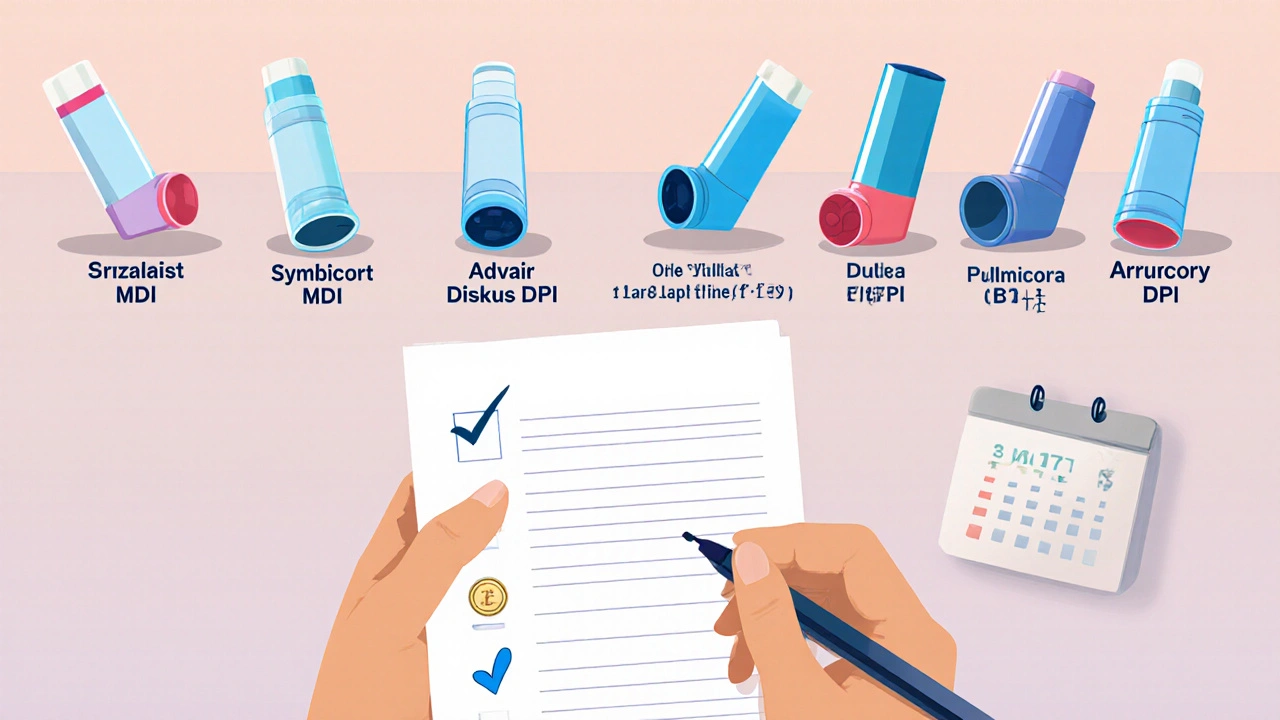
Below are the most frequently mentioned alternatives, each with its own steroid‑LABA pairing and delivery device.
Advair Diskus (fluticasone propionate / salmeterol) is delivered as a dry‑powder inhaler (DPI) and is approved for asthma and COPD. It requires a deep, fast inhalation to disperse the powder.
Breo Ellipta (fluticasone furoate / vilanterol) comes in a once‑daily DPI. Its ultra‑low‑dose steroid is designed for patients who prefer a single daily inhalation.
Dulera (mometasone furoate / formoterol) uses an MDI similar to Symbicort but with a different steroid. It is positioned for adolescents and adults with moderate asthma.
Pulmicort (budesonide) is a steroid‑only inhaler, available as a DPI or nebulizer solution. It’s often added to a LABA inhaler when a separate steroid is preferred.
Arnuity Ellipta (fluticasone furoate) is a steroid‑only once‑daily DPI, useful for patients who already use a separate LABA inhaler.
Side‑Effect Profile Comparison
All inhaled steroids can cause oral thrush, hoarseness, and, in rare cases, systemic effects like lowered bone density. LABAs may lead to tremor, palpitations, or headache. The main differentiators are:
- Device type: MDIs (Symbicort, Dulera) are easier for patients with limited inspiratory flow, while DPIs (Advair Diskus, Breo Ellipta) need a strong inhalation breath.
- Dose frequency: Twice‑daily (Symbicort, Advair) versus once‑daily (Breo, Arnuity).
- Cost: Generic budesonide/formoterol inhalers have become more affordable in the UK, while branded DPIs remain pricier.
Price Snapshot (UK 2025)
| Inhaler | Active Ingredients | Device | Dosing Frequency | Monthly Cost (£) |
|---|---|---|---|---|
| Symbicort | Budesonide 160µg / Formoterol 4.5µg per actuation | MDI | 2× daily | £28‑£34 |
| Advair Diskus | Fluticasone 100µg / Salmeterol 50µg per inhalation | DPI | 2× daily | £32‑£38 |
| Breo Ellipta | Fluticasone furoate 100µg / Vilanterol 25µg per inhalation | DPI | Once daily | £38‑£44 |
| Dulera | Mometasone furoate 100µg / Formoterol 5µg per actuation | MDI | 2× daily | £30‑£36 |
| Pulmicort DPI | Budesonide 200µg per inhalation | DPI | 2× daily | £22‑£28 |
| Arnuity Ellipta | Fluticasone furoate 200µg per inhalation | DPI | Once daily | £35‑£41 |
Choosing the Right Inhaler: Decision Criteria
- Inhalation technique: If you struggle with a deep breath, an MDI (Symbicort, Dulera) is safer.
- Dosing convenience: For a busy lifestyle, once‑daily DPIs (Breo, Arnuity) cut down on forgetting doses.
- Cost sensitivity: Generic budesonide/formoterol options are usually cheaper than branded DPIs.
- Side‑effect tolerance: Some patients report less throat irritation with fluticasone‑based inhalers.
- Specific disease profile: COPD patients who need stronger bronchodilation may benefit from the higher LABA potency in Salmeterol (Advair).
Pros & Cons at a Glance
| Inhaler | Pros | Cons |
|---|---|---|
| Symbicort | Fast‑acting LABA, good for rescue; MDI works with low inspiratory flow. | Twice‑daily dosing, higher price than generic budesonide alone. |
| Advair Diskus | Well‑studied; combines two proven agents. | Requires strong inhalation; twice daily. |
| Breo Ellipta | Once‑daily convenience; very low steroid dose. | More expensive; DPI may be hard for young children. |
| Dulera | Formoterol gives rapid onset; MDI. | Less data than Advair; slightly higher cost. |
| Pulmicort | Steroid‑only, good for step‑down therapy. | No LABA - you’ll need a separate bronchodilator. |
| Arnuity Ellipta | Once‑daily high‑potency steroid. | No LABA component; higher price. |
Tips for Getting the Most Out of Your Inhaler
- Shake MDI inhalers (like Symbicort and Dulera) for at least 5 seconds before each use.
- Exhale fully, then inhale slowly and deeply for DPIs (Advair, Breo, Arnuity).
- Hold your breath for about 10 seconds after inhalation to let the medication settle.
- Rinse your mouth with water and spit after each steroid dose to prevent thrush.
- Keep the inhaler dry and store it at room temperature; avoid extreme heat.
When to Talk to Your Healthcare Provider
If you notice worsening symptoms despite regular use, experience frequent oral thrush, or have difficulty mastering the inhaler technique, schedule a review. A small adjustment-switching from a twice‑daily MDI to a once‑daily DPI-can dramatically improve adherence and control.
Frequently Asked Questions
Can I use Symbicort as a rescue inhaler?
Formoterol in Symbicort works faster than many LABAs, so many clinicians allow a single actuation for sudden breathlessness. However, a short‑acting bronchodilator like salbutamol is still the preferred rescue medication for most patients.
Is a DPI better than an MDI for severe asthma?
DPIs need a strong inhalation flow, which can be difficult during an asthma attack. MDIs deliver medication regardless of flow, making them safer for severe or uncontrolled asthma.
How does the cost of Symbicort compare to generic alternatives?
In the UK, a generic budesonide/formoterol inhaler costs around £22‑£28 per month, while the branded Symbicort sits at £28‑£34. The price gap narrows when the NHS provides the prescription pre‑payment certificate.
Do I need a spacer with Symbicort?
A spacer can help if you have coordination issues, but it isn’t required for most adults. Using a spacer may reduce oropharyngeal deposition and lower the risk of thrush.
Can I switch from Advair Diskus to Symbicort without a doctor’s approval?
No. Both drugs contain different steroids and LABAs, and the dosing schedule changes. Switching without medical guidance can lead to loss of control or increased side‑effects.
Author

kevin tarp
October 12, 2025 AT 00:58Symbicort is a combination inhaler that delivers both a corticosteroid and a long‑acting beta‑agonist, which can simplify a patient’s regimen. The device uses a metered‑dose inhaler (MDI) format, making it suitable for individuals who have limited inspiratory flow. Because it’s dosed twice daily, adherence can be a challenge for some, but the consistent dosing helps maintain steady lung function. Cost‑effectiveness varies by insurance coverage, so checking formularies is advisable.
ravi kumar
October 12, 2025 AT 12:05From an Indian perspective the market offers a plethora of DPIs that are cheaper than brand‑name MDIs, yet the inhalation technique matters a lot. If you can generate a strong inhalation, a DPI might save you rupees while delivering comparable control. However, budget constraints often push patients toward generic MDI options, even if the technique is sub‑optimal.
SandraAnn Clark
October 12, 2025 AT 23:11Just another calculator, nothing new.
Rex Wang
October 13, 2025 AT 10:18Interesting tool!; I like the clear breakdown of technique versus dosing; the budget slider is handy, too. It’s good to see both MDI and DPI options laid out side‑by‑side. Helps patients think through what actually fits their daily routine.
mark Lapardin
October 13, 2025 AT 21:25The calculator does a solid job of mapping patient preferences to pharmacologic classes, especially by highlighting the LABA/ICS synergy in Symbicort. From a formulation standpoint, the propellant‑free DPI alternatives reduce coordination demands, which can be a boon for elderly users. Yet, insurers often favor the MDI due to established rebate contracts, so cost‑benefit analyses should include formulary tier considerations. Overall, it’s a pragmatic step toward personalized inhaler selection.
Barry Singleton
October 14, 2025 AT 08:31While the presented decision matrix appears user‑friendly, several critical nuances deserve attention. First, the pharmacokinetic profile of budesonide versus fluticasone can influence systemic exposure, especially in high‑dose regimes, yet the tool lumps all corticosteroids together. Second, the algorithm assumes a binary technique choice, ignoring hybrid devices like the Respimat, which may be optimal for patients with intermediate inspiratory flow. Third, medication adherence is not solely a function of dosing frequency; psychosocial factors such as health literacy and caregiver support play pivotal roles, and these are absent from the model. Fourth, budgetary inputs are expressed in British pounds, which could mislead users outside the UK, particularly regarding insurance co‑pay structures. Fifth, the safety profile of LABA monotherapy is glossed over; the tool should flag the need for concurrent inhaled steroids to mitigate asthma‑related mortality. Sixth, there is no consideration for comorbid conditions like COPD, where a long‑acting muscarinic antagonist might be indicated. Seventh, the calculator does not adjust for age‑related changes in inhalation technique – pediatric and geriatric populations often require spacer devices or breath‑actuated inhalers. Eighth, the data sources powering the recommendation are not cited, raising concerns about evidence provenance. Ninth, environmental impact is omitted; MDIs contribute to greenhouse gas emissions, an increasingly relevant factor for eco‑conscious patients. Tenth, there is no allowance for patient preference regarding device aesthetics or brand loyalty, which can affect long‑term adherence. Eleventh, drug–drug interaction checks are missing, potentially overlooking interactions with CYP3A4 inhibitors that can increase steroid levels. Twelfth, the algorithm appears to default to Symbicort for MDI‑based, twice‑daily regimens, ignoring cost‑effective generic alternatives like budesonide/formoterol combos. Thirteenth, inhaler technique education is implied but not integrated; without proper training, even the best‑matched device fails. Fourteenth, the model does not stratify severity beyond “once” vs. “twice” daily, neglecting step‑wise guideline recommendations. Finally, while the interface seems polished, the underlying logic needs transparency and peer‑review to earn clinical trust.
Javier Garcia
October 14, 2025 AT 19:38The calculator makes the choice process less intimidating. I appreciate the clear split between MDI and DPI options. It’s a useful first step before talking to a pulmonologist.
christian quituisaca
October 15, 2025 AT 06:45Hey everyone! 🌟 It’s awesome to see a tool that actually respects personal preferences – whether you love the click‑click of a DPI or the familiar spray of an MDI. Remember, the best inhaler is the one you’ll actually use every day, so comfort and confidence matter just as much as the drug itself. If you’ve got a favorite brand or a trick that makes your inhalation smoother, share it so we can all learn! Also, keep an eye on insurance formularies – they can turn a perfect match into a pricey surprise.
Donnella Creppel
October 15, 2025 AT 17:51Wow... you really think a calculator can replace a doctor??!!?? I mean, sure, it looks fancy, but c'mon – breath‑inhalers are **serious** stuff!!! If u just push a button and hope for the best, u might end up with a *bleeding* lung... (yeah, that’s a thing, lol). Definitely double‑check with a professional before you trust this thingy.
Jarod Wooden
October 16, 2025 AT 04:58In the grand tapestry of therapeutic decision‑making, reliance on a simplistic algorithm risks reducing patient agency to a binary output. The inherent reductionism strips away the phenomenological lived experience of asthma, substituting nuanced clinical judgment with an oversimplified heuristic. While the interface is aesthetically pleasing, it masks a mechanistic undercurrent that can perpetuate iatrogenic harm if uncritically adopted. Real‑world pharmacodynamics demand contextual appraisal-something a static calculator cannot embody. Thus, clinicians must wield such tools with epistemic humility, integrating them into a broader deliberative framework.
lee charlie
October 16, 2025 AT 16:05Great discussion! It’s clear that tools like this can help start the conversation, but always pair them with a professional’s guidance. Stay safe and keep breathing easy!