
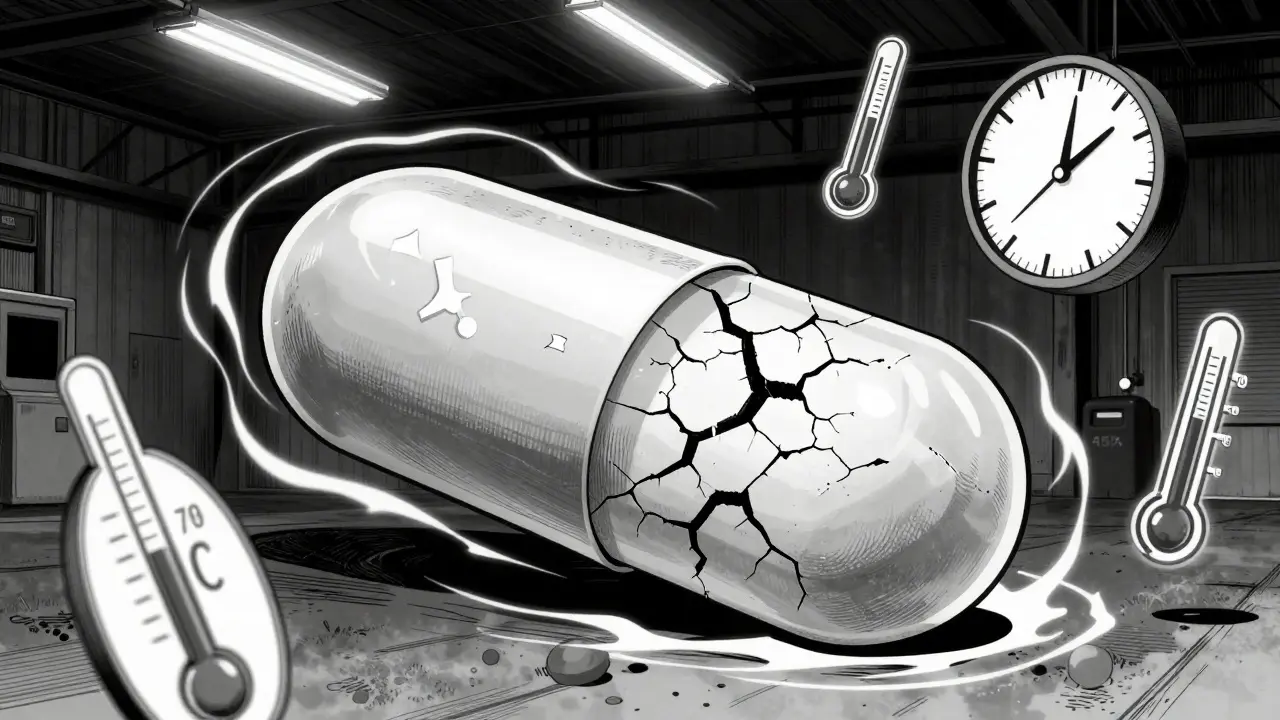
When a drug leaves the lab and enters the market, it has to last. Not just for weeks or months-but for years. Patients expect their pills, injections, or inhalers to work exactly as intended, even after sitting on a shelf in a hot bathroom or a cold garage. That’s where stability testing comes in. It’s not optional. It’s not a suggestion. It’s the backbone of drug safety, and it all hinges on two things: temperature and time.
Why Temperature and Time Matter
Imagine a tablet sitting in a warehouse in Florida during summer. The temperature hits 35°C, humidity climbs to 80%. Now imagine that same tablet in a freezer in Minnesota. Both environments stress the drug differently. One might cause moisture to seep in and break down the active ingredient. The other might make it crystallize or separate. If you don’t test how it behaves under these conditions, you’re gambling with patient health. Stability testing answers one simple question: How does this drug change over time under real-world conditions? The answer determines how long the drug stays safe and effective, what kind of packaging it needs, and how it should be stored. Without this data, regulators won’t approve the product. And if it hits the market without proper testing? Recalls happen. Warning letters fly. Companies lose millions.The Global Standard: ICH Q1A(R2)
There’s one rulebook that nearly every country follows: ICH Q1A(R2). Developed in the 1990s by regulators from the U.S., Europe, and Japan, it’s the closest thing we have to a universal language for drug stability. It doesn’t just say “test it.” It says exactly how to test it. For most solid oral drugs-tablets and capsules-the standard long-term condition is either:- 25°C ± 2°C with 60% RH ± 5% RH, or
- 30°C ± 2°C with 65% RH ± 5% RH
How Long Do You Test?
Time isn’t just a number-it’s a commitment. You can’t rush it. The minimum data you need to submit for approval is 12 months of long-term testing. That means your drug has to sit in a controlled room for a full year, being checked at regular intervals: 0, 3, 6, 9, 12, 18, 24, and 36 months. Why so many time points? Because degradation isn’t always linear. Some drugs stay stable for a year, then suddenly break down in month 14. Others degrade slowly but steadily. Frequent testing catches those surprises. Accelerated testing is the speed round. You push the drug to its limits: 40°C ± 2°C and 75% RH ± 5% RH for six months. If the drug shows significant change here-like a 5% drop in potency or visible clumping-it triggers deeper investigation. This isn’t meant to predict shelf life directly. It’s a stress test. A red flag system.What Counts as “Significant Change”?
This is where things get messy. ICH Q1A(R2) defines “significant change” as:- A 5% change in assay (potency)
- Any degradation product exceeding its qualification threshold
- Failure to meet physical appearance, pH, or dissolution criteria
Refrigerated and Frozen Drugs
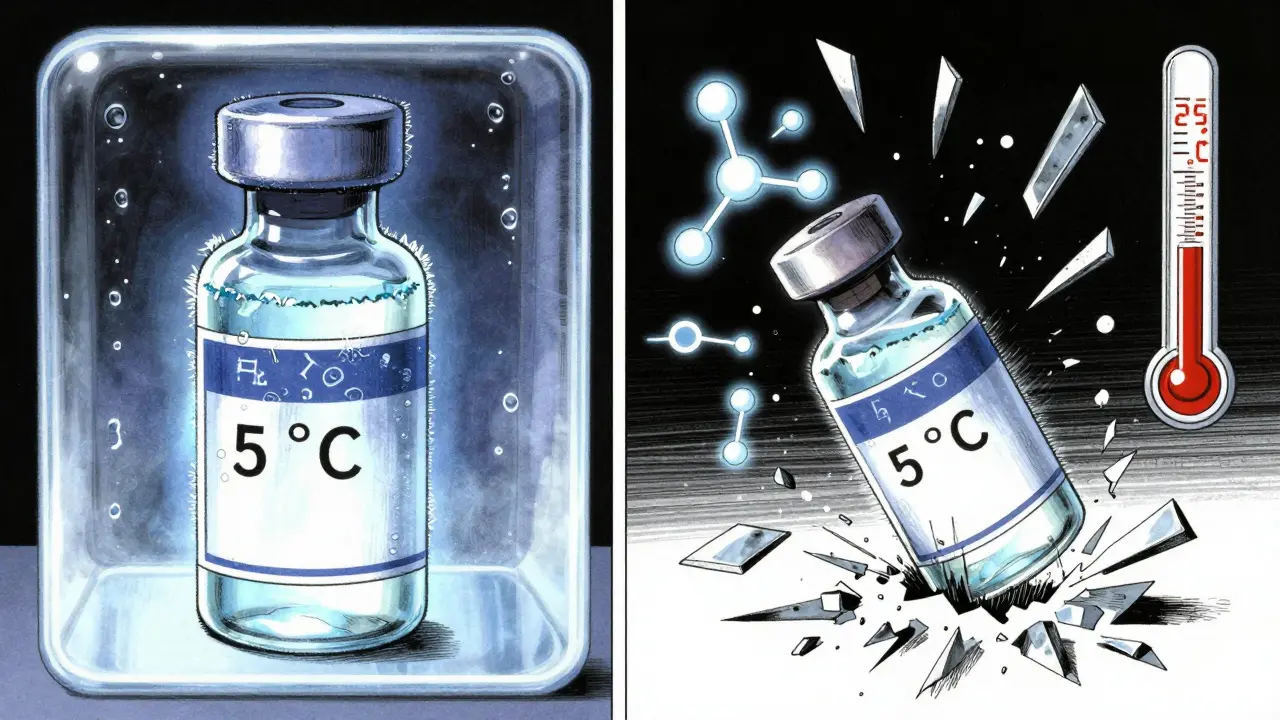
Not all drugs sit at room temperature. Insulin, vaccines, biologics-they need cold. For refrigerated products, long-term testing happens at 5°C ± 3°C for at least 12 months. Accelerated testing? Not at 40°C. That would destroy them. Instead, it’s done at 25°C ± 2°C and 60% RH for six months. Freeze-thaw cycles are another nightmare. mRNA vaccines, for example, can degrade if they’re frozen and thawed even once. Standard stability protocols don’t capture this. That’s why companies now run extra tests-simulating shipping delays, power outages, or storage errors. It’s not in the ICH guidelines, but it’s in the real world.Global Zones and Regional Differences
The world isn’t one climate. ICH recognizes five zones:- Zone I: Temperate (21°C, 45% RH)
- Zone II: Subtropical (25°C, 60% RH)
- Zone III: Hot-Dry (30°C, 35% RH)
- Zone IVa: Hot-Humid (30°C, 65% RH)
- Zone IVb: Hot-Higher Humidity (30°C, 75% RH)
Real-World Failures and Lessons Learned
In 2021, Teva had to recall 150,000 vials of Copaxone because their stability testing didn’t catch aggregation at 40°C. The drug looked fine. But under stress, proteins clumped together-changing how it worked in the body. Merck, on the other hand, used intermediate testing (30°C/65% RH) on Keytruda® and found a polymorphic shift that wasn’t visible at 25°C. They adjusted the formulation before launch. That’s stability testing done right: not just to pass regulators, but to prevent problems before they happen. A 2023 survey found that 78% of labs had at least one temperature excursion during a 12-month study. One degree too high. One day too long. And the whole study? Invalidated. The data? Useless. That’s why chambers are calibrated monthly. Why data loggers are everywhere. Why one failed test can cost months of work.
What’s Changing? The Future of Stability Testing
The ICH Q1A(R2) guidelines haven’t changed since 2003. But the drugs have. We’re not just making aspirin anymore. We’re making antibody-drug conjugates, gene therapies, lipid nanoparticles. These don’t behave like tablets. They’re sensitive to light, vibration, even the air they’re packaged in. The FDA is testing real-time stability using process analytical technology (PAT). Instead of waiting a year, you monitor the drug as it’s made. If the data shows consistent stability, maybe you don’t need 36 months of shelf-life testing. Companies are also using predictive models. Run tests at 50°C, 60°C, even 80°C. Use math to extrapolate what happens at 25°C. Some say this cuts development time by a year. But regulators are skeptical. EMA rejected eight model-based submissions in 2022-2023. The science is promising. The trust isn’t there yet.What You Need to Get Started
If you’re launching a new drug, here’s your checklist:- Choose your target markets and pick the right ICH zone.
- Set up qualified environmental chambers with ±0.5°C and ±2% RH control.
- Run long-term testing for at least 12 months (24-36 months ideal).
- Run accelerated testing at 40°C/75% RH for 6 months.
- For refrigerated products, test at 5°C and 25°C.
- Document everything: protocols, raw data, deviations, reports.
- Plan for at least 18 months of testing before submission.
Final Thought: It’s Not Just Compliance. It’s Trust.
Stability testing isn’t about checking boxes. It’s about making sure a mother in Nairobi can give her child the same medicine as a man in Berlin. It’s about knowing that the drug in your hand today will work just as well next year. That’s the promise of pharmaceutical science. And temperature and time? They’re the only things that can prove it’s real.What are the standard temperature and humidity conditions for long-term stability testing?
The ICH Q1A(R2) guidelines define two standard long-term conditions: 25°C ± 2°C with 60% RH ± 5% RH, or 30°C ± 2°C with 65% RH ± 5% RH. The choice depends on the climatic zone of the target market. For example, tropical regions (Zone IVa) require the 30°C/65% RH condition, while temperate regions (Zone II) often use 25°C/60% RH.
How long must stability testing last before submitting a drug for approval?
A minimum of 12 months of long-term stability data is required for regulatory submission under ICH Q1A(R2). The FDA mandates this 12-month minimum, while the EMA allows either 6 or 12 months depending on the submission option chosen. However, 12 months is the global standard for full approval, and many companies extend testing to 24-36 months to support the full shelf life claim.
What is accelerated stability testing, and why is it done?
Accelerated stability testing subjects the drug to harsher conditions-40°C ± 2°C and 75% RH ± 5% RH-for six months. It’s not meant to predict exact shelf life, but to identify potential degradation pathways quickly. If significant changes occur during accelerated testing, it triggers deeper investigation into long-term stability, packaging, or formulation issues.
Do refrigerated drugs follow the same stability rules?
No. Refrigerated products, such as insulin or biologics, are tested at 5°C ± 3°C for long-term stability. Their accelerated testing is done at 25°C ± 2°C and 60% RH ± 5% RH for six months-not the 40°C/75% RH used for room-temperature drugs. This prevents irreversible damage to heat-sensitive molecules.
What happens if a stability study fails?
A failed stability study can delay regulatory approval, trigger product recalls, or lead to warning letters from agencies like the FDA or EMA. For example, Teva’s 2021 recall of 150,000 vials of Copaxone resulted from undetected aggregation under accelerated conditions. Companies must investigate the root cause, update formulations or packaging, and often restart testing, adding months or even years to the timeline.
Are there new technologies changing stability testing?
Yes. The FDA is piloting real-time stability assessment using process analytical technology (PAT), which monitors drug quality during manufacturing instead of waiting for months of shelf testing. Predictive modeling using high-temperature data (50-80°C) is also gaining traction, potentially cutting development time by 9-12 months. However, regulators remain cautious-EMA rejected eight model-based submissions in 2022-2023, showing that physical testing is still the gold standard.
Author

Ryan Hutchison
January 17, 2026 AT 17:23Melodie Lesesne
January 18, 2026 AT 02:11Corey Sawchuk
January 19, 2026 AT 13:09evelyn wellding
January 20, 2026 AT 15:48Corey Chrisinger
January 21, 2026 AT 01:06Bianca Leonhardt
January 22, 2026 AT 19:06swarnima singh
January 23, 2026 AT 22:13Isabella Reid
January 25, 2026 AT 11:19kanchan tiwari
January 26, 2026 AT 07:06Bobbi-Marie Nova
January 27, 2026 AT 04:08Allen Davidson
January 27, 2026 AT 15:32john Mccoskey
January 29, 2026 AT 00:30