
Beta-Blocker Selector
Select your primary condition and medical history to see which beta-blocker might be most appropriate for you. Always consult with your healthcare provider before making any changes to your medication.
Your Condition
Your Medical History
When your heart races too fast, your blood pressure climbs, or your chest tightens after exertion, beta-blockers are often the go-to solution. But not all beta-blockers are the same. Choosing the right one isn’t just about picking a name off a list-it’s about matching the drug’s unique behavior to your body’s needs. Some lower heart rate without touching your lungs. Others open up your blood vessels. A few even help your heart repair itself over time. If you’ve been prescribed one and wonder why it’s carvedilol and not metoprolol, or why your friend’s propranolol made them tired while yours didn’t, you’re asking the right question.
How Beta-Blockers Work-Simple Version
Your body has a natural stress system. When you’re scared, excited, or exercising, your adrenal glands pump out adrenaline and noradrenaline. These chemicals bind to beta receptors in your heart, making it beat faster and harder. That’s fine when you’re running from a bear. Not so great when you’re sitting at your desk with heart failure or high blood pressure.
Beta-blockers step in like a bouncer at a club. They block those adrenaline molecules from latching onto beta receptors. No signal means no rush. Your heart slows down. It doesn’t squeeze as hard. Blood pressure drops. That’s the basic job. But here’s where things get messy: not all beta receptors are the same. And not all drugs block them the same way.
Three Generations, Three Different Strategies
Beta-blockers come in three generations, each with a different playbook.
First-gen: These are the original blockers-propranolol, atenolol (sometimes grouped here), and sotalol. They don’t care which beta receptor they block. They hit both beta-1 (heart) and beta-2 (lungs, blood vessels, liver). That’s why they can cause breathing trouble in people with asthma. Their effect is broad, blunt, and sometimes harsh.
Second-gen: These are the selective ones. Metoprolol, bisoprolol, and atenolol mostly stick to beta-1 receptors. That means they calm your heart without messing with your lungs as much. This makes them safer for people with mild asthma or COPD-though you still need to be careful. These are the most common today for high blood pressure and after a heart attack.
Third-gen: These are the upgrade. Carvedilol and nebivolol don’t just block beta receptors. They also open blood vessels. Carvedilol blocks alpha-1 receptors too, which relaxes arteries. Nebivolol tells your blood vessels to make more nitric oxide-the same chemical that makes your arteries widen during exercise. This dual action isn’t just a bonus. It’s life-changing for heart failure patients.
Why Carvedilol and Nebivolol Stand Out in Heart Failure
If you’ve been diagnosed with heart failure with reduced ejection fraction (HFrEF), your doctor is likely to pick either carvedilol or nebivolol. Why? Because they don’t just slow your heart-they help it heal.
Studies show carvedilol cuts death risk by 35% compared to placebo. Nebivolol reduces cardiovascular death by 14% in older adults. How? Their vasodilating effects reduce the strain on your heart over time. They also lower oxidative stress in heart tissue by 30-40%, meaning less damage from free radicals. In lab studies, carvedilol even helps prevent heart muscle cells from dying off.
Compare that to older beta-blockers like metoprolol tartrate. Yes, it helps. But it doesn’t do the same repair work. That’s why guidelines from the European Society of Cardiology and the American College of Cardiology now say: if you have HFrEF, start with carvedilol, bisoprolol, metoprolol succinate, or nebivolol. Not just any beta-blocker.
Side Effects Aren’t the Same Across Drugs
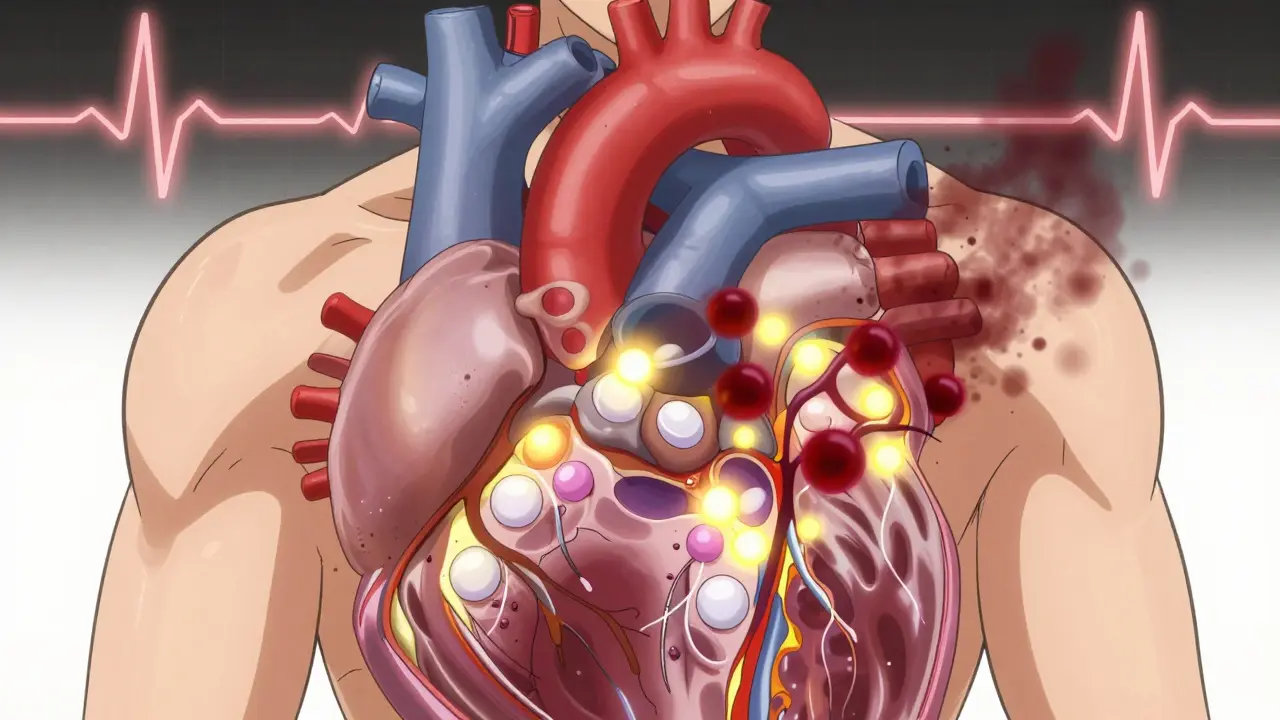
Everyone talks about beta-blockers causing fatigue, cold hands, or low energy. But not everyone gets them the same way.
On patient forums, people report that propranolol often causes sleep problems, depression, or trouble exercising. One study found 38% of users had moderate to severe side effects. Bisoprolol, on the other hand, had only 18% reporting sleep issues and 11% depression. Why? Because bisoprolol is more selective, stays in the system longer, and doesn’t cross the blood-brain barrier as easily.
Another big one: sexual function. Men on older beta-blockers often report erectile dysfunction. But in a Reddit thread with 2,000+ responses, 65% of men over 50 on nebivolol said their sexual function improved or stayed the same. That’s because nitric oxide doesn’t just help blood vessels-it helps blood flow to the penis too. Carvedilol also has a better reputation here than propranolol.
Cold hands? Common with non-selective blockers. Fatigue? Worse with propranolol. Dizziness? More likely with carvedilol if you don’t titrate slowly. Each drug has its own fingerprint of side effects. Your experience isn’t just "beta-blockers are bad." It’s "this specific beta-blocker doesn’t suit me."
How Dosing Changes Everything
Metoprolol comes in two forms: tartrate and succinate. Sounds like a typo. It’s not.
Metoprolol tartrate lasts 4-6 hours. You take it twice a day. Miss a dose? Your heart rate spikes. Metoprolol succinate is extended-release. One pill a day. Smoother effect. Better adherence. Same drug. Different outcomes.
Carvedilol? You can’t start at 25 mg twice a day. You begin at 3.125 mg and creep up over 8-16 weeks. Why? Because it drops blood pressure hard. Too fast, and you pass out. Nebivolol? You can start at 5 mg and ramp up in 2-4 weeks. Less risky. Less guesswork.
And don’t forget: some beta-blockers are cleared by the liver. Others by the kidneys. If you have kidney disease, avoid atenolol. If you have liver cirrhosis, carvedilol needs a lower dose. One size doesn’t fit all.
Why Beta-Blockers Are No Longer First-Line for High Blood Pressure
Twenty years ago, beta-blockers were the default for high blood pressure. Now? Not so much.
Studies show they lower central aortic pressure less than ACE inhibitors or calcium channel blockers-by only 5-7 mmHg versus 10-12 mmHg. That’s the pressure that actually stresses your heart and brain. They also don’t reduce stroke risk as well as other drugs.
Guidelines from the Mayo Clinic and NICE in the UK now recommend beta-blockers only if you have another reason to use them-like angina, arrhythmia, or heart failure. For pure hypertension? Start with an ACE inhibitor, ARB, or thiazide diuretic instead.
But here’s the catch: if you’ve had a heart attack, beta-blockers are still mandatory. Same if you have heart failure. They’re not outdated. They’re specialized.
What Happens If You Stop Suddenly?
Don’t quit beta-blockers cold turkey. Ever.
The FDA issued a warning in 2021: stopping abruptly increases your risk of heart attack by 300% in the first two days. Why? Your body gets used to the blockade. Beta receptors multiply to compensate. When you pull the drug away, your adrenaline floods in with no resistance. Your heart goes into overdrive. You can get chest pain, arrhythmias, even sudden death.
Always taper down over 1-2 weeks, under medical supervision. Even if you feel fine. Even if you think you don’t need it anymore.
What’s New in 2026?
There’s a new drug in the pipeline: entricarone, a combo beta-3 agonist and beta-1 blocker, approved in early 2023 for heart failure with preserved ejection fraction (HFpEF). Early trials showed a 22% drop in hospitalizations.
Also coming: a nebivolol/valsartan combo pill in 2024. Valsartan is an ARB-so you’re getting blood vessel relaxation from two angles. And researchers are testing gene tests to predict who responds best to which beta-blocker. It’s not mainstream yet, but it’s coming.
Meanwhile, doctors are using decision tools that ask 12 questions: Do you have asthma? Kidney disease? Diabetes? Are you over 80? Taking other meds? The tool cuts wrong choices by 25%.
Final Takeaway: It’s Not About the Class. It’s About You.
Beta-blockers aren’t a one-size-fits-all fix. Propranolol isn’t "bad." It’s just not ideal for someone with asthma or depression. Nebivolol isn’t "better" for everyone-it’s better for heart failure patients who need vessel opening and better sexual function. Carvedilol isn’t "stronger"-it’s more complex, and requires patience to titrate.
If you’re on a beta-blocker and something feels off-fatigue, cold feet, low mood, breathing trouble-don’t assume it’s just "part of the drug." Talk to your doctor. Ask: "Is this the right one for me?" There’s a good chance there’s a better fit.
And if you’re not sure why you’re on it? Ask that too. You deserve to know why your heart is being calmed-and how.
Are beta-blockers safe for people with asthma?
Beta-blockers can be risky for people with asthma because they block beta-2 receptors in the lungs, which can trigger bronchospasm. Non-selective beta-blockers like propranolol are generally avoided. Cardioselective agents like metoprolol or bisoprolol are safer but still used with caution. Nebivolol and carvedilol are preferred in patients with mild asthma because they have less impact on the airways. Always use the lowest effective dose and monitor closely.
Why is carvedilol preferred over metoprolol for heart failure?
Carvedilol blocks both beta and alpha receptors, which reduces blood vessel resistance and improves blood flow. It also has strong antioxidant properties that reduce heart tissue damage by 30-40%. In clinical trials, carvedilol lowered death rates by 35% in heart failure patients, outperforming older beta-blockers. Metoprolol tartrate helps, but metoprolol succinate (extended-release) is acceptable too-just not the immediate-release version.
Can beta-blockers cause depression or fatigue?
Yes, especially with non-selective beta-blockers like propranolol, which cross the blood-brain barrier easily. Studies show up to 19% of users report depression and 42% report fatigue. Newer agents like bisoprolol and nebivolol are less likely to cause these effects because they’re more selective and don’t enter the brain as much. If you’re feeling down or exhausted, ask your doctor if switching agents might help.
Do beta-blockers affect sexual function?
Traditional beta-blockers like propranolol and atenolol are linked to erectile dysfunction in up to 50% of men. Nebivolol, however, promotes nitric oxide release, which improves blood flow-including to the penis. In patient surveys, 65% of men over 50 on nebivolol reported improved or unchanged sexual function, compared to only 35% on older beta-blockers. Carvedilol also has a better profile than propranolol in this regard.
Why do I need to take beta-blockers for years after a heart attack?
After a heart attack, your heart is vulnerable to abnormal rhythms and further damage. Beta-blockers reduce heart rate and oxygen demand, lowering the risk of another heart attack or sudden death by up to 25%. Guidelines recommend continuing them for at least one year, and often longer, especially if you have reduced heart function. Stopping early increases your risk of death by 300% in the first 48 hours.
Can I switch from one beta-blocker to another?
Yes, but not without medical supervision. Switching requires tapering the old drug and gradually introducing the new one. For example, switching from metoprolol tartrate to carvedilol means reducing metoprolol over 7-10 days while starting carvedilol at 3.125 mg twice daily. Never switch cold turkey. Your doctor will use your heart rate, blood pressure, and symptoms to guide the change.
Author

Jenci Spradlin
January 8, 2026 AT 18:03bro i was on propranolol for anxiety and it made me feel like a zombie. switched to nebivolol and suddenly i could run without wanting to nap. also my hands aren’t cold anymore. weird how one drug can be a godsend and another a curse.
Heather Wilson
January 8, 2026 AT 21:31It is statistically significant that beta-blockers exhibit differential receptor affinity profiles, which directly modulate downstream physiological responses in cardiac and pulmonary tissues. The clinical implications of non-selective versus cardioselective blockade are not trivial, and yet, the lay public routinely conflates pharmacodynamic equivalence with therapeutic interchangeability-a dangerous misconception rooted in anecdotal extrapolation.
Chris Kauwe
January 9, 2026 AT 20:13Look, I get it. You want to blame Big Pharma for your fatigue. But the truth? You’re just weak. Back in my day, we took whatever the doctor gave us, didn’t whine about sexual side effects, and didn’t demand ‘personalized’ meds like we’re ordering a latte. Beta-blockers are medicine, not a spa package. If you can’t handle it, maybe you shouldn’t have heart issues.
Meghan Hammack
January 10, 2026 AT 04:00OH MY GOSH I FEEL YOU!! I was on metoprolol tartrate and I felt like a sloth in a snowstorm. Then my cardiologist switched me to carvedilol and I cried. Not from sadness-from relief. I could breathe. I could walk up stairs. I could hold my grandkid without needing a nap. It’s not magic. It’s science. And it saved my life.
RAJAT KD
January 11, 2026 AT 18:22Carvedilol’s alpha-1 blockade reduces afterload significantly more than metoprolol succinate. This is why it shows superior mortality benefit in HFrEF. Also, its antioxidant properties are dose-dependent. 25 mg daily is the minimum effective dose. Anything less is placebo.
Matthew Maxwell
January 13, 2026 AT 11:18It’s appalling how people treat their health like a menu. You don’t get to pick your meds based on how ‘good’ they make you feel. If you have heart failure, you take what works. Period. Nebivolol might help your sex life, but if your ejection fraction is below 35%, you don’t get to be picky. This isn’t Tinder. It’s your heart.
Ian Long
January 14, 2026 AT 09:30Just wanna say-this post is one of the clearest explanations I’ve ever read. I’ve been on carvedilol for 3 years after my MI. I used to think I was just ‘getting old.’ Turns out, I was just on the wrong drug. My wife says I’m more present now. That’s worth more than any pill.
Pooja Kumari
January 16, 2026 AT 09:08I’m so tired of people acting like beta-blockers are this magical cure-all. I’ve been on three different ones. Propranolol made me suicidal. Bisoprolol made me feel like I was underwater. Carvedilol gave me dizziness so bad I fell down the stairs. I just want to feel normal. Why is that too much to ask? I’ve cried so much over this. My husband doesn’t even understand. He thinks I’m dramatic. But I’m not dramatic-I’m just broken.
Jacob Paterson
January 17, 2026 AT 21:53Wow. So you’re telling me that after 40 years of doctors telling us to just ‘take the pill,’ now we need a 12-question quiz and a gene test just to get a beta-blocker? Congrats. You turned medicine into a Netflix algorithm. Next they’ll ask if your zodiac sign affects your beta-receptor density.
Angela Stanton
January 18, 2026 AT 15:15OMG I just found out nebivolol boosts NO? 😍 That’s why my libido came back!! 🥹 Also, I’m using the new combo pill (nebivolol/valsartan) and it’s like my heart finally got a spa day 🌿✨ #HeartHealth #NitricOxideIsLife
Johanna Baxter
January 18, 2026 AT 21:50I stopped my beta-blocker because I was tired of feeling like a ghost. Two days later I almost died. My husband found me on the floor. They said I had a 300% higher risk of heart attack. I’m alive because I listened. But I still hate these pills. They stole my energy. My joy. My sleep. I’m not grateful. I’m just lucky.
Patty Walters
January 20, 2026 AT 19:48My mom was on atenolol for years. Kidney issues? No one checked. She got dizzy every time she stood up. Switched to bisoprolol-poof. No more falls. She’s 82 and still gardening. Just because it’s ‘old school’ doesn’t mean it’s right. Always ask: is this the best one for ME?
Phil Kemling
January 21, 2026 AT 19:29It’s fascinating how a molecule that blocks adrenaline can also become a vessel for healing. We think of drugs as weapons, but carvedilol? It’s more like a quiet gardener-removing toxins, softening the soil, letting the heart rebuild itself. Maybe medicine isn’t about control. Maybe it’s about restoration.
tali murah
January 23, 2026 AT 08:12Of course you’re tired. You’re on a drug that was designed for 1970s patients with no internet, no data, and no voice. Now we know better. But your doctor still prescribes metoprolol tartrate like it’s 2005. This isn’t progress. It’s negligence wrapped in a white coat.