
Medication Guide Finder
Check if Your Drug Has a Medication Guide
Medication Guides are required for only about 1 in 80 prescription drugs in the U.S. They're designed to help patients understand serious side effects.
What You Need to Know
Only about 250 out of 20,000+ prescription drugs in the U.S. require a Medication Guide. These are drugs with serious risks that could cause permanent damage or death if not understood.
Important: If your drug requires a Medication Guide, pharmacies must provide one when you pick up your prescription. If they don't, ask for it.
When you pick up a new prescription, you might get a small paper booklet with your medicine. Or maybe you get a thick, stapled packet full of tiny text. You might wonder: which one actually tells me what I need to know about side effects? The answer isn’t simple. Two very different documents exist for the same drug - and they’re meant for two completely different people.
What Is a Medication Guide?
A Medication Guide is a short, plain-language handout the FDA requires for certain prescription drugs. It’s designed for you - the patient. These guides are only given out for drugs with serious risks that could harm you if you don’t understand them. Think blood thinners like Xarelto, antidepressants like clozapine, or acne medicine like isotretinoin. These aren’t just any side effects. These are risks that could kill you or cause permanent damage - like birth defects, severe allergic reactions, or life-threatening blood disorders.The FDA made these guides because they realized patients weren’t getting the critical info they needed. Before 1998, most drug info was written for doctors. So in 1998, under the Food and Drug Administration Modernization Act, the FDA started requiring Medication Guides. Today, about 250 out of 20,000+ prescription drugs in the U.S. need one. That’s only about 1 in 80 drugs.
These guides are short - usually 4 to 6 pages. They’re written at a 6th to 8th grade reading level. No medical jargon. No Latin terms. No confusing charts. They use clear headings like: “What is the most important information I should know?” and “What are the possible serious side effects?”
Here’s what you’ll actually find in a Medication Guide:
- A bold warning about the most dangerous side effects
- What to do if you experience them
- When to call your doctor right away
- How to take the drug correctly
- What to avoid (like alcohol, other meds, or pregnancy)
It’s meant to be something you can read in five minutes and walk away knowing exactly what to watch out for. And by law, pharmacies must give you one the first time you fill a prescription for a drug that requires it.
What Is a Package Insert?
Now, flip the page. The Package Insert - also called the Prescribing Information or PI - is the full technical manual. It’s not for you. It’s for doctors, pharmacists, and nurses. This document is where the complete science lives. Every study. Every trial. Every side effect ever recorded. It’s long - often 10 to 50 pages. And it’s dense.Package Inserts have been required since 1962. Every single prescription drug in the U.S. must have one. But you won’t get it unless you ask. Most pharmacies don’t hand them out. They’re not meant for patients. They’re written for professionals who understand medical terms like “hepatotoxicity,” “QT prolongation,” and “CYP450 enzyme inhibition.”
A typical Package Insert includes 23 sections. Here are just a few:
- Boxed Warning - the FDA’s strongest warning, printed in a black border
- Indications and Usage - what the drug is approved for
- Contraindications - when you should NOT take it
- Warnings and Precautions - all possible risks, even rare ones
- Adverse Reactions - every side effect reported in clinical trials, sorted by frequency
- Drug Interactions - how it reacts with other meds, supplements, even food
- Use in Specific Populations - pregnancy, kids, elderly, liver or kidney problems
Let’s say you’re on a blood thinner. The Medication Guide might say: “This drug can cause serious bleeding. Call your doctor if you notice unusual bruising or blood in your stool.” The Package Insert? It lists every type of bleeding ever seen - gastrointestinal, intracranial, retroperitoneal - with exact percentages from clinical trials, dates of onset, and how often it led to hospitalization. It’s overwhelming. But it’s complete.
Where Do You Actually Get These Documents?
If you’re picking up a prescription, here’s what happens:
- Medication Guide: The pharmacy is legally required to give you this one. If they don’t, ask for it. You have the right to receive it. If they say they don’t have it, call the manufacturer or check the FDA website.
- Package Insert: You won’t get this automatically. Pharmacists keep it in their back office or in digital systems like DailyMed. You have to ask for it. Many patients don’t even know it exists.
So where can you find them if you didn’t get one at the pharmacy?
- Medication Guides: Go to the FDA’s website - fda.gov/medication-guides. It’s a searchable list of all 250+ guides. You can download, print, or email them to yourself.
- Package Inserts: Use DailyMed - a free database run by the National Library of Medicine. Search by drug name. You’ll get the full, official PDF. Or check the drug manufacturer’s website. Most have a “Resources” or “Patient Information” section.
Here’s the catch: 63% of pharmacies don’t consistently give out Medication Guides, according to a 2018 FDA study. That means a lot of people are missing critical safety info. And most patients don’t know where to find the Package Insert. So they turn to Google. Or WebMD. Or Reddit. And that’s dangerous. Online info is often outdated, incomplete, or wrong.
Why This System Is Broken - And What’s Changing
Right now, you’re stuck in a confusing mess. If your drug has a Medication Guide, you get a simple warning. But you have no idea what other side effects might happen - like nausea, dizziness, or weight gain - unless you dig up the Package Insert. And if your drug doesn’t have a Medication Guide (which is most of them), you get nothing. No warning. No plain-language help. Just silence.
Patients are confused. A 2022 survey found only 28% could even recognize a Medication Guide when they saw one. And 68% of patients search for side effects online because they can’t find reliable info in the materials they’re given.
Experts agree: the system doesn’t work. Medication Guides are too limited. Package Inserts are too hard to read. And most patients don’t know either exists.
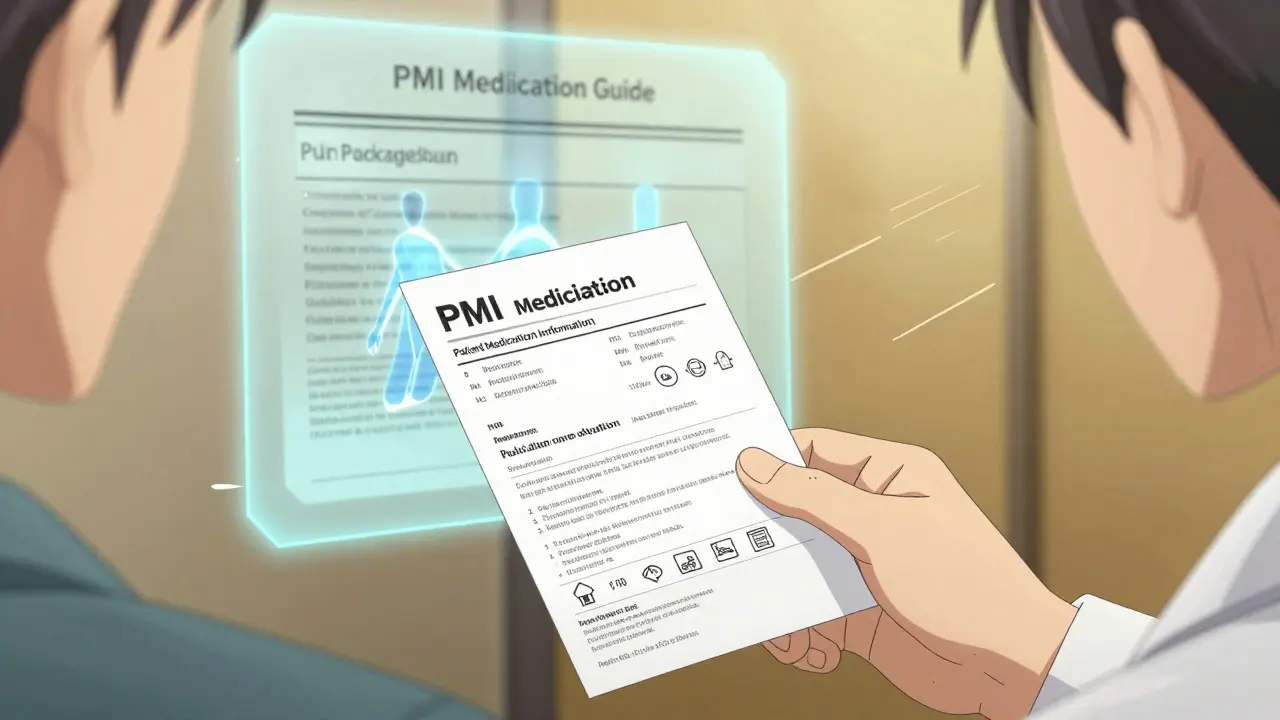
That’s why the FDA is changing it. In May 2023, they proposed a new system called Patient Medication Information (PMI). Starting in 2026, every prescription drug will have a single, standardized one-page patient handout - replacing both Medication Guides and Patient Package Inserts.
The PMI will:
- Be required for ALL prescription drugs, not just high-risk ones
- Be written in plain language (6th-8th grade level)
- Include the most common and serious side effects
- Be given to every patient at the pharmacy
- Be consistent in format - same layout, same headings, same font size
This is a huge shift. Instead of only warning you about rare, deadly risks, you’ll get a clear picture of what to expect - including the everyday side effects you’re more likely to experience.
What Should You Do Right Now?
You don’t have to wait for 2026 to get better info. Here’s what to do today:
- Always ask for the Medication Guide when you pick up a new prescription - even if the pharmacist doesn’t offer it.
- If you’re on a drug with a Medication Guide, read it. Keep it. Don’t throw it away.
- If you want to know EVERY possible side effect - even the rare ones - ask your pharmacist for the Package Insert. They can print it for you.
- Bookmark DailyMed (dailymed.nlm.nih.gov) and the FDA’s Medication Guides page. These are the only two official, free, trustworthy sources.
- Don’t rely on Google, WebMD, or forums. They’re not regulated. They can be wrong.
If you’re on a drug like warfarin, lithium, or olanzapine - the ones with black box warnings - you need both documents. The Medication Guide tells you what to watch for. The Package Insert tells you why it happens and what your doctor needs to know.
Side effects aren’t just a list of symptoms. They’re signals. They’re your body talking. And you deserve to understand what it’s saying - clearly, completely, and without having to be a doctor to read it.
What’s Coming Next?
The FDA’s new PMI system will roll out between 2026 and 2031. By the end of 2031, Medication Guides will be gone. Package Inserts will still exist for doctors - but patients will get one simple, clear, standardized sheet with every prescription.
This change is long overdue. Right now, your access to side effect info depends on luck - what drug you’re on, whether your pharmacy remembers to hand out the guide, whether you know to ask for the insert. In five years, that won’t be the case. Everyone will get the same clear, reliable info. No more guessing. No more searching. Just the facts - in plain language.
Until then, don’t wait. Ask. Read. Save. Know your drugs. Your health depends on it.
Do I always get a Medication Guide with my prescription?
No. Only about 250 out of 20,000+ prescription drugs in the U.S. require a Medication Guide. These are drugs with serious risks - like birth defects, life-threatening bleeding, or severe allergic reactions. If your drug isn’t on that list, you won’t get one. But you can always ask your pharmacist if one exists.
Can I get the Package Insert from my pharmacy?
Yes, but you have to ask. Pharmacists keep Package Inserts in their system or in print. They’re not given out automatically because they’re meant for professionals. But if you want the full side effect list, including rare reactions, just say, “Can I get the full prescribing information for this drug?” They’ll print it for you.
Why don’t all drugs have Medication Guides?
The FDA only requires them when a drug has a serious risk that patients need to understand to stay safe. For example, antibiotics like amoxicillin don’t need one because their side effects - like upset stomach - are common and not life-threatening. But drugs like isotretinoin (Accutane) do, because they can cause severe birth defects. The goal is to focus patient warnings on the most dangerous risks.
Is the FDA changing how side effect info is given?
Yes. Starting in 2026, the FDA will replace Medication Guides and Patient Package Inserts with a new standard called Patient Medication Information (PMI). Every prescription drug will come with a single, one-page, plain-language handout that all patients get - no matter the risk level. This will make side effect info consistent, reliable, and easier to understand.
Where can I find official side effect info online?
Use only two official sources: the FDA’s Medication Guides page (fda.gov/medication-guides) for patient handouts, and DailyMed (dailymed.nlm.nih.gov) for full Package Inserts. These are government-run, up-to-date, and legally accurate. Avoid drug info sites like WebMD or Healthline - they’re not regulated and often outdated.
What if my pharmacy doesn’t give me the Medication Guide?
You have a legal right to receive it. Politely ask again. If they still refuse, call the drug manufacturer’s customer service line - their contact info is on the drug bottle. Or download the guide yourself from the FDA website. You can print it and bring it to your next appointment to show your doctor.
Author

Alexandra Enns
January 24, 2026 AT 04:19This whole system is a joke. The FDA thinks slapping a 6th-grade pamphlet on a blood thinner is enough? My cousin died because she didn't know about the delayed bleeding risk - the guide said 'unusual bruising' but didn't mention retroperitoneal hemorrhage. Meanwhile, the package insert had 17 pages of clinical data she never saw. This isn't patient care - it's liability theater.
Marie-Pier D.
January 24, 2026 AT 14:17Thank you for writing this 💗 I’ve been telling my patients for years to ask for the insert - but most think it’s 'too scary' to read. I print them out in big font and highlight the 'what to watch for' parts. You’re not supposed to be a doctor to understand your meds. 🙏
Izzy Hadala
January 24, 2026 AT 18:53It is noteworthy that the FDA's Medication Guide requirement, established pursuant to the Food and Drug Administration Modernization Act of 1997 (Pub. L. 105-115), applies only to drugs deemed to present a 'serious risk' as defined under 21 CFR 310.5. The statistical prevalence of such drugs - approximately 1.25% of all FDA-approved prescription medications - suggests a targeted, risk-based regulatory approach. However, the absence of standardized dissemination protocols across community pharmacies remains a critical operational gap.
Elizabeth Cannon
January 25, 2026 AT 14:17OMG I just realized I’ve been throwing these guides away like junk mail 😳 I got my new anticoagulant last week and didn’t even open the little booklet. Now I’m going back to the pharmacy to ask for the insert. Also, why does no one ever tell you this stuff??
Shelby Marcel
January 26, 2026 AT 16:14so like… if i dont get a med guide, does that mean my drug is safe?? i asked my pharmer and she just shrugged. now im scared to take my blood pressure pill 😭
Luke Davidson
January 27, 2026 AT 22:18Y’all need to stop treating your meds like a mystery box from Amazon. I used to be scared of my antidepressant until I read the package insert - turns out the 'rare' side effect of weight gain? Yeah, that happened to 1 in 5 people. Not rare. Just buried in 47 pages of jargon. I printed it, taped it to my fridge, and now I feel like I’m actually in control. Knowledge isn’t scary - ignorance is.
Karen Conlin
January 29, 2026 AT 17:26Stop waiting for the system to fix itself. Ask. For. The. Insert. I’m a nurse. I’ve seen patients go to ERs because they read a Reddit post that said 'X drug causes hallucinations' - turns out it was a 0.003% case from a 1998 trial. Meanwhile, they ignored the guide that said 'dizziness is common, don’t drive.' You don’t need to be a scientist. You just need to ask. And keep the paper.
Sushrita Chakraborty
January 30, 2026 AT 18:34It is imperative to acknowledge that the current dichotomy between Medication Guides and Package Inserts reflects a fundamental misalignment between regulatory intent and patient literacy. While the proposed Patient Medication Information (PMI) initiative is commendable, its success will hinge upon linguistic accessibility, cultural adaptation, and pharmacovigilance integration - particularly in non-English-speaking communities. I recommend multilingual dissemination via QR codes linked to audio summaries.
Sawyer Vitela
January 31, 2026 AT 02:30Only 250 drugs need guides? That’s because 99% of side effects are just nausea. Stop crying. If you can’t handle a 50-page PDF, don’t take pills.
Shanta Blank
February 1, 2026 AT 23:45THEY’RE HIDING THE TRUTH. The package insert says 1 in 500 people get 'sudden cardiac arrhythmia' - but the guide says 'sometimes your heart beats weird.' That’s not transparency. That’s gaslighting. And the FDA knows it. They’re scared people will panic. But we’re not idiots. We just want the truth - even if it’s ugly.
Vatsal Patel
February 2, 2026 AT 01:24Ah, the great Western pharmaceutical illusion: you give a man a pill, then give him a pamphlet that says 'this might kill you' - but never explain why it works. The real question isn’t where to find the insert… it’s why we let corporations design our health education. The PMI? Just a new label on the same poison bottle. The system isn’t broken - it’s working exactly as designed.