
23
Mar

Side Effect Detection Calculator
Clinical trials often miss rare side effects. This calculator shows how many people need to use a drug or device for a rare side effect to be detected, considering that only 6-10% of adverse events get reported.
in
Typical reporting rate is 6-10% (enter as decimal: 0.06-0.10)
Enter as decimal (e.g., 0.95 for 95% confidence)
Enter values and click Calculate
When a new drug or medical device hits the market, it doesn’t mean the safety check is over. In fact, some of the most dangerous side effects are only found after thousands or even millions of people start using it. That’s where post-market surveillance comes in - the quiet, relentless system that watches what happens when a product leaves the controlled world of clinical trials and enters real life.
Why Clinical Trials Aren’t Enough
Before a drug gets approved, it goes through clinical trials. These studies are tightly controlled. Participants are carefully selected. They’re healthy enough to join. They’re monitored closely. And they’re usually only a few thousand people at most. But real life is messy. Millions of people take the same drug. Some are 80 years old. Others have five chronic conditions. Some are pregnant. Some mix it with other medications they’re already on. And some don’t even tell their doctor about it. That’s where things go unseen in trials. A rare rash. A heart rhythm problem that only shows up after three years. A reaction in people with kidney disease. These don’t show up in a trial of 2,000 patients. But they can show up in a population of 5 million. The thalidomide disaster in the 1960s - where a drug meant to ease morning sickness caused severe birth defects - changed everything. It proved that pre-market testing alone can’t catch everything. Since then, governments have built systems to watch what happens after approval.How Side Effects Are Caught: The Systems at Work
There are two main ways side effects are discovered after a product is sold: passive reporting and active monitoring. Passive reporting is the most common. It’s simple: a doctor, pharmacist, or even a patient notices something odd - like unexplained bruising, sudden confusion, or a skin reaction - and reports it. In the U.S., that’s done through the FDA’s MedWatch system. In Europe, it’s EudraVigilance. These systems collect hundreds of thousands of reports every year. But here’s the catch: only about 6 to 10% of actual adverse events get reported. Why? Because most people don’t know how. Doctors are busy. Patients assume it’s just bad luck. And many don’t even realize they’re supposed to report it. Active monitoring is where things get smarter. Instead of waiting for reports, agencies go looking for problems. The FDA’s Sentinel Initiative pulls data from electronic health records of over 300 million Americans. It looks for patterns: “Are people taking Drug X having more heart attacks than expected?” “Is there a spike in liver damage in a certain age group?” Medical devices are watched differently. A broken pacemaker lead or a faulty hip implant doesn’t show up in a blood test. So under the EU’s Medical Device Regulation (MDR), manufacturers must run Post-Market Clinical Follow-up (PMCF) studies. These are real-world studies tracking how devices perform over time. If a certain model starts failing more often after two years, they have to act - fast.What Happens When a Problem Is Found
Finding a side effect is just the start. The real work begins after. If a pattern emerges - say, a new blood thinner is linked to dangerous bleeding in older adults - regulators don’t just pull the drug. They assess the risk versus the benefit. Is the drug life-saving for most? Or is the danger too high? Sometimes, they add a warning to the label. Sometimes, they restrict use - like only allowing it for patients under 65. Other times, they ask the company to run a new study. In extreme cases, the product is pulled. The diabetes drug rosiglitazone was restricted in 2010 after post-market data showed it increased heart attack risk. The arthritis drug Vioxx was pulled entirely in 2004 after studies confirmed it raised heart attack and stroke risk. But not all findings are bad. Sometimes, post-market surveillance uncovers hidden benefits. The blood pressure drug losartan was originally approved for hypertension. Later, data showed it reduced kidney damage in diabetics - a benefit not seen in trials. Now it’s a first-line treatment for diabetic kidney disease.
The Real-World Gap: Underreporting and Burnout
Here’s the uncomfortable truth: our systems are overloaded. Doctors report side effects less than half the time, according to studies. Why? It’s time-consuming. Filling out forms, navigating portals, waiting weeks for confirmation - it’s not part of their job. Patients? Only 12% know about MedWatch. Most think if they feel weird, it’s just “part of aging.” Manufacturers are struggling too. Under the EU MDR, companies must now submit detailed PMS reports every year. For small device makers, this means hiring new staff, buying software, training teams - often without extra budget. One quality manager on Reddit said the new rules doubled their workload. “We’re burning out,” they wrote. And then there’s the data problem. Systems like FAERS (FDA’s Adverse Event Reporting System) get flooded with reports. Some are duplicates. Some are vague. Some are just “I felt dizzy.” Algorithms try to sort through it, using statistical models like the Multi-Item Gamma Poisson Shrinker. But false alarms are common. It’s like trying to find a needle in a haystack - and the haystack is on fire.What’s Changing Now
The field is evolving fast. Artificial intelligence is starting to help. Companies like Oracle Health use AI to scan social media, online forums, and electronic records to spot early warning signs. One company reported finding safety signals 40% faster than traditional methods. Patient-reported data is also gaining traction. Apps now let people log symptoms daily. If 500 users report the same strange side effect within two weeks, that’s a red flag. The FDA is testing these tools in real time. Blockchain is being explored for secure, tamper-proof data sharing between hospitals, regulators, and manufacturers. And in low-income countries, where only 28% have functional safety systems, global groups are pushing for better infrastructure. But the biggest shift? We’re starting to accept that safety isn’t a one-time check. It’s an ongoing conversation - between patients, doctors, manufacturers, and regulators.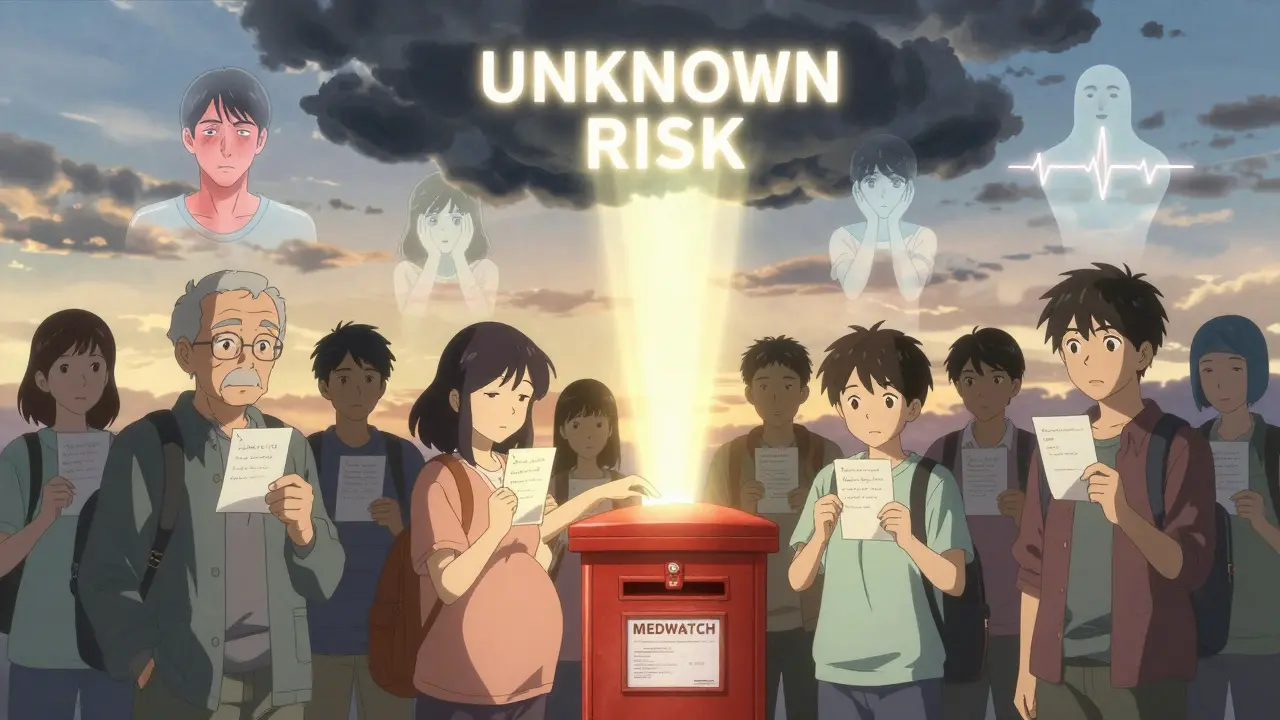
What You Can Do
You don’t need to be a scientist to help. If you take a new medication and notice something unusual - a rash, fatigue, mood changes, trouble breathing - don’t brush it off. Talk to your doctor. Ask: “Could this be related to the drug?” And if you’re comfortable, report it. In the U.S., go to fda.gov/medwatch. In Europe, contact your national health authority. Even one report can be the first clue in a pattern that saves lives. Manufacturers, too, need to listen. A complaint about a device failing after six months? That’s not just a warranty issue. It’s a safety signal.The Bottom Line
Approval isn’t the finish line. It’s the starting gun. Post-market surveillance isn’t perfect. It’s slow. It’s underfunded. It relies on human effort in a world that’s moving too fast. But it’s the only system we have that can catch the side effects no lab, no trial, no regulator could predict. Every time someone reports a strange reaction, they’re not just complaining. They’re protecting someone else. And that’s the quiet, essential work of keeping medicines and devices safe - long after they leave the factory and enter our lives.Author

Danielle Arnold
March 23, 2026 AT 21:21Donna Fogelsong
March 25, 2026 AT 11:08Seth Eugenne
March 26, 2026 AT 22:58rebecca klady
March 28, 2026 AT 00:52Namrata Goyal
March 29, 2026 AT 00:32Blessing Ogboso
March 30, 2026 AT 04:14Jefferson Moratin
March 31, 2026 AT 00:59Caroline Dennis
April 1, 2026 AT 04:38Zola Parker
April 2, 2026 AT 17:09florence matthews
April 2, 2026 AT 22:30Kenneth Jones
April 4, 2026 AT 16:44Raphael Schwartz
April 5, 2026 AT 03:35