
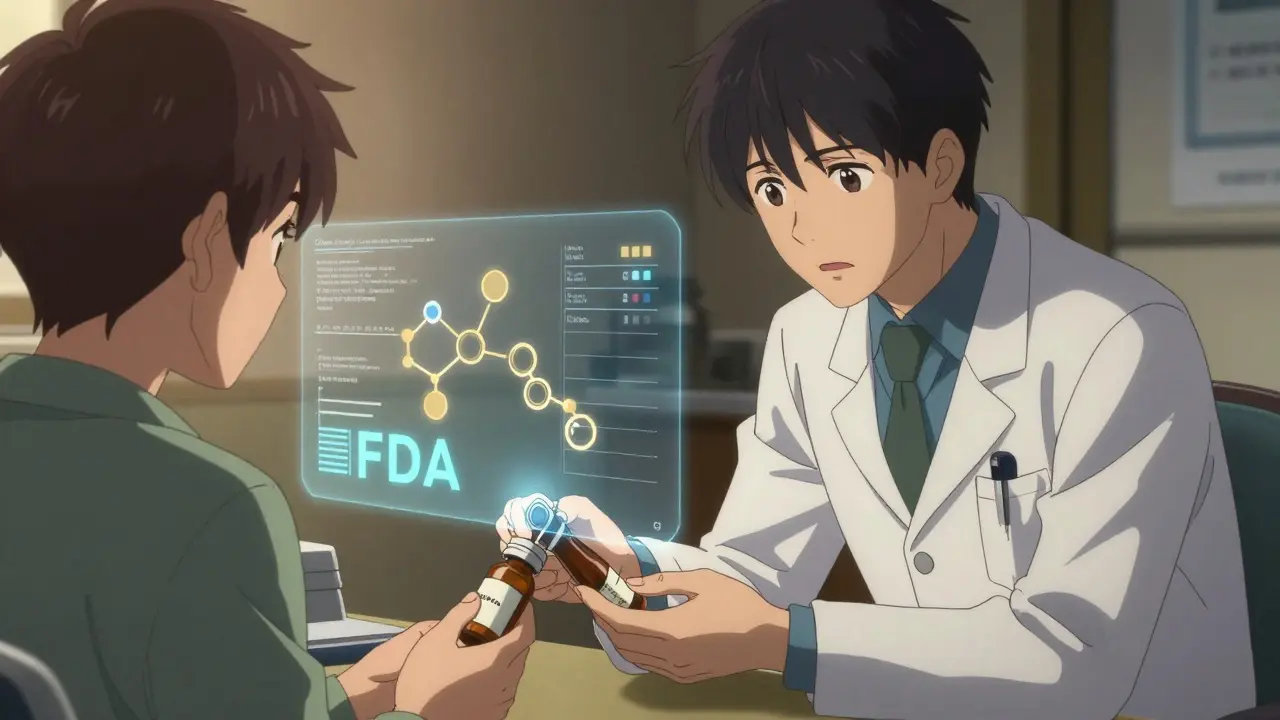
When a doctor hands you a prescription for a generic drug, you might not think much of it. But what they say-or don’t say-about that pill can change whether you take it, stick with it, or stop cold because you’re afraid it won’t work. The truth? clinician communication is the single biggest factor influencing whether patients believe generic medications are safe and effective.
It’s not about the pill itself. The FDA requires generics to match brand-name drugs in active ingredients, strength, and how the body absorbs them-within an 80% to 125% bioequivalence range. That’s not a guess. It’s science. Yet, nearly 30% of patients still believe brand-name drugs work better. Why? Because their doctor didn’t explain it. Or worse, they said something like, “Let’s try this generic and see how it goes.” That kind of language doesn’t reassure. It plants doubt.
What Patients Really Think About Generics
A 2015 study found that over half of patients said their doctor never discussed generic options. Another survey showed that 52% of patients got no explanation from their pharmacist either. That silence speaks volumes. Without context, patients fill the gap with fear. They see a different color, shape, or name on the bottle and assume it’s inferior. Some even think generics are made in lower-quality factories. They’re not. They’re made in the same facilities, under the same rules, as brand-name drugs.
But it’s not just about misinformation. There’s something deeper called the nocebo effect. If you expect a drug to cause side effects, your brain can make you feel them-even if the pill is identical to the one you’ve taken before. A 2019 JAMA study tracked 412 patients switching to generics. Those who got a clear explanation about FDA approval reported 28% fewer side effects than those who got a quick, vague handoff. The pill didn’t change. Their belief did.
The Power of the Right Words
Not all communication is created equal. Saying “This generic is cheaper” isn’t enough. Saying “This is the same medicine, just without the brand name” is better. But the best approach? Be confident, specific, and personal.
Patients who heard all four key points were far more likely to accept generics:
- “This drug has the same active ingredient as the brand-name version.” (That’s the core fact.)
- “The FDA requires it to work just as well-within 80% to 125% absorption.” (That’s the science they don’t know.)
- “It costs 80-85% less.” (That’s the real-world benefit.)
- “Some people worry about generics, but if you’ve had no issues with the brand, you won’t here.” (That’s the nocebo fix.)
One cardiologist in a Reddit thread shared how he spent 10 minutes showing a patient the FDA data on amlodipine. He even said, “I take generics myself.” That patient stayed on the generic for two years. No problems. That’s the power of trust.
Who’s Most Likely to Doubt Generics-and Why
It’s not random. Research shows certain groups are more skeptical. Non-Caucasian patients are 1.7 times more likely to question generics than white patients. People earning under $30,000 a year are over twice as likely to insist on brand names. Why? Past experiences with unequal care. Lack of access to reliable health info. Marketing that paints generics as “second-rate.”
Culturally competent communication cuts skepticism by 41% in these groups. That means using language they relate to, acknowledging their concerns without dismissing them, and sometimes even using the same examples they’ve heard from family or friends. One pharmacist in Texas started handing out printed cards with photos of generic pills next to brand-name ones-side by side-with a simple note: “Same medicine. Different price.” Patient acceptance jumped.

What Happens When Communication Fails
Bad communication doesn’t just cost money-it costs health.
On Healthgrades, a patient wrote: “My pharmacist just handed me a different pill. When I said I got headaches, he said, ‘Some people react to generics.’ I stopped taking it for three weeks.” That’s not just poor service. That’s medical abandonment. That patient could’ve had a stroke or heart attack if they were on blood pressure meds.
Analysis of 4,200 patient reviews found that 89% of negative experiences blamed poor communication. Meanwhile, 78% of positive experiences mentioned their doctor or pharmacist took the time to explain. That’s not coincidence. That’s cause and effect.
When both the doctor and pharmacist talk to a patient about generics, acceptance rates hit 92%. If only one does, it drops to 76%. If neither does? Only 61% accept the switch. That’s a 31-point gap created by a simple conversation.
Why Clinicians Struggle to Communicate
Doctors aren’t ignoring this on purpose. They’re stretched thin. A 2020 study found they spend an average of 1.2 minutes per patient on generic discussions-barely enough to say “Here’s your prescription.”
Many don’t know the facts themselves. Only 54% of physicians could correctly answer basic FDA bioequivalence questions. And 39% admitted they felt unsure about using generics for conditions like epilepsy or thyroid disease-even though the science says they’re just as effective.
That’s why Kaiser Permanente’s “Generic First” program worked. They trained every provider. They gave them scripts. They built prompts into their electronic records. Result? 94% of prescriptions filled were generics. They saved $1.2 billion a year.

What’s Changing Now
Things are shifting. In 2024, Epic Systems launched the “Generic Confidence Score,” a tool that pops up in electronic health records and reminds doctors: “Did you explain the FDA bioequivalence?” “Did you address patient concerns?”
The American Medical Association now includes communication quality in physician evaluations. The FDA released multilingual patient guides. Medicare is starting to tie reimbursement to whether providers actually talk to patients about generics.
And it’s working. A 2023 survey showed 87% of physicians and 94% of pharmacists believe better communication is the key to keeping generic use high-especially as complex generics like inhalers and injectables enter the market.
The Bottom Line
Generics aren’t second-choice drugs. They’re the same medicine, priced for real life. But they only work if patients believe in them. And patients only believe in them when their clinician makes them feel confident, not confused.
This isn’t about sales. It’s about trust. It’s about science. It’s about preventing real harm caused by fear. A 10-minute conversation can save a patient money, prevent a relapse, and even save a life. And it doesn’t require new drugs, new tech, or new laws. Just better talk.
Author

Laia Freeman
January 30, 2026 AT 08:10This is SO true!!! I had a doctor just hand me a generic pill like it was a candy wrapper-no explanation, no nothing. I thought it was a mistake until I checked the bottle. Then I panicked and stopped taking it for a week. My blood pressure went through the roof. I wish someone had just said, 'This is the same medicine, just cheaper.' 😭
rajaneesh s rajan
January 31, 2026 AT 09:11Wow. So the real generic scandal isn’t the pill-it’s the silence. In India, we call this 'doctor culture'-they think explaining things is for nurses. Meanwhile, patients are Googling 'is generic poison?' at 2 a.m. The FDA doesn’t care if your brain believes you’re getting scammed. Only the doctor does. And most don’t even know what 'bioequivalence' means.
paul walker
February 1, 2026 AT 00:51My pharmacist actually showed me the FDA chart once. Same active ingredient. Same factory. Different label. I cried. Not because I was sad-because I realized I’d been scared of nothing. People need to see that. Not hear it. See it.
Alex Flores Gomez
February 1, 2026 AT 14:46Let’s be real-this isn’t about communication. It’s about class. People who can’t afford brand names are treated like they’re too stupid to understand science. Meanwhile, rich folks get the brand because their doctor 'wants the best for them.' The system’s rigged. And now they want us to thank them for explaining the obvious?
Frank Declemij
February 2, 2026 AT 00:20The data is clear. Clear communication increases adherence by 31%. That’s not a suggestion. It’s a clinical imperative. Doctors who skip this aren’t being efficient-they’re being negligent.
Pawan Kumar
February 3, 2026 AT 22:20Did you know that 73% of generic pills are manufactured in China? And that the FDA inspects less than 2% of those facilities? The 'same rules' argument is a marketing lie. You think your blood pressure pill was made in a sterile lab? It was made in a warehouse with no air filtration. The FDA is a puppet. The pharmaceutical industry owns it.
DHARMAN CHELLANI
February 5, 2026 AT 16:26Generics? More like generic lies. If they were the same, why do they cost 80% less? Magic? No. Cut corners. Same pill? Nah. Same name, different soul.
Keith Oliver
February 6, 2026 AT 23:35Ugh. Another feel-good article. The real issue? Doctors don’t have time. They’re paid by the minute. If you want them to spend 10 minutes explaining bioequivalence, pay them to do it. Stop blaming them for a broken system. Also, I take brand-name insulin. Because I don’t trust generics. And I’m not stupid.
Andy Steenberge
February 7, 2026 AT 07:28One of my patients asked me last week why her pill looked different. I showed her the FDA page on her phone. Same active ingredient. Same absorption curve. Same side effect profile. She said, 'So it’s not like I’m getting the cheap version?' I said, 'No. It’s like you’re getting the same version, but your wallet gets a raise.' She smiled. Took it. No issues since. It’s not rocket science. Just human.
kabir das
February 8, 2026 AT 10:41But what if the generic makes you feel weird? I took one and had nightmares for three nights. My mom said it was the pills. My aunt said it was the devil. I haven’t trusted generics since. And now you want me to believe it’s all in my head? What if it’s not? What if the pills are different? What if they’re poisoning us slowly? Who’s gonna test that? Not the FDA. Not the doctors. Just me… alone… with my pills…
LOUIS YOUANES
February 10, 2026 AT 00:42Let’s be honest-this is all just corporate propaganda. The same companies that make brand-name drugs make the generics. They just slap a new label on it. The 'same medicine' line? A lie to sell more pills. And now they want us to believe the doctor’s words are magic? Please. The system is designed to keep you dependent. And confused.
Robin Keith
February 11, 2026 AT 02:30There’s a deeper layer here, beyond bioequivalence and FDA guidelines-something existential. When a patient receives a generic, they’re not just receiving a chemical compound-they’re receiving a narrative. A narrative of scarcity. Of compromise. Of being told, 'This is good enough for you.' And that narrative, however unintentional, becomes internalized. It’s not just about trust in the pill-it’s about trust in the system that deemed you worthy of the cheaper version. And when you’ve been told your whole life that you’re not worth the best, even the most scientifically identical pill becomes a symbol of abandonment. The clinician’s words don’t just explain a drug-they either heal that wound… or deepen it.
Sheryl Dhlamini
February 12, 2026 AT 22:01I’m a nurse. I’ve seen this a thousand times. A patient gets a generic. They come back in a week, shaking, saying they feel 'off.' I ask if they took it. They say yes. Then they whisper: 'But it’s not the same color.' I show them the FDA chart. I explain the science. I tell them I take generics too. And then-sometimes-they cry. Not because they’re sick. Because they finally feel heard. That’s the real medicine.