
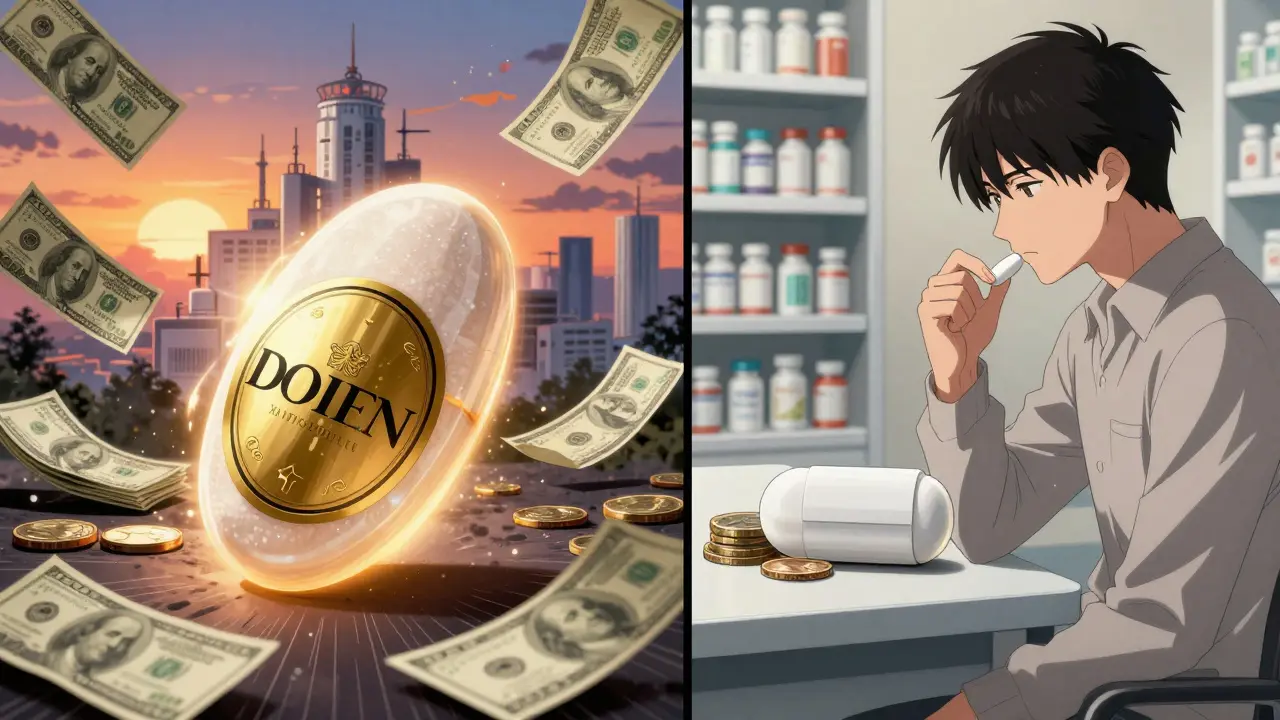
Have you ever looked at your prescription receipt and wondered why the generic version costs a fraction of the brand-name drug? It’s not a trick. It’s not a scam. It’s simple economics, smart regulation, and a system designed to save money without cutting corners on safety. A pill made by a generic company can cost as little as 4% of what the brand-name version charges - and yet, it works exactly the same.
Identical Medicine, Different Price Tag
Let’s clear up the biggest myth right away: generic drugs are not weaker, less effective, or lower quality. They contain the exact same active ingredient, in the same strength, and delivered the same way - whether it’s a pill, injection, or inhaler. The FDA requires that a generic drug delivers the same amount of medicine into your bloodstream at the same rate as the brand-name version. That’s not a suggestion. It’s a legal requirement. If it doesn’t meet that standard, it doesn’t get approved.
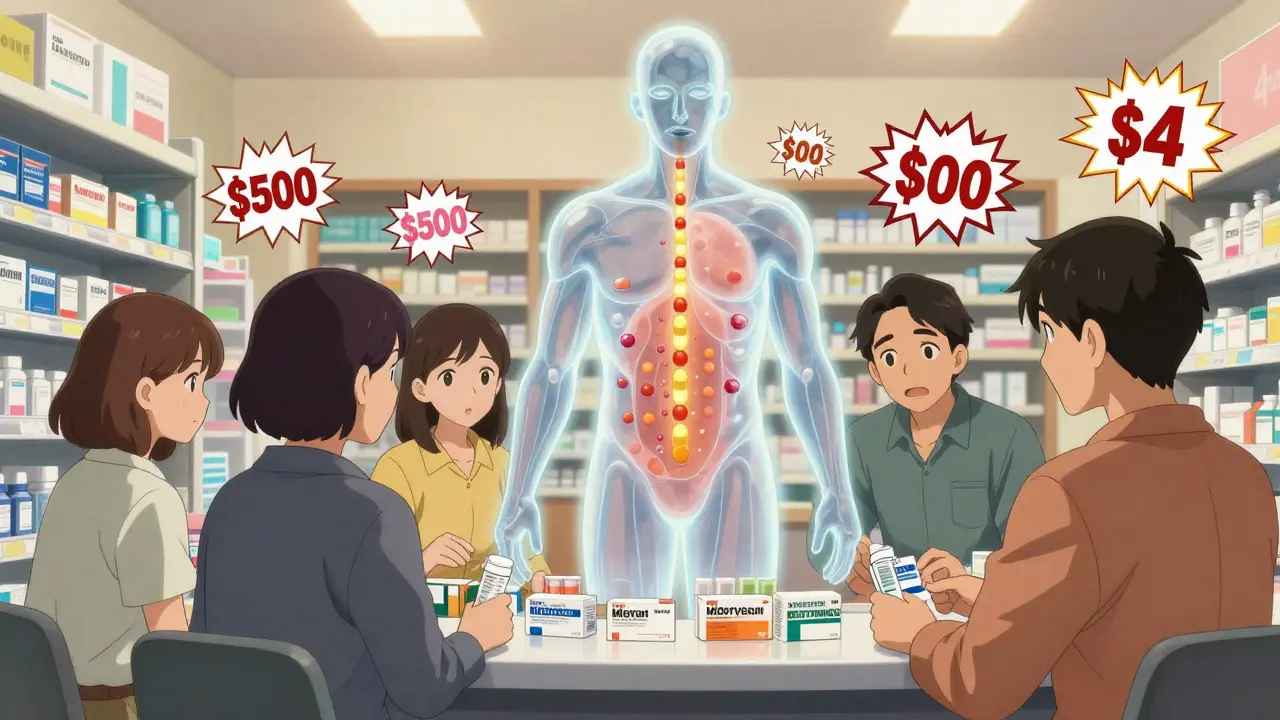
So why does a generic version of atorvastatin (the cholesterol drug sold as Lipitor) cost $4 a month while the brand name runs $500? The answer isn’t in the pill. It’s in what came before it.
The $2.6 Billion Price of Being First
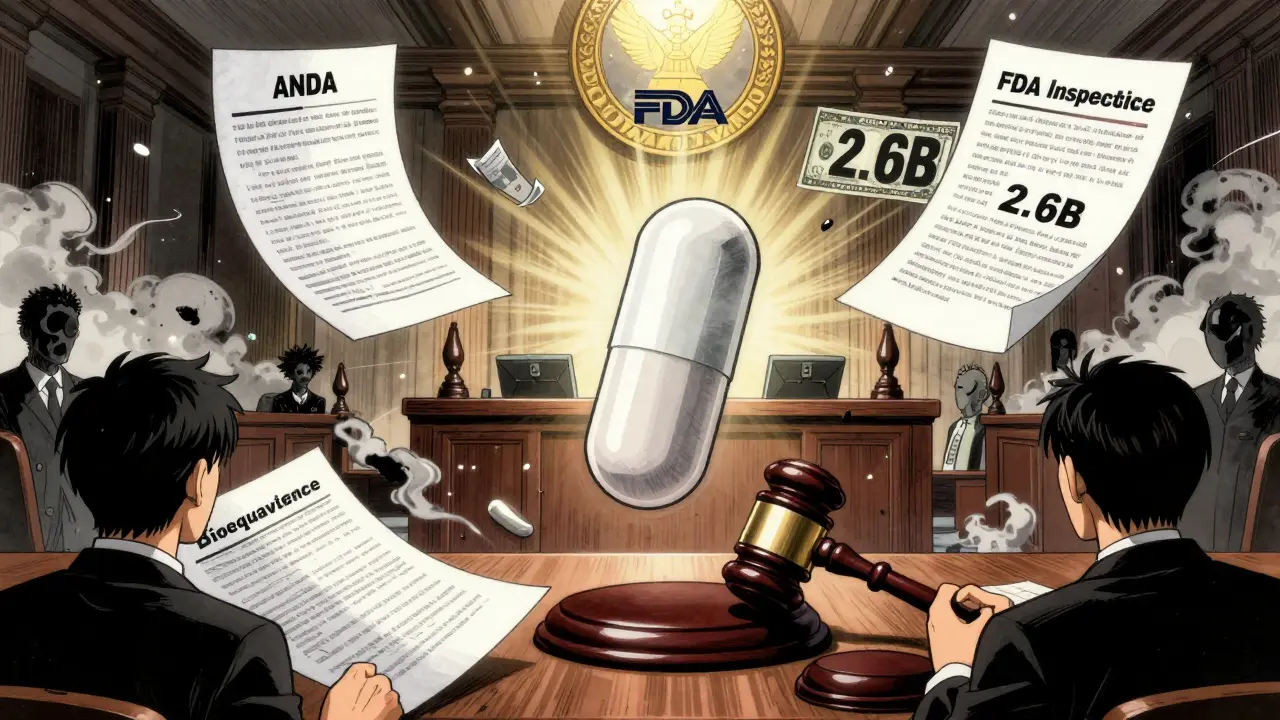
Brand-name drug companies don’t just wake up one day and start selling pills. They spend years - often more than a decade - developing a new drug. This includes everything from lab research, animal testing, and dozens of clinical trials involving thousands of people. According to the Tufts Center for the Study of Drug Development, the average cost to bring a single new drug to market is about $2.6 billion. That includes failed attempts, lawsuits, marketing campaigns, and the cost of money tied up over 10-15 years.
That’s why brand-name drugs are so expensive at first. The company needs to recoup that investment. And they have a legal monopoly to do it: a 20-year patent, starting from the day they first file it. During that time, no one else can legally make the same drug. That exclusivity lets them charge what the market will bear.
How Generics Skip the Cost
When that patent expires, the game changes. Generic manufacturers don’t need to start from scratch. They don’t need to repeat the animal studies. They don’t need to run new clinical trials on humans. All they need to prove is that their version behaves the same way in the body - a process called bioequivalence.
This is where the Hatch-Waxman Act of 1984 comes in. It created a fast-track approval path for generics called the Abbreviated New Drug Application (ANDA). Instead of spending $2 billion, a generic company spends $1 million to $5 million. Instead of taking 10-15 years, the process takes 1-3 years. That’s the core reason for the price drop.
Think of it like this: if you built a car from scratch, you’d need to design the engine, source the parts, test safety, and build a factory. But if someone else already built the exact same car and you just copy the blueprint? You save 90% of the cost. That’s what generics do.
Competition Drives Prices Even Lower
It doesn’t stop at one generic maker. Once the patent expires, multiple companies can enter the market. On average, 14 different manufacturers will make the same generic drug. That’s not a guess - it’s FDA data from 2022.
When one company lowers its price, others have to follow. If you’ve ever seen a generic drug go from $20 to $5 to $2 in a few months, that’s why. In fact, the Congressional Budget Office found that generic competition typically slashes prices by 80-90% within the first year. By the time five or six companies are selling the same pill, you’re looking at pennies per dose.
Compare that to brand-name drugs, which rarely face direct competition for two decades. No wonder they stay expensive.
Same Rules, Different Label
Some people worry that generics aren’t held to the same standards. They’re not. The FDA inspects manufacturing plants for generics just as often as those for brand-name drugs - over 12,000 inspections a year worldwide. Both must follow the same strict rules for cleanliness, consistency, and stability. A generic pill must stay potent within 90-110% of its label claim for its entire shelf life - the same as the brand.
The only differences you’ll notice? Color, shape, flavor, or the name on the pill. Those are trademarks. A brand-name company owns the look of its pill. A generic company can’t copy it, so they make their own version. That’s why your generic omeprazole might be a blue capsule instead of a red one. But inside? Same chemistry. Same effect.
Who Uses Generics - And Why
Nine out of every 10 prescriptions filled in the U.S. are for generic drugs. That’s not because people are forced into them - it’s because they choose them. Tebra’s 2023 survey found that 63% of Americans actively pick generics over brand-name drugs. Another 60% said they’d prefer the brand, but they can’t afford it.
The savings are massive. Generic atorvastatin saves $496 a month. Generic omeprazole saves $294. Generic levothyroxine? Patients on Reddit report $400 monthly savings with zero change in how they feel. According to the Association for Accessible Medicines, generics saved the U.S. healthcare system $293 billion in 2022 alone.
Insurance plans encourage this. Most have a three-tier system: generics are Tier 1, with copays as low as $0 or $5. Brand-name drugs? Tier 2 or 3 - $25 to $100 or more. Pharmacists often switch to generics automatically unless you ask for the brand. And if you do ask? Your doctor may need to jump through hoops to get it covered.
What About When Generics Don’t Work?
You’ve probably heard stories: “I switched to generic and my symptoms got worse.” It happens - but rarely because the drug is different. More often, it’s because:
- You switched between two different generic brands (e.g., from Teva to Mylan), and your body reacted to a change in inactive ingredients like fillers or dyes.
- You’re on a narrow therapeutic index drug - like warfarin, levothyroxine, or phenytoin - where tiny changes in blood levels matter.
- You’re not taking it consistently, or you stopped checking your levels after the switch.
The FDA and the American Medical Association both say: for 99% of drugs, generics are interchangeable. For the 1% that are tricky, doctors and pharmacists know to monitor closely. If you feel off after switching, talk to your provider - don’t assume the generic is faulty.
The Bigger Picture
Generics aren’t just cheaper. They’re essential. Without them, millions of people couldn’t afford their medications. One in four Americans skips doses because of cost. Generics keep them alive. They keep chronic conditions under control. They prevent hospitalizations.
And the trend is only growing. Over 150 brand-name drugs are set to lose patent protection by 2028, with combined sales of $157 billion. That means even more generics hitting the market - and even more savings for patients.
Meanwhile, regulators are working to speed up approval for complex generics - like inhalers and topical creams - which have historically taken years to get approved. The FDA’s new 2023 guidance aims to cut those timelines in half. That’s not just good for business. It’s good for health.
Bottom Line
Generics cost 80-85% less because they don’t carry the weight of research, patent exclusivity, or marketing hype. They’re not a bargain because they’re inferior. They’re a bargain because they’re smart. They’re the same medicine, made without the overhead. And for the vast majority of people, they work just as well - for a fraction of the price.
Next time you’re handed a generic prescription, don’t second-guess it. You’re not getting a second-rate drug. You’re getting the same drug - without the brand markup.
Are generic drugs as safe as brand-name drugs?
Yes. The FDA requires generic drugs to meet the same safety and quality standards as brand-name drugs. They must contain the same active ingredient, strength, dosage form, and route of administration. Both are manufactured under the same strict rules, and both undergo regular inspections. The only difference is cost - not safety.
Why do generic drugs look different from brand-name drugs?
Trademark laws prevent generic manufacturers from copying the exact color, shape, or logo of the brand-name pill. So they make their own version - different color, size, or imprint. But the active ingredient is identical. If you’re concerned about switching, ask your pharmacist to confirm the generic matches your prescription.
Can I trust generics if they’re made overseas?
Yes. Over 70% of the active ingredients in U.S. generic drugs come from countries like India and China, but they’re still subject to FDA inspections. The FDA inspects foreign manufacturing plants just like U.S. ones - and has done so for decades. If a facility fails inspection, its drugs are blocked from entering the U.S. market. Your medication is held to the same standard, no matter where it’s made.
Do insurance companies push generics to save money?
Yes - and that’s a good thing. Insurance plans encourage generics by charging much lower copays - often $0 to $15 - compared to $25-$100 for brand-name drugs. This isn’t about denying care. It’s about making sure you can afford your medicine. Most plans automatically substitute generics unless your doctor specifically says “do not substitute.”
What if I don’t feel the same on a generic?
If you notice changes in how you feel after switching, talk to your doctor or pharmacist. It’s rare, but possible that a change in inactive ingredients (like fillers) affects you. Or, if you’re on a drug with a narrow therapeutic index (like thyroid or blood thinners), even small variations matter. Your provider can check your levels, switch you back, or help you find a different generic brand. Don’t assume the generic is broken - get it checked.

Nicholas Gama
March 7, 2026 AT 13:22Mary Beth Brook
March 7, 2026 AT 23:28Dan Mayer
March 9, 2026 AT 10:24Janelle Pearl
March 9, 2026 AT 21:38Generics saved my life. Not because they’re cheap. Because they’re real.
Ray Foret Jr.
March 10, 2026 AT 21:57Robert Bliss
March 12, 2026 AT 09:58Peter Kovac
March 13, 2026 AT 14:05APRIL HARRINGTON
March 15, 2026 AT 02:47Leon Hallal
March 15, 2026 AT 11:53Judith Manzano
March 15, 2026 AT 16:05