
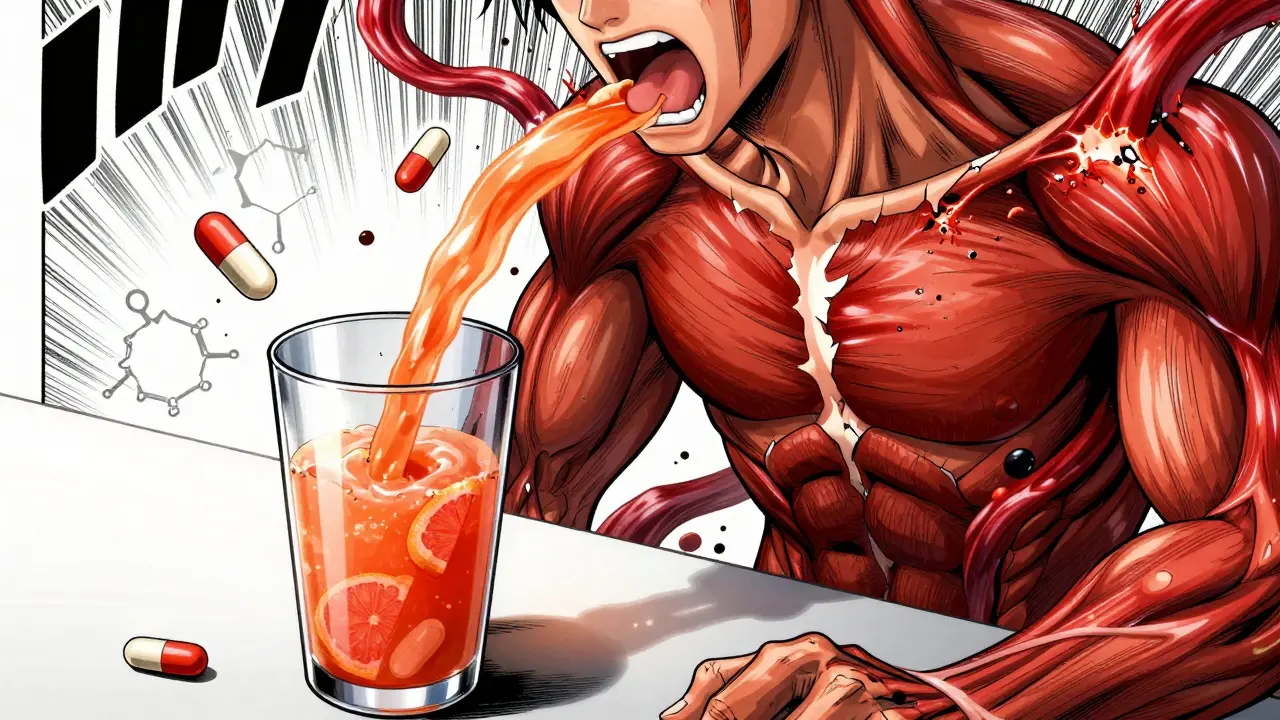
Drinking a glass of grapefruit juice with breakfast might seem like a healthy habit-until you're taking simvastatin. For millions of people on this cholesterol-lowering drug, that innocent glass could be quietly raising the risk of serious muscle damage, kidney failure, or even death. This isn’t speculation. It’s backed by decades of clinical research and confirmed by the FDA, the American Heart Association, and top cardiology centers. The interaction between grapefruit juice and simvastatin is one of the most dangerous and poorly understood drug-food interactions in modern medicine.
How Grapefruit Juice Turns Simvastatin Into a Poison
Simvastatin, sold under the brand name Zocor, works by blocking an enzyme called HMG-CoA reductase to lower LDL cholesterol. But before it can do that, it has to pass through your gut. That’s where grapefruit juice steps in-and ruins everything.
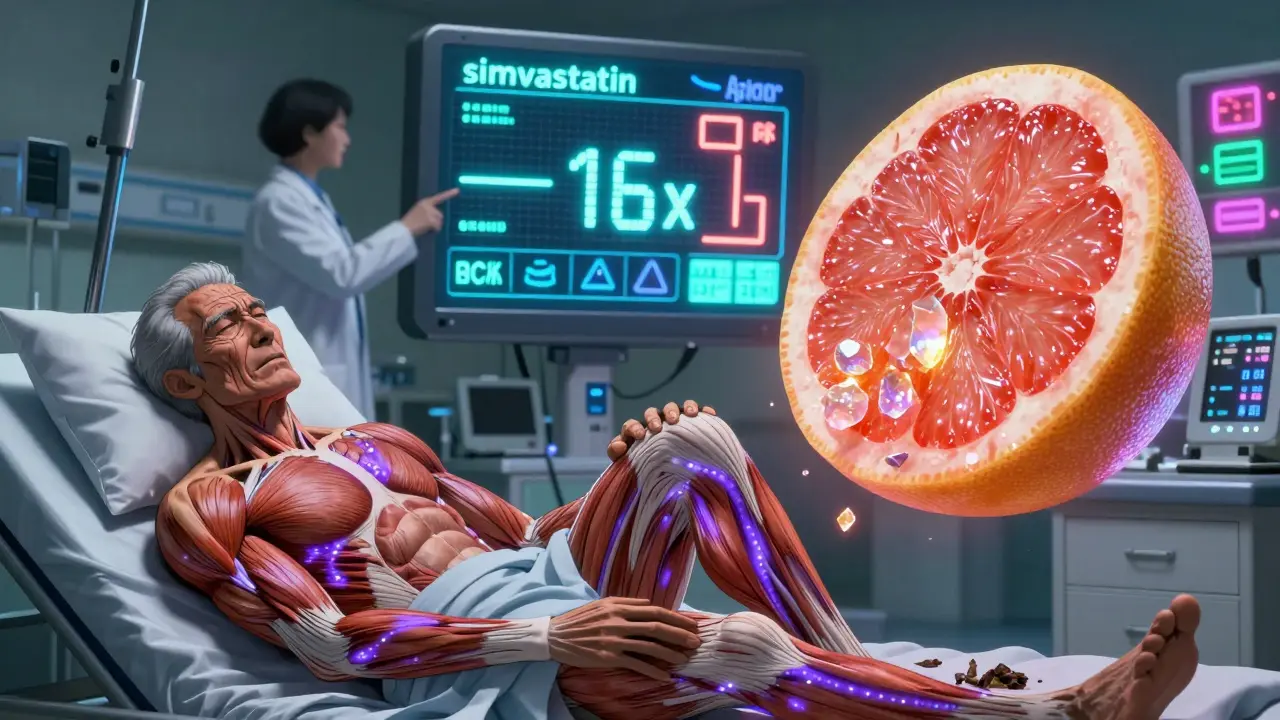
Grapefruit contains chemicals called furanocoumarins, natural compounds found in citrus fruits that irreversibly disable the CYP3A4 enzyme in the intestinal lining. This enzyme normally breaks down simvastatin before it enters your bloodstream. When it’s shut down, up to 90% more of the drug gets absorbed. Studies show that drinking just 200 mL of grapefruit juice with simvastatin can spike blood levels of the drug by 16 times-a jump that pushes the medication far beyond its safe range.
The result? Too much simvastatin in your system overloads your muscles. It triggers myopathy, a condition where muscle fibers break down, releasing toxic proteins into the blood. In its worst form, this becomes rhabdomyolysis, a life-threatening breakdown of skeletal muscle that can clog kidneys and cause acute renal failure. About 0.1% of statin users develop rhabdomyolysis. With grapefruit juice, that risk can triple or more.
How Much Juice Is Dangerous?
You might think, "I only have a small glass." But here’s the catch: there’s no safe amount if you’re on high-dose simvastatin. The FDA’s 2023 update says the danger threshold is 1.2 liters per day-that’s five 8-ounce glasses. But here’s what most people don’t realize: even one glass can be risky if you’re older, have kidney problems, or take other meds that also interfere with CYP3A4.
Research from the American Heart Association shows that consuming just one 8-ounce glass daily increases simvastatin levels by 30-40%. For most people, that’s not enough to cause harm. But for someone over 65, or someone on 80 mg of simvastatin, or someone also taking amiodarone or diltiazem? That extra 40% could be the difference between a mild ache and hospitalization.
And it’s not just juice. The interaction happens with whole grapefruit, too. One grapefruit contains the same amount of furanocoumarins as a full glass of juice. Even grapefruit-flavored sodas, candies, or supplements can contain enough of these compounds to matter.
Not All Statins Are Created Equal
Here’s the good news: not every statin reacts this way. The problem is specific to drugs that rely on CYP3A4 for breakdown.
Simvastatin and lovastatin are the worst offenders. Atorvastatin (Lipitor) also interacts, but less severely-typically increasing levels by 3-4 times. Pravastatin (Pravachol) and rosuvastatin (Crestor)? They’re safe. They don’t go through CYP3A4 at all. That’s why experts now recommend switching to one of these if you regularly eat grapefruit.
Here’s a quick comparison:
| Statin | Primary Metabolism Pathway | Grapefruit Interaction Risk | Recommended Alternative if Consuming Grapefruit |
|---|---|---|---|
| Simvastatin | CYP3A4 | Very High (up to 16x increase) | Pravastatin, Rosuvastatin |
| Lovastatin | CYP3A4 | Very High (up to 15x increase) | Pravastatin, Rosuvastatin |
| Atorvastatin | CYP3A4 | Moderate (up to 3.3x increase) | Pravastatin, Rosuvastatin |
| Pravastatin | Non-CYP3A4 | None | - |
| Rosuvastatin | Non-CYP3A4 | None | - |
Over 23 million prescriptions for simvastatin were written in the U.S. in 2023. That’s nearly one in five statin users. If even 10% of them regularly drink grapefruit juice, we’re talking about tens of thousands of people at avoidable risk.
Who’s Most at Risk?
It’s not just about how much juice you drink. Some people are far more vulnerable:
- Age 65+ - Older adults metabolize drugs slower and have less muscle mass, making them more prone to damage.
- Chronic kidney disease - Impaired kidneys can’t clear muscle toxins, letting them build up fast.
- Diabetes or hypothyroidism - These conditions increase baseline muscle sensitivity to statins.
- On other CYP3A4-inhibiting drugs - Medications like diltiazem, verapamil, clarithromycin, or even some antifungals can stack on top of grapefruit’s effect.
- High simvastatin dose (40-80 mg) - The FDA warns that doses above 20 mg carry significantly higher risk when combined with grapefruit.
One 2022 Mayo Clinic survey found that 28% of statin users consumed more than 1.2 liters of grapefruit juice weekly-often without knowing the danger. Meanwhile, 63% thought even a small amount was unsafe. That confusion is part of the problem.
What Should You Do?
If you’re taking simvastatin, here’s what to do:
- Check your prescription. Is it simvastatin or lovastatin? If yes, avoid grapefruit entirely.
- Ask your doctor about switching. Pravastatin or rosuvastatin work just as well and don’t interact with grapefruit.
- Read labels. Grapefruit flavoring hides in sodas, candies, and even some supplements.
- Know the warning signs. Muscle pain, weakness, dark urine, or unexplained fatigue? Call your doctor immediately.
- Wait it out. If you accidentally drank grapefruit juice, don’t panic. The enzyme inhibition fades in 3-7 days. But don’t repeat it.
The FDA says: if you experience muscle pain, weakness, or dark urine while taking simvastatin-especially after drinking grapefruit juice-seek medical help right away. Rhabdomyolysis can lead to kidney failure in under 48 hours.

The Future: Safer Grapefruit?
There’s hope on the horizon. Researchers at the University of Florida have developed a new grapefruit hybrid called UF Sweetie, which has 87% less of the dangerous furanocoumarins. Early trials show it doesn’t raise simvastatin levels at all. It’s not on shelves yet-but if it makes it to market, it could change everything.
For now, though, the safest rule is simple: if you’re on simvastatin, skip the grapefruit. Not because it’s "bad," but because the science is clear: it turns a life-saving drug into a hidden threat.
What About Orange Juice?
Good news: sweet oranges (not grapefruit) are completely safe. They don’t contain furanocoumarins. You can drink orange juice, eat oranges, or use orange-flavored products without worry. The problem is unique to grapefruit and a few related citrus varieties like Seville oranges and pomelos.
Can I drink grapefruit juice if I take simvastatin once a day at night?
No. The interaction happens in your gut, not your liver, and it doesn’t matter what time of day you take the juice or the medication. The enzyme inhibition lasts for days, so even spacing them apart won’t help. Avoid grapefruit entirely if you’re on simvastatin.
Is it safe to eat half a grapefruit instead of drinking juice?
No. Half a grapefruit contains the same amount of furanocoumarins as a full glass of juice. The risk is identical. Whether you drink it or eat it, the effect on CYP3A4 is the same.
How long does the grapefruit effect last after I stop drinking it?
It takes 3 to 7 days for your body to make new CYP3A4 enzymes. During that time, simvastatin will still be absorbed at dangerously high levels. Don’t assume the interaction is gone just because you haven’t had grapefruit in a day or two.
Can I switch to a different statin to keep eating grapefruit?
Yes. Pravastatin and rosuvastatin are not broken down by CYP3A4 and have no known interaction with grapefruit. Many patients switch successfully with no loss of cholesterol-lowering effect. Talk to your doctor about alternatives.
I’ve been drinking grapefruit juice for years with simvastatin and feel fine. Should I still stop?
Yes. The risk of rhabdomyolysis is unpredictable. You may feel fine now, but a small change-like increasing your dose, getting older, or starting another medication-could push you into danger overnight. There’s no safe way to predict who will have a reaction. Avoiding grapefruit eliminates the risk entirely.
Author

RacRac Rachel
March 3, 2026 AT 04:33Just switched from simvastatin to rosuvastatin after reading this-thank you for laying it out so clearly! 🙌 I used to have that daily grapefruit juice habit and had no idea I was playing Russian roulette with my muscles. Now I drink orange juice and feel way safer. Also, my doctor was shocked I hadn’t been warned before. This needs to be on every prescription label. 💚
Jane Ryan Ryder
March 4, 2026 AT 02:49Callum Duffy
March 5, 2026 AT 22:06Thank you for this meticulously researched and calmly presented overview. The distinction between statin types and their metabolic pathways is crucial, and yet rarely communicated with such clarity. I have recommended this piece to several colleagues in primary care. The table comparing metabolic pathways is particularly valuable for patient education. A model of evidence-based communication.
Chris Beckman
March 5, 2026 AT 23:53Levi Viloria
March 7, 2026 AT 06:58As someone who grew up in a household where grapefruit was a daily ritual, this hit differently. I remember my grandmother insisting it was a "natural cleanser"-and now I realize she was unknowingly putting her health at risk. The fact that even grapefruit-flavored sodas contain these compounds is wild. We need better public health messaging-not just for statin users, but for anyone who thinks "natural" equals "safe." This isn’t about fear. It’s about informed choice.
Richard Elric5111
March 8, 2026 AT 09:21One is compelled to reflect upon the epistemological paradox inherent in this phenomenon: that a substance, revered for its nutritional virtues and perceived as emblematic of health-conscious living, simultaneously functions as a pharmacological saboteur. The CYP3A4 enzyme, a guardian of metabolic homeostasis, is rendered inert by furanocoumarins-an evolutionary adaptation in the plant, now tragically misaligned with human pharmacokinetics. Thus, the modern individual stands at the intersection of ancestral biology and synthetic pharmacology, where the very act of nourishment becomes a potential violation of physiological integrity.
Dean Jones
March 9, 2026 AT 11:56Look, I get it. The science is solid. But let’s be real here-this isn’t just about grapefruit juice. It’s about how the medical-industrial complex treats patients like data points instead of people. You tell someone they have high cholesterol, hand them a prescription, and don’t even ask if they like grapefruit with breakfast. Then, years later, you drop this bombshell like it’s a revelation. But the warning labels? Barely legible. The pamphlets? Lost in the pile. The pharmacist? Too busy scanning prescriptions to say a word. This isn’t a failure of patient knowledge-it’s a failure of systemic responsibility. We’ve turned healthcare into a checklist, not a conversation. And now we’re surprised when people get hurt? The real tragedy isn’t the juice. It’s that nobody cared enough to tell you properly until you were already at risk.
Donna Zurick
March 11, 2026 AT 03:37