
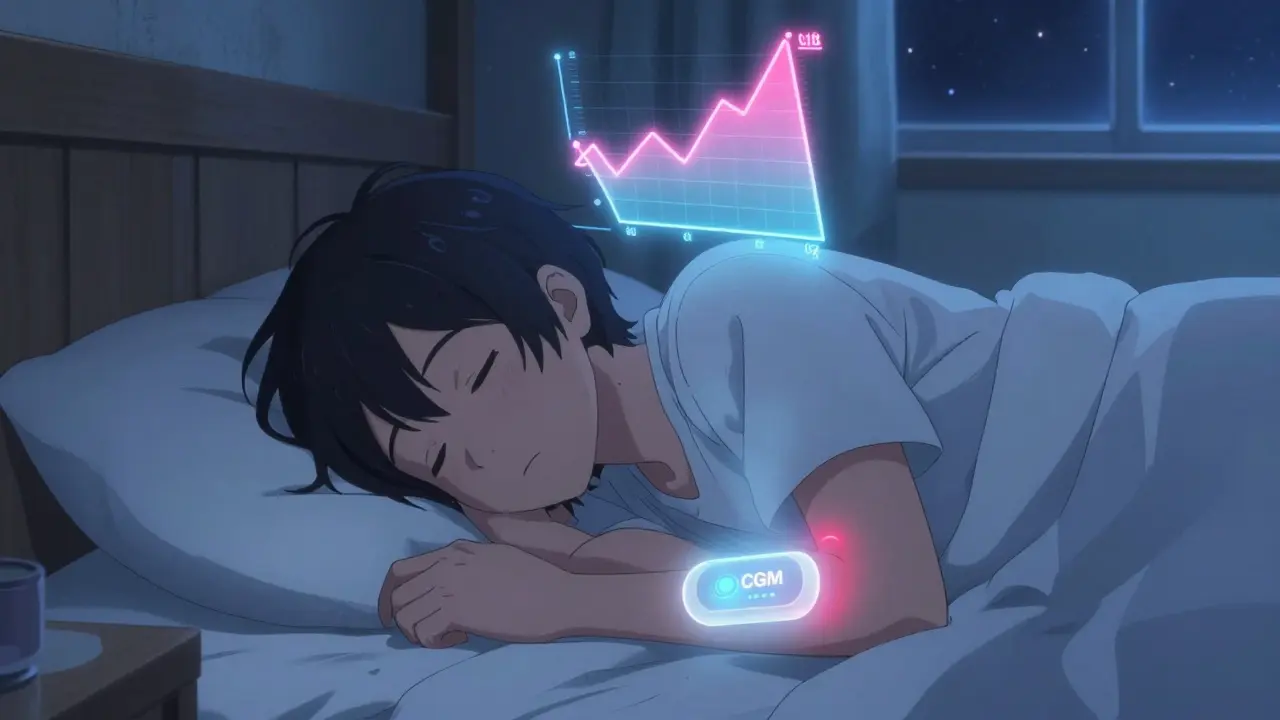
How CGMs Changed Everything for People with Diabetes
Before continuous glucose monitors (CGMs), checking blood sugar meant poking your finger several times a day-morning, before meals, at bedtime. You got a number, but you had no idea what was happening between those checks. Was your sugar dropping while you slept? Spiking after a walk? Rising slowly after lunch? You were flying blind. Then CGMs came along and turned the dark into daylight.
Today’s CGMs, like the Abbott FreeStyle Libre 3, Dexcom G7, and Medtronic Guardian 4, send glucose readings every five minutes, day and night. They don’t just show you your current number-they show you the trend. Are you going up? Down? Stable? You can see it on your phone or watch in real time. And it’s not just a convenience. A 2025 study from the University of Miami found that people using CGMs had fewer hospital visits for heart problems. Abbott’s Libre tech was the first CGM ever linked to lower rates of heart complications in people with diabetes.
The American Diabetes Association now says CGMs aren’t optional-they’re essential. They’re recommended for everyone with Type 1 diabetes, anyone with Type 2 on insulin, pregnant people, older adults at risk of low blood sugar, and even children from the moment they’re diagnosed. That’s a huge shift from just five years ago.
Accuracy matters. The best CGMs today have a MARD score of around 8%, meaning their readings are within 8% of a lab test on average. The Glucotrack implantable sensor, still in trials, is hitting 7.7%. That’s as good as or better than what you’d get from a fingerstick. And unlike older systems, Glucotrack measures glucose directly from blood, not interstitial fluid. That means no more 5- to 15-minute delays. If your sugar crashes while you’re driving, you’ll know it before it happens.
Smart Pens: The Quiet Partner in Your Diabetes Routine
CGMs tell you what’s happening with your blood sugar. Smart pens tell you what you did about it. The InPen by Medtronic is one of the few smart insulin pens on the market. It doesn’t just record your dose-it remembers when you took it, how much you gave, and even suggests the right amount based on your CGM data. It’s like having a personal diabetes assistant in your pocket.
But here’s the catch: only 15% of insulin users use them. Why? Cost. Complexity. Lack of awareness. Most people still use regular pens and jot down doses in a notebook-or forget them entirely. The InPen connects to apps, syncs with CGMs, and can even remind you if you’re due for a dose. But if your CGM doesn’t talk to your pen, the whole system falls apart.
And that’s the problem with many smart devices: they don’t play well together. Only 43% of diabetes apps can connect with all major CGMs. If you’re using a Dexcom G7 and an InPen, you might need two separate apps. That’s not integration-that’s frustration.
Still, for people who take multiple insulin doses a day, smart pens reduce errors. One study showed users made 30% fewer dosing mistakes after switching. For older adults or anyone with memory issues, that’s life-changing. And when paired with CGM data, smart pens can predict when you’re likely to go low or high, and suggest adjustments before you even feel it.

Apps That Actually Work (and the Ones That Don’t)
There are hundreds of diabetes apps. Most of them are useless. Some just let you log meals. Others show graphs you don’t understand. A few? They actually help.
mySugr and One Drop are two that stand out. They pull data from your CGM, track carbs, log insulin, and even let you add notes-like "felt shaky after coffee" or "walked 3 miles." Over time, they spot patterns you’d never see on your own. One user in Bristol noticed his sugar spiked every time he ate pasta on Friday nights. He started swapping it for lentils. His A1c dropped half a point in three months.
But here’s the truth: most apps don’t work with every device. If you have a Libre 3 and try to use an app that only supports Dexcom, you’re out of luck. The 2025 Diabetes Technology Conference found only 43% of third-party apps can connect to all major CGMs. That’s a huge barrier. You shouldn’t have to choose between a good CGM and a good app.
Some apps now use AI to predict your glucose levels. EarlySense and Dexcom are launching a tool in mid-2026 that predicts highs and lows up to 30 minutes in advance-with 89% accuracy. That’s not science fiction. That’s coming next year. Imagine getting a warning before your sugar crashes while you’re sleeping. Or before it spikes after a meal you didn’t expect.
Who Benefits Most? Real Stories from Real People
It’s easy to talk about numbers. But what does this tech actually do for someone’s life?
On Reddit’s r/diabetes community, 78% of users said they sleep better because their CGM wakes them up if their sugar drops at night. Before, they’d wake up exhausted, confused, and scared. Now, they get an alert, grab a juice box, and go back to sleep. No more panic.
One woman in her 70s in Bristol started using a CGM after two scary hypoglycemic episodes. Her doctor told her she was at risk of falling or having a seizure. Within six weeks, she went from spending 7 hours a day in range to over 12. She stopped worrying about driving. She started walking her dog again.
And it’s not just individuals. A remote CGM program in rural areas helped lower A1c from 10.4% to 7.5% in three months. Foot wounds healed faster-72% closed in four months, compared to just 47% without CGMs. For people without easy access to clinics, this tech is a lifeline.
But it’s not perfect. Forty-five percent of users say their sensors fall off during summer heat or workouts. Thirty-seven percent of insured people still get denied coverage by insurers. And 68% of new users feel overwhelmed by alerts at first. Too many beeps. Too many alarms. That’s why the ADA now says: customize your alerts. If you work nights, your low-sugar alert should be different than someone who works 9 to 5.

The Hidden Costs and Barriers to Access
Let’s be real: this tech is expensive. A single CGM sensor can cost $150 to $300. If you need one every 10 to 14 days, that’s $300 to $900 a month. Uninsured? You’re paying full price. Even with insurance, 37% of people report prior authorization denials. Some insurers make you prove you’ve tried fingersticks for six months before approving a CGM. That’s outdated. The science says CGMs are better from day one.
Medicare coverage has improved-usage jumped from 2.1% in 2019 to 28.7% in 2024. But Medicaid and private plans lag behind. A 2025 JAMA study found 41% of low-income patients still can’t get access. That’s not just unfair. It’s dangerous.
And then there’s data security. A 2025 study found 63% of CGM systems had vulnerabilities that could let someone hack your glucose readings. Imagine someone manipulating your data to make you think your sugar is low-so you take insulin you don’t need. That’s not paranoia. That’s a real risk.
Even with all the advances, the biggest challenge isn’t technology. It’s equity. Who gets to benefit? Who’s left behind? If we don’t fix access, we’ll have a two-tiered system: those who can afford to thrive, and those who just survive.
What’s Next? Implants, AI, and the Future of Diabetes Care
The next big leap isn’t in your pocket-it’s under your skin. Glucotrack’s implantable sensor is about the size of three nickels. It’s inserted by a doctor, lasts up to three years, and measures glucose directly from blood. No more tape. No more sensor changes. No lag time. The company aims for a U.S. launch in 2028. If it works, it could prevent 12,000 to 15,000 severe low-blood-sugar events every year in the U.S. alone.
And it’s not just sensors. Vaxess Technologies is testing a needle-free patch for semaglutide (Ozempic), a popular weight-loss and diabetes drug. Right now, people have to inject it weekly. A patch could make adherence easier-especially for those afraid of needles.
AI is getting smarter, too. Machine learning models now predict glucose trends with 89% accuracy. In 2026, you’ll get alerts not just for what’s happening now-but what’s coming next. Your phone might say: "Your sugar will drop in 20 minutes. Eat 15g of carbs."
By 2028, 85% of people on insulin will use CGMs. That’s the projection. But it won’t happen unless we fix the cost, the access, and the training. Right now, only 31% of people who buy over-the-counter CGMs get proper education. That’s a recipe for misuse.
The future isn’t just about better gadgets. It’s about smarter systems-ones that connect your CGM, your insulin, your app, your doctor, and your life. The tech is ready. Now we just need to make sure everyone can use it.
Author

Solomon Ahonsi
February 2, 2026 AT 12:45George Firican
February 3, 2026 AT 15:24Matt W
February 4, 2026 AT 04:13Anthony Massirman
February 5, 2026 AT 09:23Murarikar Satishwar
February 6, 2026 AT 21:26larry keenan
February 8, 2026 AT 09:44Chinmoy Kumar
February 10, 2026 AT 03:58Sandeep Kumar
February 11, 2026 AT 08:01Gary Mitts
February 11, 2026 AT 12:34clarissa sulio
February 12, 2026 AT 18:41Bridget Molokomme
February 13, 2026 AT 06:43Brittany Marioni
February 14, 2026 AT 01:06