

Stopping your medication because of side effects is one of the most common mistakes people make-especially when they feel worse before they feel better. But here’s the truth: medication side effects don’t always mean the drug isn’t working. In fact, many are temporary, manageable, or even a sign your body is adjusting. You don’t have to quit. You just need to know how to talk about them the right way.
Why People Stop Taking Their Meds (And Why It’s Risky)
Half of all patients stop taking their prescribed meds within the first year. Side effects are the #1 reason. But what most don’t realize is that stopping suddenly can be more dangerous than the side effects themselves. High blood pressure meds? Stopping them can spike your risk of stroke. Antidepressants? Abruptly quitting can trigger withdrawal symptoms worse than the original depression. Antibiotics? Stopping early breeds resistant bacteria.
The American Medical Association says poor adherence costs the U.S. healthcare system over $200 billion a year. That’s not just money-it’s hospital stays, emergency visits, and lives lost to preventable complications. The good news? Most side effects can be handled without quitting your treatment. You just need a plan.
Track Your Side Effects Like a Pro
Most people say, “I feel sick,” and leave it at that. That’s not enough. Doctors need details. Start a simple log-paper or phone app. Write down:
- What symptom you felt (dizziness? nausea? fatigue?)
- When it happened (within 30 minutes of taking the pill? at night?)
- How bad it was on a scale of 1 to 10
- What you were doing when it happened (eating? walking? sleeping?)
- How long it lasted
Research from the Journal of the American Medical Informatics Association shows patients who tracked side effects this way cut their chances of quitting meds by 23%. One Reddit user, u/MedPatient92, said: “I showed my doctor my spreadsheet with timestamps and severity ratings. She didn’t take me off the med-she just changed the time I took it.”
Use the SWIM Framework to Talk to Your Doctor
Don’t go in with vague complaints. Use SWIM to structure your conversation:
- Severity: “The nausea is a 7 out of 10.”
- When: “It hits 45 minutes after I take it, right after breakfast.”
- Intensity: “I’ve missed two workdays this week because I couldn’t get out of bed.”
- Management: “I tried taking it with food, but it didn’t help. What else can I try?”
This isn’t just helpful-it’s what doctors want to hear. It turns a vague complaint into a solvable problem. A 2021 UCSF study found that patients who used this method were 40% more likely to keep their meds than those who just said, “I don’t feel good.”
Many Side Effects Fade-Don’t Panic Too Soon
Feeling dizzy after starting a new blood pressure pill? Nausea after beginning an antidepressant? Fatigue after starting a statin? These are common. And often, they fade.
According to the British Heart Foundation, 68% of typical side effects disappear within 7 to 14 days as your body adjusts. That doesn’t mean you should suffer through it blindly-but it does mean you shouldn’t quit after three days. Give it time. Track it. Talk to your doctor after a week or two. They might say: “Keep going. We’ll check in next week.”
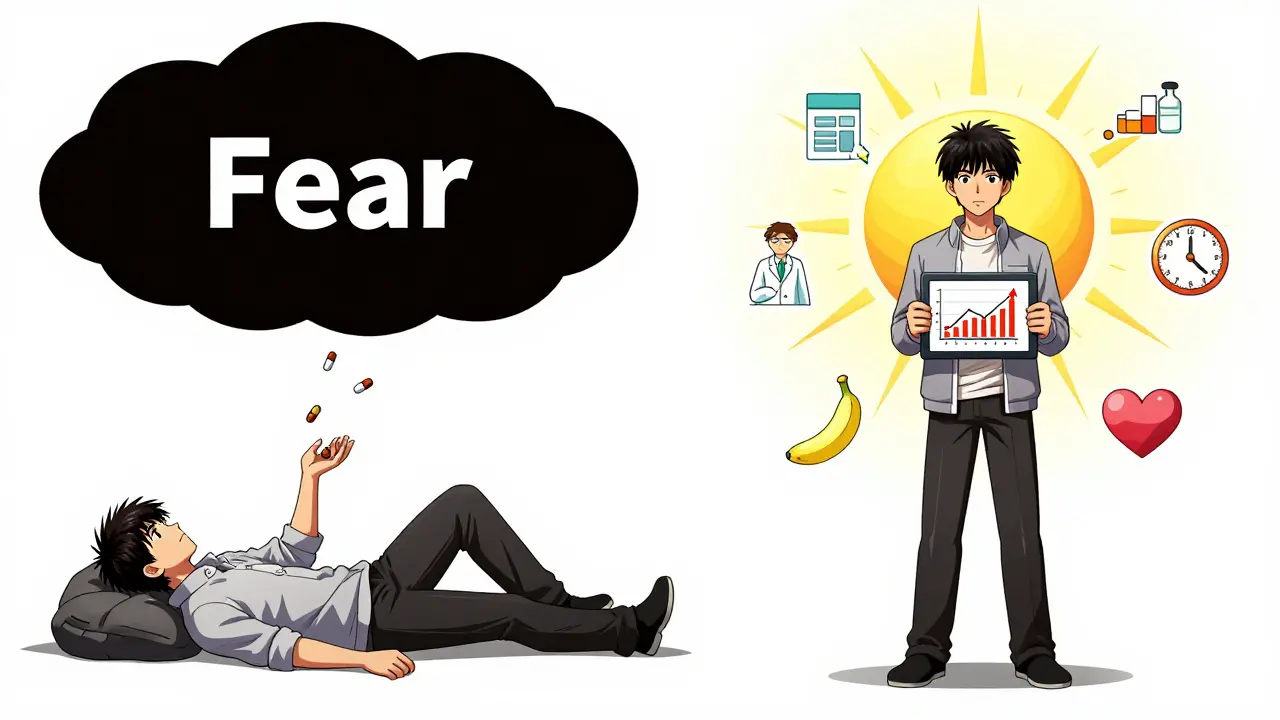
There’s even a psychological trick that works: some doctors now tell patients, “This feeling? It’s your body responding to the medicine. It means it’s working.” A 2021 study in PMC showed this simple reframing reduced anxiety about side effects by 37% and cut discontinuation rates by nearly 30%.

Ask About Adjustments-There’s Almost Always a Way
Your doctor isn’t trying to force you to suffer. They want you to stay on the medication because it’s helping. So ask:
- “Can I take this at night instead of in the morning?” (Many people find side effects like dizziness or nausea lessen if they take meds before bed.)
- “Is there a lower dose I can try?”
- “Could I add something to help with the side effect?” (Like an anti-nausea pill for chemo or acid reflux meds with certain antibiotics.)
- “Is there another drug in the same class that might be easier on me?”
A 2022 study from HealthUnlocked found patients who asked about timing changes were 4.2 times more likely to stick with their meds. One patient on a blood pressure med had terrible nausea until her pharmacist suggested taking it with a small banana. Nausea dropped from 5-6 times a day to just 1-2.
Know Your Deal-Breakers
Not all side effects are temporary. Some are serious-and you should stop immediately. These include:
- Rash, swelling, or trouble breathing (signs of an allergic reaction)
- Severe dizziness or fainting
- Unusual bleeding or bruising
- Thoughts of self-harm or sudden mood swings
- Yellowing skin or eyes (liver issues)
If you have any of these, call your doctor or go to urgent care. But if it’s just fatigue, dry mouth, or mild stomach upset? That’s not a deal-breaker. That’s something you can work on.
Don’t Rely on Google Alone
Searching “side effects of lisinopril” will give you a list of 50 scary symptoms. But most of them affect less than 1% of people. The FDA requires every prescription to come with a Medication Guide-read it. It’s written in plain language and tells you what’s common vs. rare.
Also, ask your pharmacist. They see hundreds of patients every week. They know what’s normal and what’s not. One patient in Bristol told me she asked her pharmacist why she felt so tired on her new cholesterol pill. The pharmacist said, “That’s common with simvastatin. Try taking it at night. Most people feel better.” She did. And she’s been on it for two years.
Technology Can Help-Use It
There are now FDA-approved apps that help you track side effects, set reminders, and even send summaries to your doctor. Apps like Medisafe, MyTherapy, and Dosecast have been shown to boost adherence by 18% in a 2023 JAMA study. You don’t need to be tech-savvy. Most are simple: tap when you take your pill, tap when you feel side effects. Done.
And if your clinic uses electronic records, ask if they offer a patient portal where you can message your provider directly. Many now let you send side effect logs right from your phone.
What to Do If Your Doctor Dismisses You
Some providers still treat side effects like inconveniences. If you feel ignored, don’t give up. Say: “I’m not asking to stop the med-I’m asking how we can make it work for me.” If that doesn’t work, ask for a referral to a pharmacist or a medication therapy management program. Many hospitals, including Kaiser Permanente and NHS clinics in the UK, now offer free sessions with pharmacists who specialize in side effect management.
And remember: you’re not being difficult. You’re being smart. The goal isn’t to take meds blindly-it’s to take them safely and successfully.
Final Thought: You’re Not Alone
Millions of people are managing side effects right now without quitting their meds. They’re tracking, asking questions, adjusting timing, and working with their care teams. You can too. Medication isn’t a one-size-fits-all fix. It’s a partnership. And you have every right to be part of that conversation.
Should I stop my medication if I have side effects?
Only stop if you’re having a serious reaction like trouble breathing, swelling, chest pain, or thoughts of self-harm. For most common side effects-like nausea, dizziness, or fatigue-don’t quit. Track them, talk to your doctor, and ask for adjustments. Many side effects fade within 1-2 weeks.
How long should I wait before talking to my doctor about side effects?
Wait 7 to 14 days if the side effect is mild and common (like fatigue or dry mouth). If it’s severe, sudden, or worsening after 2-3 days, contact your provider right away. Keep a log during that time-it helps your doctor spot patterns.
Can I change the time I take my medication to reduce side effects?
Yes, often. Many side effects, like dizziness or nausea, are worse when you’re upright or on an empty stomach. Taking meds at bedtime, with food, or after a snack can help. Always check with your doctor or pharmacist first-some meds must be taken on an empty stomach or at specific times.
Is it safe to lower my dose on my own to avoid side effects?
No. Never change your dose without your doctor’s approval. Too little of a medication can make it ineffective. For example, lowering your blood pressure med too much can increase stroke risk. Lowering an antibiotic dose can lead to resistant infections. Always ask for alternatives, don’t self-adjust.
What if my doctor says there’s nothing I can do about the side effects?
Ask for a second opinion or a referral to a medication therapy management (MTM) service. Many clinics now have pharmacists who specialize in side effect management. You can also ask: “Is there another drug in the same class that might work better for me?” There’s often more than one option.
Do side effects mean the medication isn’t working?
Not necessarily. For some drugs-like antidepressants, statins, or blood pressure meds-mild side effects like fatigue or stomach upset are common and don’t mean the drug isn’t working. In fact, some research shows telling patients “this feeling means the medicine is active” reduces anxiety and improves adherence. The goal is to separate side effects from effectiveness.
Can apps really help me stick to my meds?
Yes. Studies show patients using FDA-approved medication apps like Medisafe or MyTherapy have 18% higher adherence rates. These apps remind you when to take pills, let you log side effects, and even let you share reports with your doctor. They’re free or low-cost and work on any smartphone.
Why do some people stop their meds even when side effects are mild?
Fear and misinformation. Many people assume any discomfort means the drug is harmful. Others think they’ll feel better without it. A Mayo Clinic study found 61% of patients who quit meds without talking to their doctor believed their doctor wouldn’t listen. That’s why clear communication and tracking matter-it builds trust and shows you’re taking control, not giving up.
Author

Alex Smith
January 10, 2026 AT 23:28So let me get this straight-you’re telling me I should keep taking a pill that makes me feel like a zombie, just because some study says side effects ‘fade’? Cool. I’ll just sip my coffee and wait for my soul to return. Meanwhile, my cat’s judging me harder than my doctor ever did.
Alfred Schmidt
January 12, 2026 AT 00:27STOP. RIGHT. NOW. You’re telling people to ‘wait two weeks’ when they’re vomiting and dizzy? That’s not ‘adjusting’-that’s medical negligence! My cousin died because some ‘study’ said it was ‘common’! You’re not helping-you’re enabling!
Sean Feng
January 13, 2026 AT 21:55Track side effects? Really? Just call your doctor. They know. End of story.
Priscilla Kraft
January 14, 2026 AT 05:14Thank you for this!! 🙏 I was terrified to speak up about my nausea on SSRIs, but after tracking it for 10 days and using SWIM, my doctor switched me to a lower dose + took me off morning pills. I’m now 6 months in and actually sleeping. You’re not alone. 💙
Vincent Clarizio
January 14, 2026 AT 18:46Let’s be real here-modern medicine has become a corporate algorithm disguised as healthcare. We’re not patients-we’re data points in a spreadsheet. The SWIM framework? It’s just another corporate buzzword designed to make you feel like you’re in control while the real power remains with the pharmaceutical-industrial complex. You track your nausea, you log your fatigue, you submit your ‘dose report’-and still, the pill doesn’t change. The system doesn’t change. The money doesn’t change. We’re just performing compliance to keep the machine running. And yet… here we are. Still taking the pills. Still hoping. Still believing. That’s not adherence. That’s tragic resilience.
Sam Davies
January 14, 2026 AT 23:04‘Track your side effects’-brilliant. Next you’ll tell us to journal our existential dread while sipping chamomile tea. I mean, really. Did we forget that people have jobs? Kids? Lives? Not everyone has time to become a medical data entry clerk just to keep their BP meds. The real problem? Doctors don’t listen. Not because we’re bad communicators-because they’re overworked and underpaid. Fix that. Not our logging habits.
Christian Basel
January 15, 2026 AT 15:10Adherence metrics are statistically significant but clinically misaligned. The SWIM framework, while syntactically elegant, fails to account for pharmacokinetic variability across polymorphic CYP450 phenotypes. Also, ‘taking it with a banana’ is anecdotal confounding bias. You’re conflating behavioral compliance with therapeutic efficacy. And apps? They’re digital placebo wrappers with zero regulatory oversight beyond FDA 510(k) clearance. You’re not solving adherence-you’re gamifying compliance.
Adewumi Gbotemi
January 17, 2026 AT 08:10My brother in Nigeria took his blood pressure pills every day even when he felt weak. He wrote it on his wall. His doctor changed the time. Now he’s fine. Simple. No apps. Just care.
Michael Patterson
January 18, 2026 AT 10:44Okay so you’re telling me to trust a doctor who prescribed me 3 different meds that all made me feel like i was being slowly poisoned?? no thanks. i tried tracking and talking and they just said ‘it’s normal’ and gave me more pills. i’m done. i’d rather be sick than drugged.
Matthew Miller
January 19, 2026 AT 01:00Look. You’re not special. Your nausea isn’t a tragedy. Your fatigue isn’t a war crime. Everyone on meds feels this. If you can’t handle a little discomfort, maybe you shouldn’t be on meds in the first place. This article is pandering to weak people. Get tough. Take the pill. Shut up. Live.
Madhav Malhotra
January 20, 2026 AT 16:01Love this! In India, we say ‘dard hai toh dawa kaam kar rahi hai’-if you hurt, the medicine is working. But we also know when to stop. My aunt took her cholesterol pill with milk at night and never had side effects again. Small change. Big difference. ❤️
Priya Patel
January 22, 2026 AT 00:11I was ready to quit my antidepressant after 4 days of feeling like a wet sock. Then I started the log. Wrote down: ‘Day 5: still tired, but I laughed at a dog video.’ That was my turning point. I kept going. And now? I’m back to hiking, cooking, and yelling at Netflix like my old self. This post saved me. Thank you.