
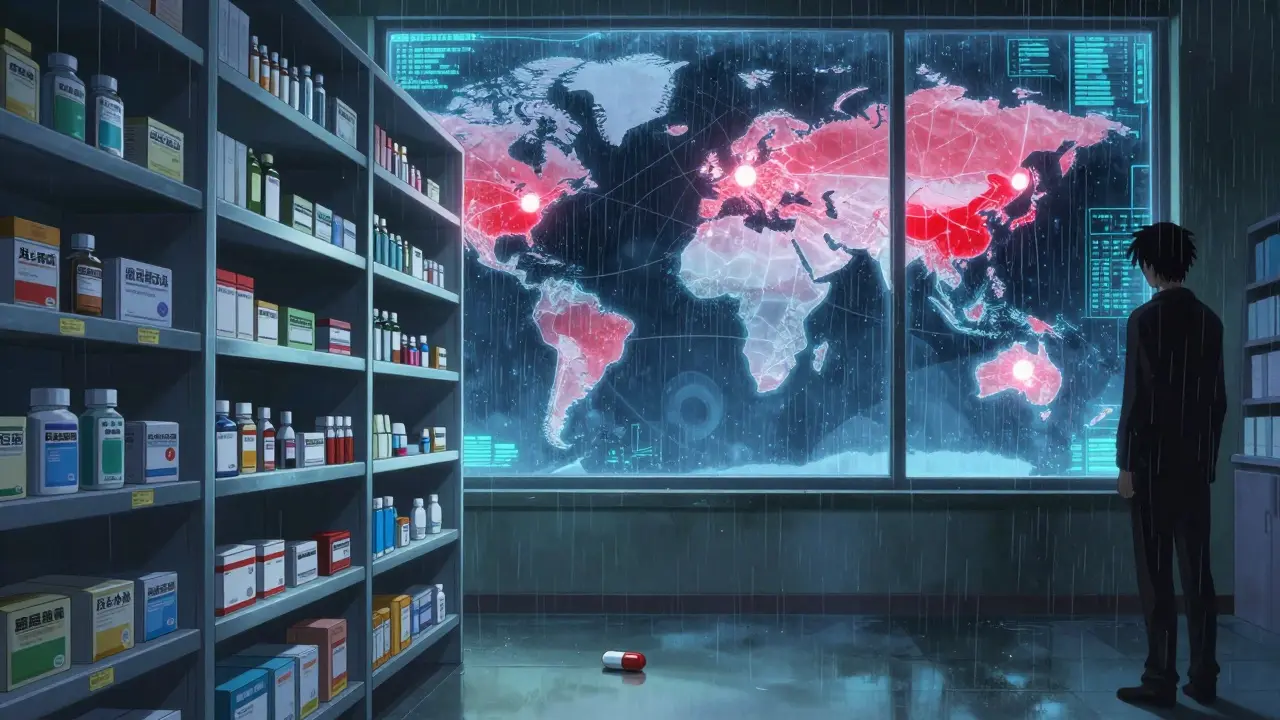
When you pick up a generic pill at your pharmacy, you probably don’t think about the journey it took to get there. But behind that small tablet is a complex, high-stakes supply chain where efficiency isn’t just about saving money-it’s about keeping people alive. In the generic drug market, companies operate on razor-thin margins. The average EBITA margin is just 8%, down from 12.5% in 2018. That means every dollar saved in logistics, every hour cut from delivery time, every stockout avoided, directly affects whether a drug stays on shelves-or disappears.
The Affordability Paradox
Generic drugs are meant to be cheap. That’s the whole point. But here’s the catch: the lower the price, the more fragile the supply chain becomes. When manufacturers compete to offer the lowest price, they cut corners. They reduce safety stock. They rely on single suppliers. They eliminate backup production lines. And when something goes wrong-a factory shutdown, a shipping delay, a regulatory inspection-they have no buffer.According to Drug Patent Watch’s 2023 analysis, generic drugs priced below $0.10 per unit face a 73% higher risk of shortage than those priced above $0.50. Why? Because low-margin products don’t justify the cost of redundancy. Meanwhile, 80% of the world’s active pharmaceutical ingredients (APIs) come from just three countries: China, India, and Italy. One earthquake. One trade dispute. One pandemic. And entire drug categories vanish from pharmacies.
What Efficiency Actually Looks Like
Efficiency in generic distribution isn’t about working faster. It’s about working smarter. Top performers don’t just move more pills-they move the right pills, at the right time, with zero waste.Take Teva Pharmaceutical. In 2022, after a $28 million overhaul, they slashed inventory carrying costs by 32%. How? They replaced guesswork with data. Instead of ordering based on last year’s sales, they used predictive analytics to forecast demand down to the week. They integrated IoT sensors into shipping containers to monitor temperature in real time (critical for 45% of generics that need climate control). And they connected their ERP system to suppliers, so when a warehouse hit 15% stock, an order auto-generated.
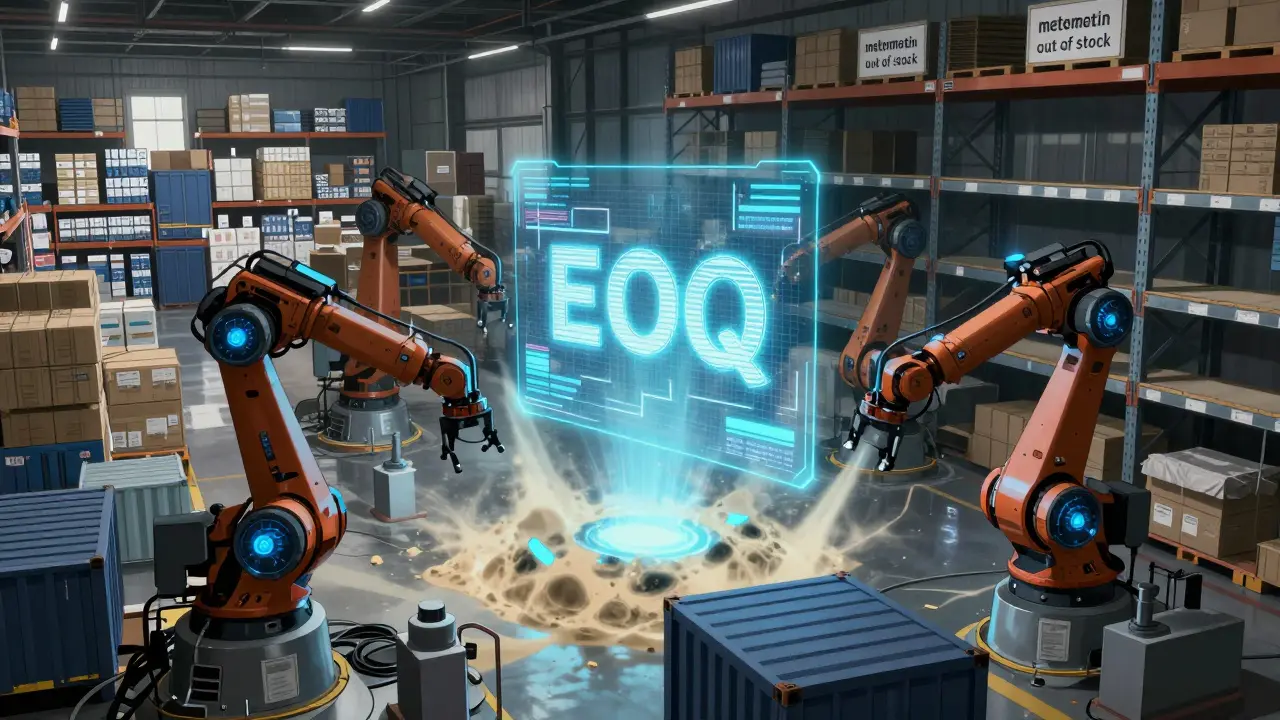
The math behind it is simple. The Economic Order Quantity (EOQ) formula-Q = √(2KD/G)-helps balance ordering costs against storage costs. Leading distributors using this model cut stockouts by 30-45%. That’s not theory. It’s real. Cardinal Health saw inventory turnover rise from 8.3x to 12.7x annually after adopting similar techniques.
Technology That Makes the Difference
You can’t optimize what you can’t see. That’s why cloud-based ERP systems are no longer optional-they’re survival tools.Imagine this: A hospital in Ohio runs out of metformin. Instead of waiting days for a manual reorder, their system flags the drop in real time. The distributor’s AI model cross-references that data with regional flu trends, Medicare prescription changes, and even social media mentions of diabetes symptoms. Within hours, it reroutes inventory from a warehouse in Georgia that has surplus stock. That’s what Oracle SCM Cloud and SAP IBP enable.
But technology alone isn’t enough. IoT sensors track humidity and temperature during transit. AI forecasting reduces prediction errors by 25-40%. Blockchain systems verify authenticity-though they cost $2.5-4 million to implement, which puts them out of reach for smaller distributors. The result? Top performers hit 98.5% service levels and 85%+ Overall Equipment Effectiveness (OEE) scores. The industry average? 68-72%.
Two Models, One Reality
There are two ways to run a generic drug supply chain: efficient or responsive.The Efficient Chain Model is the industry standard. It focuses on high-volume, low-variety products. Standardized processes. Fewer SKUs. Bulk shipments. It’s why Nestlé’s pharmaceutical division turns inventory 12.7 times a year-nearly 50% faster than the industry average. But it’s brittle. If demand spikes suddenly, like during a flu outbreak, it breaks.
The Responsive Chain Model is the opposite. It’s built for unpredictability. It holds extra stock. It uses multiple suppliers. It’s more expensive. But in generic distribution, that’s exactly what you can’t afford-unless you’re dealing with critical medications like insulin or epinephrine.
Here’s the trade-off: Just-in-time (JIT) inventory cuts storage costs by 22-35%. But it raises stockout risk by 15-20%. Just-in-case (JIC) keeps buffers that increase holding costs by 18-28% but cuts stockouts by 40-60%. The smartest distributors don’t pick one. They use JIT for common drugs and JIC for life-saving ones.
The Human Factor
Technology helps. But people break systems.One manager at McKesson posted on Reddit about how their procurement process required seven approvals to change a supplier quote. That delay led to 22% more expensive expedited shipments. Another user on LinkedIn said their team had to manually update inventory across five different spreadsheets. No automation. No real-time data. Just guesswork.
And then there’s the compliance burden. The FDA’s Drug Supply Chain Security Act (DSCSA) requires full electronic traceability. The EU’s Falsified Medicines Directive adds similar rules. Together, they’ve added 5-8% to operational costs. Many small distributors can’t afford the software. So they fall behind. And the gap only widens.

Who’s Winning and Who’s Falling Behind
The market is splitting into two tiers.The top 25% of distributors-those using AI forecasting, real-time tracking, and integrated networks-earned 9.2% EBITA margins in 2023. The bottom 25%? Just 6.8%. That 2.4-point gap isn’t just about profits. It’s about survival.
McKesson, Cardinal Health, and AmerisourceBergen control 85% of U.S. generic distribution. And they’re investing heavily. Cardinal Health gained 3.2% market share in 2022 after spending $150 million on predictive analytics. McKesson launched DemandSignal in Q2 2023 and cut forecast errors by 37% in trials. Meanwhile, smaller players struggle to upgrade legacy systems. Integration delays last 6-9 months. Consultants charge $200+ an hour. Many just don’t have the cash.
By 2025, distributors with OEE scores below 85% and perfect order rates under 95% risk losing 15-20% of their market share. The MIT Center for Transportation and Logistics predicts that by 2027, the leaders will run digital twins of their entire supply chains-simulating every possible disruption before it happens.
What You Can’t Ignore
There’s one warning that keeps coming up: don’t eliminate all safety stock.A January 2023 Supply Chain Dive article found that 68% of distributors who removed all buffer inventory suffered severe shortages. Even the most efficient systems can’t predict every disruption. A storm in Mumbai. A labor strike in China. A regulatory hold in the U.S. You need a cushion. Experts recommend at least a 15% buffer for critical generics-insulin, antibiotics, heart medications.
And don’t fall for the myth that cheaper is always better. The cheapest supplier might be the one with no backup capacity. The fastest route might be the one that skips temperature controls. Efficiency isn’t about cutting costs. It’s about reducing risk while keeping prices low.
Where the Industry Is Headed
The future belongs to those who treat supply chains like living systems-not pipelines.By 2026, we’ll see:
- AI models that predict demand shifts based on weather, social trends, and insurance claims-not just past sales
- Micro-distribution hubs near hospitals, cutting delivery time from days to hours
- Regulators rewarding manufacturers with faster approvals if their supply chains are resilient
- Blockchain becoming standard for traceability, not just compliance
The companies that survive won’t be the ones with the lowest prices. They’ll be the ones who know exactly where every pill is, when it will arrive, and what to do when something goes wrong. Because in generic drug distribution, efficiency isn’t a cost center. It’s the only thing standing between patients and no treatment at all.
Author

Chelsea Deflyss
February 9, 2026 AT 02:22Also, typo in 'EBITA' - should be EBITDA. Just sayin'.
Brandon Osborne
February 9, 2026 AT 15:22Also, I'm calling the FDA right now to report this. Someone needs to go to jail.
Marie Fontaine
February 9, 2026 AT 22:59Did you know IoT sensors can track temp in real time?? That's like magic!! And AI predicting demand based on flu trends?? That's next level!! We need more of this!!
Also, I'm starting a petition to get every pharmacy to install blockchain scanners. Let's go!! 💪
Lyle Whyatt
February 10, 2026 AT 20:21Tatiana Barbosa
February 11, 2026 AT 05:01Ken Cooper
February 12, 2026 AT 20:15MANI V
February 14, 2026 AT 04:15Tasha Lake
February 14, 2026 AT 08:35Tom Forwood
February 14, 2026 AT 14:35