
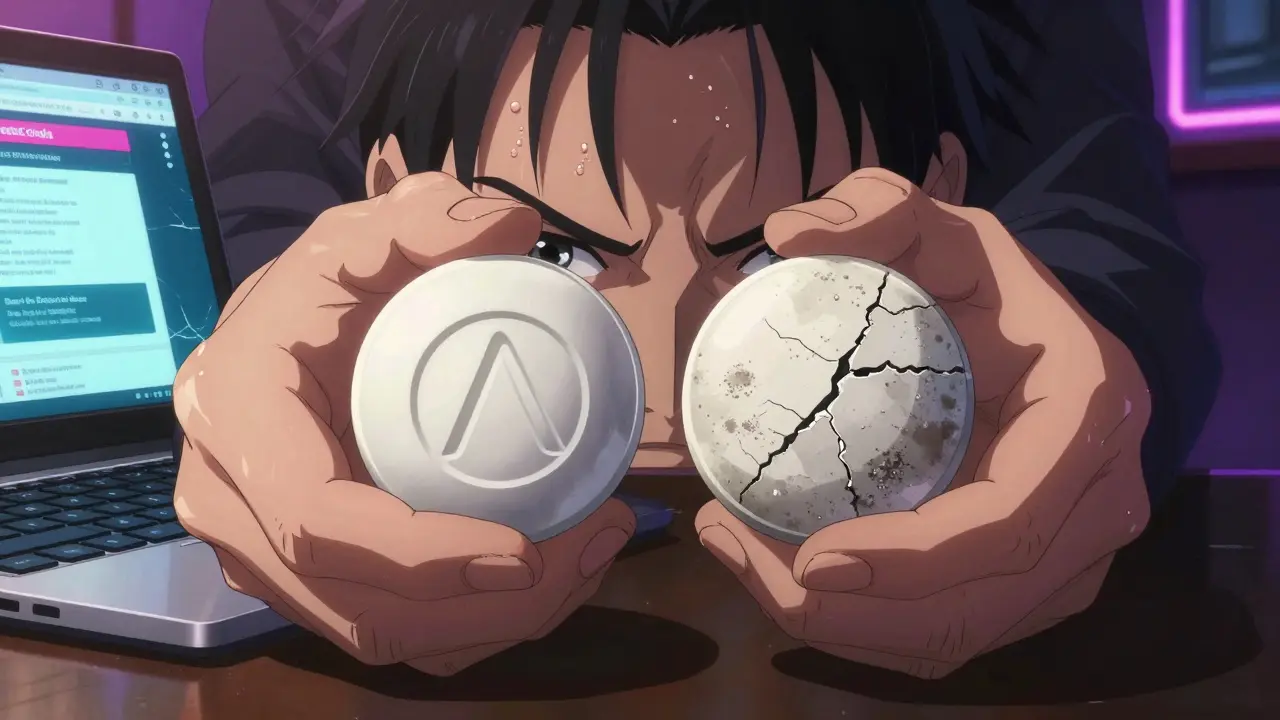
Every year, counterfeit medications kill an estimated one million people worldwide. These aren’t just bad batches or expired pills - they’re deliberate fakes, made in secret labs with no rules, no oversight, and no regard for human life. You might think it’s something that happens far away, in developing countries. But in 2026, fake pills are flooding into homes across the UK, the US, and Europe - often sold as legitimate prescriptions, disguised as your regular meds, and bought from websites that look perfectly normal.
What Exactly Are Counterfeit Medications?
Counterfeit drugs are not the same as expired or poorly stored medicine. They’re intentionally forged. Someone copies the look of a real pill - the color, shape, logo - but fills it with something completely different. It could be chalk, rat poison, fentanyl, or nothing at all. The packaging? It’s printed to look just like the real thing. Sometimes, even the lot number and expiry date are faked. The World Health Organization breaks it down simply: falsified medicines are fake by design. Substandard ones are real drugs that went bad due to bad storage or poor manufacturing. But counterfeit? That’s fraud. And it’s getting worse. In 2024, the WHO issued a global alert about fake injectable diabetes and weight-loss drugs - including Mounjaro®, Zepbound®, and tirzepatide. These aren’t obscure meds. They’re in high demand. People are paying hundreds of pounds for them online, thinking they’re getting a life-changing treatment. Instead, they’re getting dangerous chemicals.Warning Signs: What to Look For
You don’t need a lab to spot a fake. Here are the red flags you can check yourself:- The pill looks different. If it’s a different color, shape, size, or has a new marking, ask your pharmacist. Even a tiny change matters.
- The packaging is off. Look closely at the label. Is the font slightly off? Are there spelling mistakes? Is the paper thinner? Are the seals cracked or uneven?
- No lot number or expiry date. Legitimate medicine always has these. If it’s missing, walk away.
- The taste or smell changed. If your usual pill suddenly tastes bitter or smells weird, that’s not normal.
- You got it from an online pharmacy. If you didn’t get it from a UK-registered pharmacy, or if the site didn’t ask for a prescription, it’s likely fake.
- The price is too good to be true. A 70% discount on Ozempic®? That’s not a sale - it’s a trap.
- You’re feeling new side effects. If you suddenly feel dizzy, nauseous, or have chest pain after taking a pill you’ve used before, stop. Call your doctor.
Where Are These Fakes Coming From?
You won’t find counterfeit drugs on the shelves of Boots or Lloyds Pharmacy. They’re sold online - through websites that look like legitimate pharmacies. Some even have fake UK addresses and phone numbers. The DEA and UK authorities report that criminal gangs are now using Instagram, WhatsApp, and Telegram to sell fake pills directly. They post pictures of real medication, claim to be “licensed pharmacists,” and ask you to pay in cryptocurrency. No ID. No prescription. Just a package delivered to your door. In 2023, the National Association of Boards of Pharmacy found over 10,000 illegal online pharmacies. Many of them sell fake versions of popular drugs like Xanax, Adderall, and OxyContin - but also newer ones like semaglutide (Ozempic®). These aren’t just risky - they’re deadly. Fake semaglutide has been found with no active ingredient at all. Others contain dangerous amounts of fentanyl.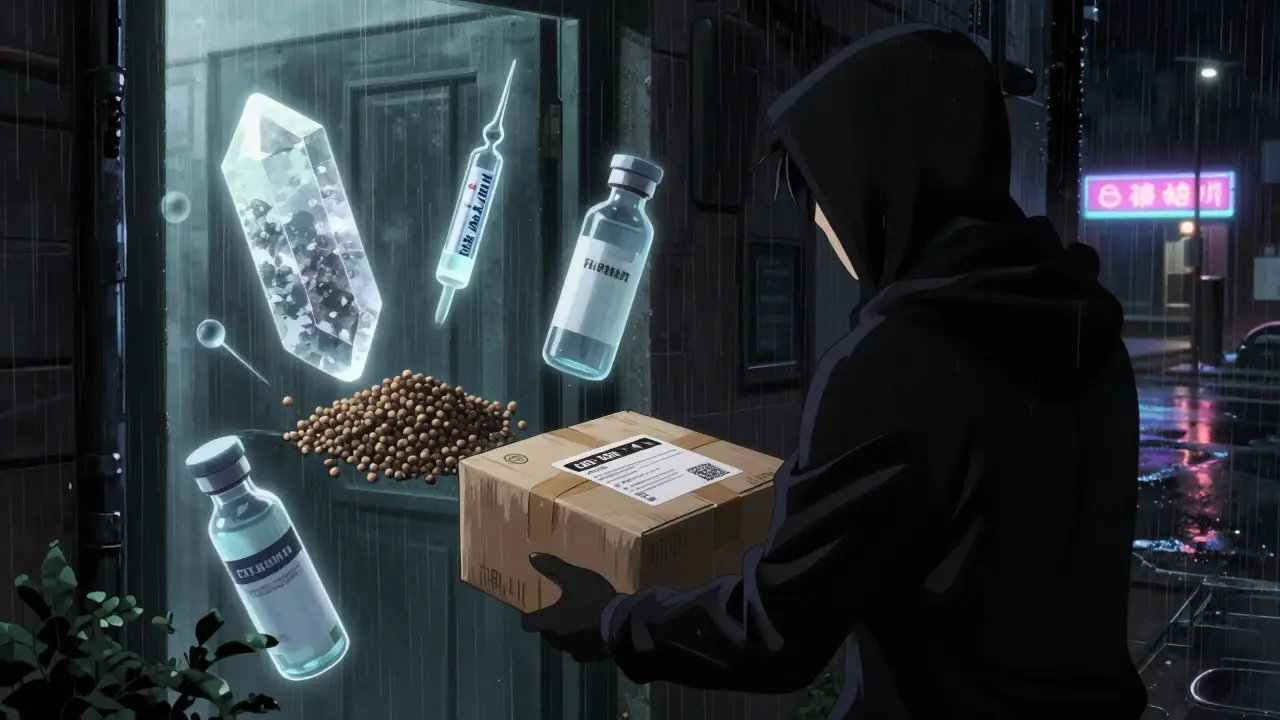
How to Protect Yourself
The best way to avoid counterfeit drugs is simple: stick to trusted sources.- Only use UK-registered pharmacies. Check the General Pharmaceutical Council (GPhC) website to verify your pharmacy is licensed.
- Never buy medicine without a prescription. Even if the site says you don’t need one, it’s illegal - and dangerous.
- Use the VIPPS check. In the UK, look for pharmacies that are part of the Verified Internet Pharmacy Practice Sites program. If it’s not on the list, don’t trust it.
- Ask your pharmacist. If your pill looks different, ask them. Pharmacists are trained to spot fakes. They’ll check the batch, compare it to previous deliveries, and tell you if something’s off.
- Don’t accept pills from friends. Even if they say it’s “just like my prescription,” it could be fake. Never take medication from someone else.
- Call the manufacturer. If you’re suspicious, find the phone number on the official website (not the one on the bottle) and call them. Pfizer, Eli Lilly, and others have hotlines to verify lot numbers. If the lot number doesn’t exist, it’s fake.
What Happens If You Take a Fake Pill?
The consequences aren’t theoretical. People die from counterfeit meds every day. A fake version of Xanax might contain fentanyl - a synthetic opioid 50 times stronger than heroin. One pill can kill. A fake version of insulin might have no active ingredient. That means your blood sugar spikes, leading to coma or death. Fake antibiotics? They might not work at all, letting an infection spread unchecked. In 2023, a 62-year-old man in Bristol died after taking a fake painkiller he bought online. The pill had no oxycodone - just fentanyl. He didn’t know he was taking a lethal dose. These aren’t rare cases. They’re happening more often.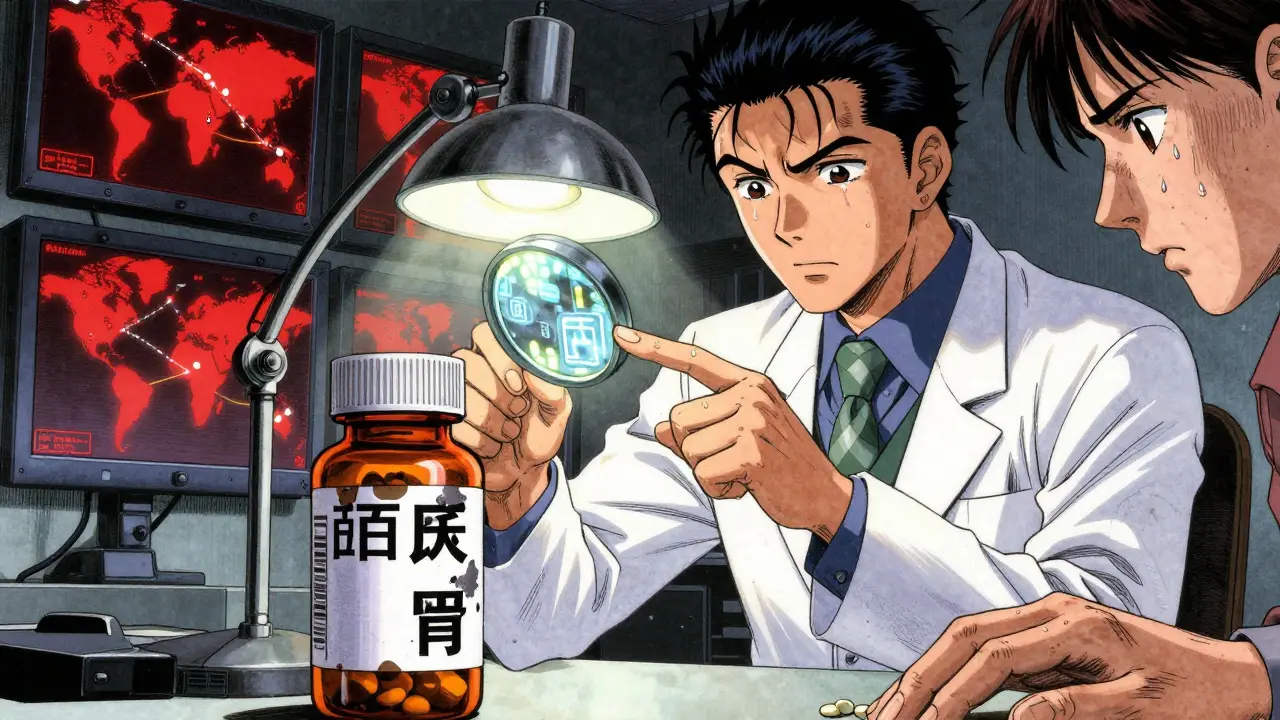
What’s Being Done About It?
The UK and EU have started using digital tracking systems to trace every pill from factory to pharmacy. The Drug Supply Chain Security Act (DSCSA) in the US, and similar systems here, require each package to have a unique code. That lets pharmacies scan and verify drugs before handing them out. Pharmaceutical companies are also adding security features: holograms, special inks, and tamper-evident seals. But counterfeiters are getting better. They copy these too. That’s why your vigilance matters. Technology helps - but you’re the last line of defense.What to Do If You Suspect a Fake
If you think you’ve been sold a counterfeit drug:- Stop taking it.
- Keep the packaging and pill.
- Call your pharmacist or GP.
- Report it to the Medicines and Healthcare products Regulatory Agency (MHRA) via their Yellow Card scheme.
- If you bought it online, report the website to Action Fraud.
Can I tell if a pill is fake just by looking at it?
Sometimes, but not always. Many counterfeit pills are made to look identical to the real thing. Look for changes in color, shape, size, taste, or packaging. If something feels off - even slightly - ask your pharmacist. The only way to be 100% sure is lab testing, but most fakes have clues you can spot before taking them.
Are online pharmacies ever safe?
Only if they’re licensed and verified. In the UK, check if the pharmacy is registered with the General Pharmaceutical Council (GPhC). Look for the VIPPS logo or similar verification programs. If the site doesn’t ask for a prescription, or if you can’t find its physical address and phone number, avoid it. Over 95% of online pharmacies selling without a prescription are illegal.
Why are fake medications so common now?
High demand and easy access. Drugs like Ozempic®, Xanax, and Adderall are expensive and hard to get legally. Criminals see a profit. They use social media to target people, offer big discounts, and ship from overseas. With encrypted messaging and cryptocurrency payments, it’s hard for law enforcement to track them.
Can counterfeit drugs be harmful even if they don’t contain poison?
Absolutely. A fake diabetes pill with no insulin can cause your blood sugar to spike dangerously. A fake antibiotic with no active ingredient won’t treat your infection, letting it spread. Even if it’s not toxic, it can still kill you by failing to do what it’s supposed to.
What should I do if I’ve already taken a suspicious pill?
If you feel unwell, call 999 or go to A&E immediately. Even if you feel fine, contact your GP or pharmacist. Bring the packaging and any remaining pills. They can report it to the MHRA and help you get tested if needed. Don’t wait - fake meds can cause delayed damage.
Is it illegal to buy medicine online without a prescription in the UK?
Yes. It’s illegal to sell prescription-only medicines without a valid prescription. It’s also illegal to import them without proper authorization. Buying from unlicensed websites puts you at risk of getting a fake, dangerous product - and you have no legal protection if something goes wrong.
Next Steps: Stay Safe
Your medication is your health. Don’t gamble with it. Always get prescriptions from your doctor. Fill them at a licensed pharmacy. Check the packaging. Ask questions. If something feels wrong - trust your gut. Counterfeit drugs aren’t going away. But you can protect yourself. Knowledge is your best defense.Author

Ali Hughey
March 15, 2026 AT 11:09Okay but have you seen the new AI-generated counterfeit pills? They’re using deepfake tech to replicate the exact chemical signature of real meds-like, the FDA can’t even tell the difference anymore. I’ve got a friend who took a fake Ozempic and woke up speaking Mandarin. No joke. 🤯
They’re embedding microchips in the coating now. Not to track you-no, to *broadcast* your vitals to the shadow pharma conglomerates. I saw a documentary. It was filmed in a basement in Moldova. The guy who made it vanished. His dog’s still barking at the door. 🐶
And don’t get me started on the QR codes. Scanning one doesn’t verify the pill-it uploads your DNA to a blockchain ledger owned by a shell corporation in the Caymans. I’ve been scanning every pill I take since 2022. My phone’s been on lockdown since. 🔐
Someone’s turning our medicine cabinets into surveillance hubs. The WHO? Complicit. The DEA? In on it. Even the pharmacist at CVS gave me a look last week like he knew. I think he’s part of the network. He smiled. Too wide. 😈
I’m not paranoid. I’m pre-emptively vigilant. And if you’re reading this and haven’t started testing your pills with a spectrometer? You’re already compromised. 🚨
My therapist says I need to “ground myself.” But what if grounding myself means touching a real pill? And what if the real pill is fake too? 😵💫
I’ve started wearing a Faraday cage hat. It’s chic. And it blocks the signals. I’m not buying meds anymore. I’m growing my own. Got a basil plant that’s now my primary care provider. 🌿
They’re coming for your insulin next. Mark my words. They’re already testing it on cats. I saw the footage. It was on a .onion site. I cried. Then I deleted my browser history. Twice.
Aaron Leib
March 16, 2026 AT 13:11Good post. Important info. Stay vigilant. Always verify your pharmacy. If something feels off, trust that feeling. Your health isn’t worth the risk.
Lorna Brown
March 18, 2026 AT 04:54I’ve been thinking about how this ties into broader systemic failures in healthcare access. If people are turning to shady online pharmacies, it’s not because they’re reckless-it’s because the system failed them. Prescription costs are astronomical. Insurance denials are rampant. People aren’t buying fakes because they’re gullible-they’re buying them because they’re desperate.
And yet the narrative always blames the consumer. ‘Don’t buy online!’-as if that’s a solution when you can’t afford the real thing. We need structural change, not just warnings. We need price caps, universal access, and real enforcement against the corporations that price-gouge.
Counterfeit drugs are a symptom. The disease is profit-driven healthcare. We’re treating the rash, not the infection.
I’ve seen people choose between insulin and rent. I’ve seen diabetics ration their doses. And then they turn to a website that promises 70% off. Is that moral failure? Or is it survival?
Yes, fake pills kill. But so does poverty. So does neglect. So does indifference.
Let’s not just warn people. Let’s fix the system that pushes them into this nightmare.
And while we’re at it-why are we still letting pharmaceutical companies patent life-saving drugs? Why can’t we have public manufacturing? Why is this a market problem instead of a human rights issue?
Maybe if we stopped treating medicine like a luxury, we wouldn’t need to warn people about fakes. We’d just have medicine.
Rex Regum
March 18, 2026 AT 10:30Oh wow, so now we’re blaming the victims for wanting to live? You think people are stupid for buying cheap meds? LOL. You’re the reason this system is broken. You sit in your gated community with your 100% verified prescription and lecture people who can’t afford to die slowly.
Meanwhile, the real criminals? The ones who charge $900 for a 30-day supply of semaglutide? The ones who lobby Congress to block generics? THEY’RE THE ONES WHO SHOULD BE IN PRISON.
I’m not buying fake pills. I’m buying justice. And if that means bypassing a corrupt system? Fine. I’ll take my chances.
You want to stop counterfeits? Break the patent monopolies. Lower prices. Then people won’t need to risk it.
But no-you’d rather keep screaming ‘DON’T BUY ONLINE’ like it’s a moral imperative. Pathetic.
Kelsey Vonk
March 18, 2026 AT 14:46This is such an important topic. I’ve been scared to even refill my anxiety meds since I read about the fake Xanax surge. I used to order online because my insurance wouldn’t cover the brand. Now I drive 45 minutes to a pharmacy I trust.
Just wanted to say-thank you for listing the red flags. I’ve been checking my bottles more carefully. Even the font. I didn’t realize how much I’d start noticing.
I’m also starting to ask my pharmacist questions. They’re so helpful. It’s weird how much they know. I feel safer now.
And yeah… I cried reading about the man in Bristol. That could’ve been my dad.
Thank you for sharing this. Really.
Emma Nicolls
March 19, 2026 AT 16:01so i just got my new pills and they looked kinda different but i thought it was just the batch? now im freakin out lol
also why is the bottle so light??
gonna call my dr tomorrow
thanks for the heads up
Richard Harris
March 21, 2026 AT 10:58Good info. I've been buying my meds from my local pharmacy since 2020. Never had an issue. But I do worry about older folks online. My mum bought something off Facebook last year. Scared the life out of me.
She's fine. But we're having a long talk about internet shopping.
Thanks for the reminder.
Kandace Bennett
March 22, 2026 AT 03:11Of course this is happening. America has the best healthcare system in the world. We don’t have counterfeit meds-we have *innovative* alternatives. If you can’t afford real medicine, maybe you shouldn’t be taking it.
And if you’re buying meds from Instagram? You’re not a victim. You’re a liability.
Stop being so dramatic. This isn’t a crisis. It’s a market correction.
Also, why are we even talking about this? It’s not like the UK or EU are doing better. They’re just slower to die.
Tim Schulz
March 23, 2026 AT 03:07Oh wow. A 12,000-word essay on how to not die from pills. Congrats. You just wrote the medical version of ‘How to Survive a Bear Attack’-while sitting in a Tesla with a $200,000 insurance policy.
Meanwhile, I’m over here trying to afford my antidepressants. My pharmacy charges $1,200 for a 30-day supply. The same pill online? $45. With free shipping. And a 300% chance it’s fake.
So tell me again-should I risk my mental health for the sake of ‘legitimacy’?
Or should I just take the pill and hope I don’t wake up as a ghost?
Thanks for the advice, Dr. Privilege.
Jinesh Jain
March 24, 2026 AT 21:25Interesting post. In India, counterfeit drugs are a huge problem too. But mostly in rural areas. People buy from street vendors who don’t even know what’s in the pills.
I’ve seen people take fake malaria pills and die within hours.
But here’s the thing-we don’t have the luxury of ‘verified pharmacies.’ Sometimes, the only option is what’s available.
Maybe the solution isn’t just ‘don’t buy online’-but ‘make real medicine affordable everywhere.’
Just a thought.
Emma Deasy
March 25, 2026 AT 14:45It is, without a doubt, an egregious and profoundly alarming development that the integrity of pharmaceutical supply chains has been so thoroughly subverted by transnational criminal enterprises operating with near-total impunity.
The systemic failure to enforce regulatory oversight-particularly in the digital domain-represents not merely a lapse in policy, but a catastrophic abdication of the state’s fundamental duty to protect the health and safety of its citizenry.
Furthermore, the normalization of self-medication via unregulated e-commerce platforms signals a disturbing erosion of medical literacy and professional deference, both of which are prerequisites for a functioning public health infrastructure.
It is imperative that we, as a society, reestablish the sanctity of the physician-patient relationship, the authority of licensed pharmacists, and the non-negotiable necessity of evidence-based therapeutic protocols.
Any deviation from these principles is not merely risky-it is ontologically unsound.
And while I appreciate the practical checklist provided, I must emphasize: the real solution lies not in consumer vigilance, but in the institutional reassertion of regulatory sovereignty.
Otherwise, we are merely rearranging deck chairs on the Titanic-while the iceberg of corporate malfeasance continues its inexorable ascent.
tamilan Nadar
March 27, 2026 AT 01:29in my village, people get medicine from neighbors or local healers. no one checks the packaging. they trust the person who gives it.
we need education. not just warnings.
Adam M
March 27, 2026 AT 14:11Fake pills kill. Stop buying online.
Noluthando Devour Mamabolo
March 28, 2026 AT 15:36From a pharmacovigilance standpoint, this is a critical adverse event signal in the global drug safety landscape. The emergence of counterfeit biologics-particularly GLP-1 analogs-represents a novel threat vector requiring immediate surveillance protocol integration.
Adverse event reporting through Yellow Card mechanisms must be normalized, not optional. We need real-time blockchain-integrated batch verification at point-of-dispense.
Also-did you know that some fakes contain heavy metal contaminants? Lead. Arsenic. Mercury. Bioaccumulation is silent. And lethal.
Don’t just report it. Document it. Tag it. Trace it.
Public health isn’t reactive. It’s predictive.
Leah Dobbin
March 30, 2026 AT 03:17It’s rather disheartening to see how little regard some have for the sanctity of medical regulation. One can’t help but wonder if the proliferation of counterfeit medications is merely the logical endpoint of a culture that prioritizes convenience over consequence.
It’s almost… quaint, in a tragic sort of way, that people would risk their lives for a discount.
Perhaps we should consider mandating pharmaceutical literacy courses in high school. Or perhaps not. Some souls are simply beyond remediation.
Emma Nicolls
March 31, 2026 AT 21:28update: called my dr. they said the pill looks fine. new batch. phew.