
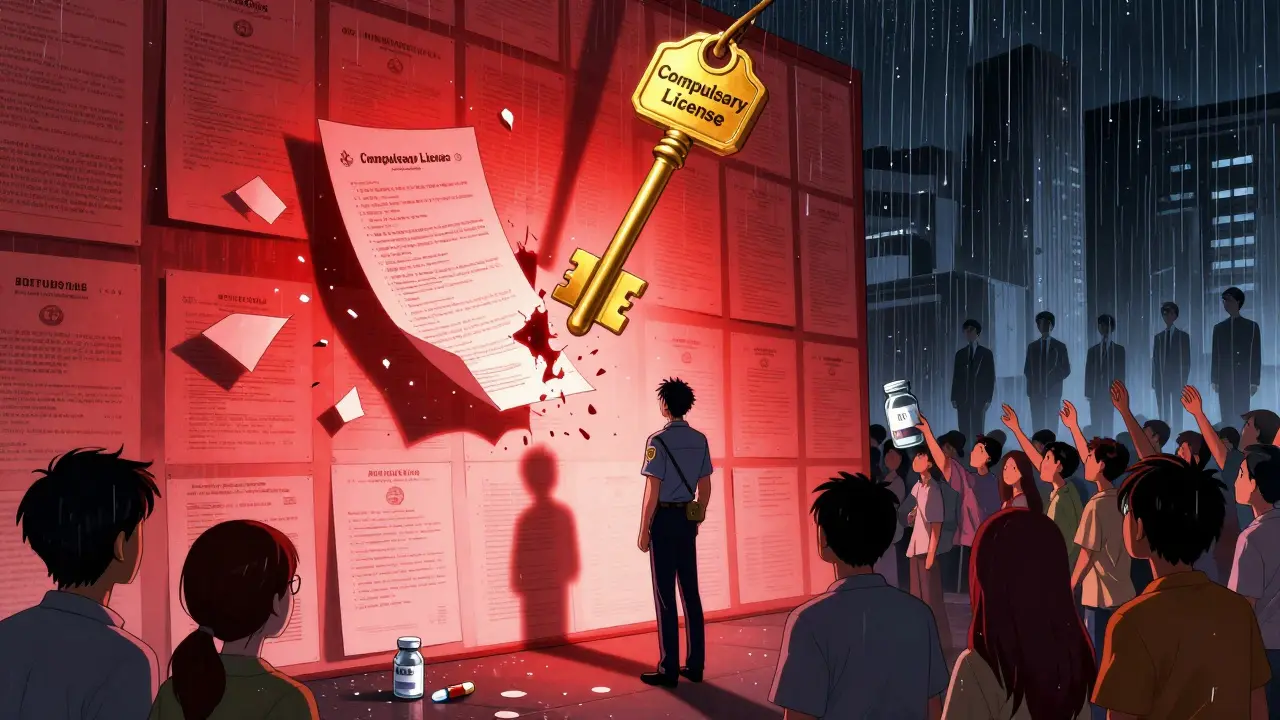
What Is Compulsory Licensing?
Compulsory licensing is a legal tool that lets governments authorize someone else to make or use a patented product - like a life-saving drug - without the patent holder’s permission. This isn’t about stealing intellectual property. It’s about balancing the rights of companies with the urgent needs of people. The patent holder still gets paid, but the government steps in when the patent is blocking access to something critical - like medicine during a pandemic or a cancer drug that’s priced out of reach.
The idea isn’t new. It dates back to the 1883 Paris Convention, but it became a global standard with the TRIPS Agreement a 1994 international treaty under the World Trade Organization that sets minimum standards for intellectual property protection. Under TRIPS Article 31, countries can issue compulsory licenses if they pay fair compensation and use the product mostly for their own population. The key phrase? "Adequate remuneration." Not a windfall. Not a pittance. Just enough to reflect the value of the invention.
Why Does It Exist?
Patents are meant to encourage innovation. But they can also create monopolies. When a company holds a patent on a drug that costs $1,200 a year - and 10 million people need it - the system breaks. Compulsory licensing exists to fix that. It’s not a weapon. It’s a safety valve.
Take HIV treatment. Between 2000 and 2020, compulsory licenses helped slash the price of first-line HIV medications by 92% in low- and middle-income countries. In Thailand, the government issued licenses for drugs like lopinavir/ritonavir. The price dropped from $1,200 per patient per year to $230. In Brazil, efavirenz went from $1.55 per tablet to $0.48. These weren’t random acts. They were calculated responses to public health emergencies.
The same thing happened during COVID-19. Over 40 countries - including Canada, Germany, and Israel - prepared or issued compulsory licenses for vaccines, tests, and treatments. The goal? Get supplies out fast. No waiting for negotiations. No corporate delays. When lives are on the line, the law allows governments to act.
How It Works in Different Countries
Not all countries use compulsory licensing the same way. The U.S. has the rules, but rarely uses them. There are three main paths:
- Section 1498 - lets the federal government use a patent without permission, but you sue for compensation in the Court of Federal Claims. Between 1945 and 2020, only 10 licenses were issued - all for military or government use.
- Bayh-Dole "march-in" rights - if a company got federal funding to develop a drug and isn’t making it available, the government can force a license. The NIH has received 12 petitions since 1980. It has denied every single one, saying the company "took effective steps."
- Environmental laws - the Clean Air Act allows compulsory licensing if a patented tech is needed to meet pollution standards. Very rare.
Compare that to India. Since 2005, India has issued 22 compulsory licenses - almost all for cancer drugs. In 2012, it licensed Natco Pharma to make a generic version of Bayer’s Nexavar. The price dropped from $5,500 per patient per year to $175. Bayer sued. It took eight years. India won. The ruling set a global precedent: affordability matters more than profit margins when people die waiting.
Thailand, Brazil, South Africa, and Indonesia have all used it. Germany and the UK have the legal tools, but have never issued one. Spain, however, passed emergency rules in 2020 that let them bypass negotiations during the pandemic. The difference? Political will.
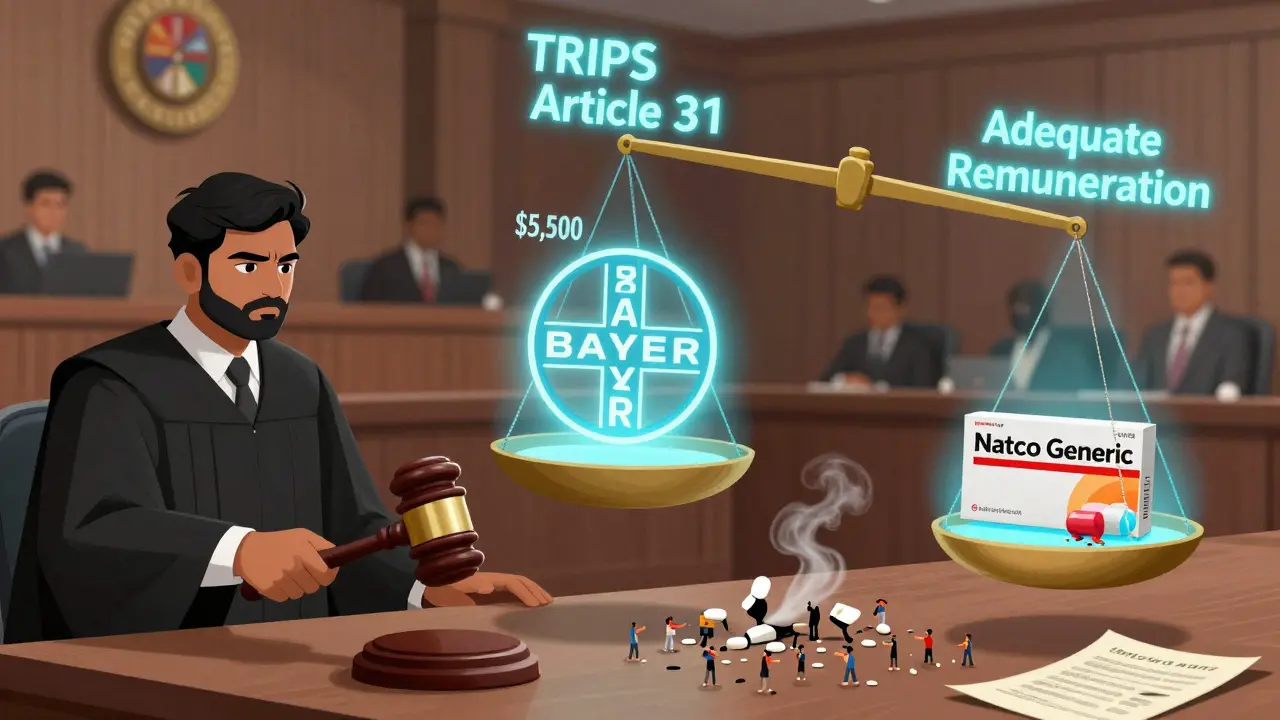
The Legal Hurdles
Compulsory licensing isn’t easy. TRIPS says you must try to negotiate with the patent holder first. That’s the "reasonable efforts" rule. But there’s an exception: "circumstances of extreme urgency." That’s what lets countries skip negotiation during a pandemic.
But even when the law allows it, the process is slow. In the U.S., a Section 1498 case takes an average of 2.7 years. In India, the Intellectual Property Appellate Board takes 18 to 24 months. And compensation? It’s messy. The U.S. uses the "Georgia-Pacific factors" - 15 different metrics to calculate what’s "fair." India uses a flat 6% of net sales. No one agrees on the right number.
There’s also the export problem. Before 2005, countries without drug factories couldn’t import generics made under license. The WTO fixed that with a 2003 waiver - later made permanent in 2005. Canada was the only country to use it, shipping HIV drugs to Rwanda in 2012. It’s technically possible. But no one else has tried.
Who Benefits? Who Loses?
Generic drugmakers win. Teva Pharmaceutical made $3.2 billion more between 2015 and 2020 from compulsory license markets. Patients win. In countries with active licensing, drug prices drop 65% to 90%. Governments win. They can control costs and ensure access.
But the pharmaceutical industry says it’s a threat. The IFPMA claims each compulsory license announcement causes an 8.2% drop in stock prices. A 2018 study in the Journal of Health Economics found countries with active licensing saw 15-20% less R&D investment. The fear? If companies can’t protect their profits, they won’t develop new drugs.
But here’s the twist: the threat of compulsory licensing often works better than the license itself. Dr. Brook Baker points out that 90% of HIV drugs in developing countries got price cuts just because manufacturers feared governments would issue licenses. The same thing happened with Hepatitis C drugs. Companies lowered prices preemptively. That’s the real power - not the license, but the possibility of one.
What’s Changing Now?
Things are shifting fast. In June 2022, the WTO agreed to a temporary waiver for COVID-19 vaccine patents. It lets developing countries produce vaccines without permission until 2027. So far, only 12 facilities in 8 countries are using it. Why? Because the paperwork is still too complex. No one’s ready.
The European Union is pushing a new Pharmaceutical Strategy. By 2024, companies may be forced to respond to licensing requests within 30 days - or lose their patent rights. That’s a game-changer. No more dragging your feet.
And the WHO is drafting a Pandemic Treaty. Draft Article 12 says: during a declared global health emergency, essential health products should be automatically licensed. No negotiations. No delays. Just access.
Experts predict that by 2030, 75% of compulsory licenses will be limited to emergencies - cancer, antibiotics, climate-related health tech. Not general use. Not fishing for cheaper drugs. Just when it truly matters.
The Bigger Picture
Compulsory licensing isn’t about undermining innovation. It’s about making sure innovation doesn’t come at the cost of human life. The patent system works when it serves people. When it doesn’t, the law gives governments a way to fix it.
It’s not a first resort. It’s a last one. And that’s how it should be. No one wants to break a patent. But no one should let someone die because a company won’t lower the price.
Is compulsory licensing legal under international law?
Yes. The TRIPS Agreement, signed by 164 countries including the U.S., EU, China, and India, explicitly permits compulsory licensing under Article 31. It requires fair compensation and limits use mostly to the domestic market. The 2001 Doha Declaration further confirmed that countries can use these tools to protect public health, even if it means overriding patents.
Can any country issue a compulsory license?
All WTO members have the legal right to issue compulsory licenses. But many don’t because of political pressure, lack of legal capacity, or fear of trade retaliation. Only 12 countries have ever issued a compulsory license for pharmaceuticals as of 2022, even though over 30 have the laws on the books.
Does compulsory licensing stop companies from innovating?
There’s no clear evidence it does. Studies show that while some companies reduce R&D investment in countries with active licensing, the overall global impact is small. The bigger driver of innovation is market size and profit potential - not just patent protection. In fact, the threat of a license often leads to voluntary price cuts, which helps companies keep sales without losing control.
What’s the difference between compulsory licensing and patent expiration?
Patent expiration is automatic. After 20 years, anyone can make the drug. Compulsory licensing is a government decision made before expiration - usually because the drug is too expensive or not available. It’s faster, targeted, and used in emergencies. It’s not about waiting. It’s about acting now.
Why don’t more countries use it?
Three reasons: legal complexity, political pressure from powerful countries, and lack of technical capacity. Many low-income nations don’t have lawyers or patent offices trained to handle these cases. Others fear trade sanctions - though none have been imposed since 2012. And some governments simply don’t want to fight big pharma.
Author

trudale hampton
March 21, 2026 AT 18:22Love that India stood up to Bayer. That case should be taught in every law school.
Shaun Wakashige
March 23, 2026 AT 14:21Nicole James
March 23, 2026 AT 19:27And don't get me started on the 'pandemic treaty' - sounds like a backdoor to global control. Who's drafting this? Are we sure it's not Bill Gates' lawyers? I'm not paranoid... I'm PREPARED.
Desiree LaPointe
March 24, 2026 AT 21:06And let's be real: if you actually believed in innovation, you'd be thrilled that a single drug can make $10B. That's the price of genius. Not a 'windfall.' A reward. And now you want to punish it? Cute.
Jackie Tucker
March 26, 2026 AT 07:53Meanwhile, the real problem? No one’s talking about why 90% of pharma R&D happens in just 5 countries. Or why India’s generics are often made with subpar ingredients. Or why the U.S. spends $1,500 per capita on drugs while Canada spends $600 - and still gets the same outcomes.
It’s not about patents. It’s about systemic dysfunction. But let’s keep blaming Big Pharma. It’s easier than fixing our own broken healthcare.
Thomas Jensen
March 27, 2026 AT 10:45I’m not anti-capitalism. I’m pro-human. And if a patent means someone can’t breathe? Then that patent should be broken. No debate.
matthew runcie
March 27, 2026 AT 14:55Keep the system. Just add teeth.
shannon kozee
March 27, 2026 AT 16:42Most countries don’t use it because they lack the legal infrastructure - not because they’re scared. That’s the real issue.
Paul Cuccurullo
March 28, 2026 AT 11:15But I also believe, with every fiber of my being, that no life should be sacrificed at the altar of profit. This is not a contradiction. It is a calling - to balance the sacred with the urgent.
Compulsory licensing, when used with moral clarity, is not a weapon. It is a hymn.
Solomon Kindie
March 29, 2026 AT 03:12also why do we even have patents if they just get ignored? idk man this feels like a slippery slope to like... all property being up for grabs
Natali Shevchenko
March 29, 2026 AT 05:36What if we stopped seeing this as 'taking' and started seeing it as 'rebalancing'? The 100 richest people in the world could pay for every single HIV drug ever needed - and still have more money than most nations. The problem isn’t the license. It’s our collective refusal to acknowledge how grotesquely unequal this is.
And yes - the threat works. But why should we have to threaten? Why can’t we just agree that a child with cancer shouldn’t be priced out of existence? That’s not radical. That’s basic decency.
Johny Prayogi
March 29, 2026 AT 13:41India did it right. Brazil did it right. Canada did it right.
U.S. still sleeping. Wake up America. People are dying. Not 'could die.' ARE dying.
Stop waiting for permission. Just do it.
Nishan Basnet
March 31, 2026 AT 09:38Don’t let anyone tell you this is anti-innovation. It’s pro-survival.