
Steroid-Induced Osteoporosis Risk Calculator
Your Bone Health Assessment
Enter your steroid dosage and treatment duration to calculate your risk of bone loss and fractures.
Your Bone Health Report
Fracture Risk
Bone Density Loss
Recommended Prevention Steps
Why Long-Term Steroids Can Break Your Bones
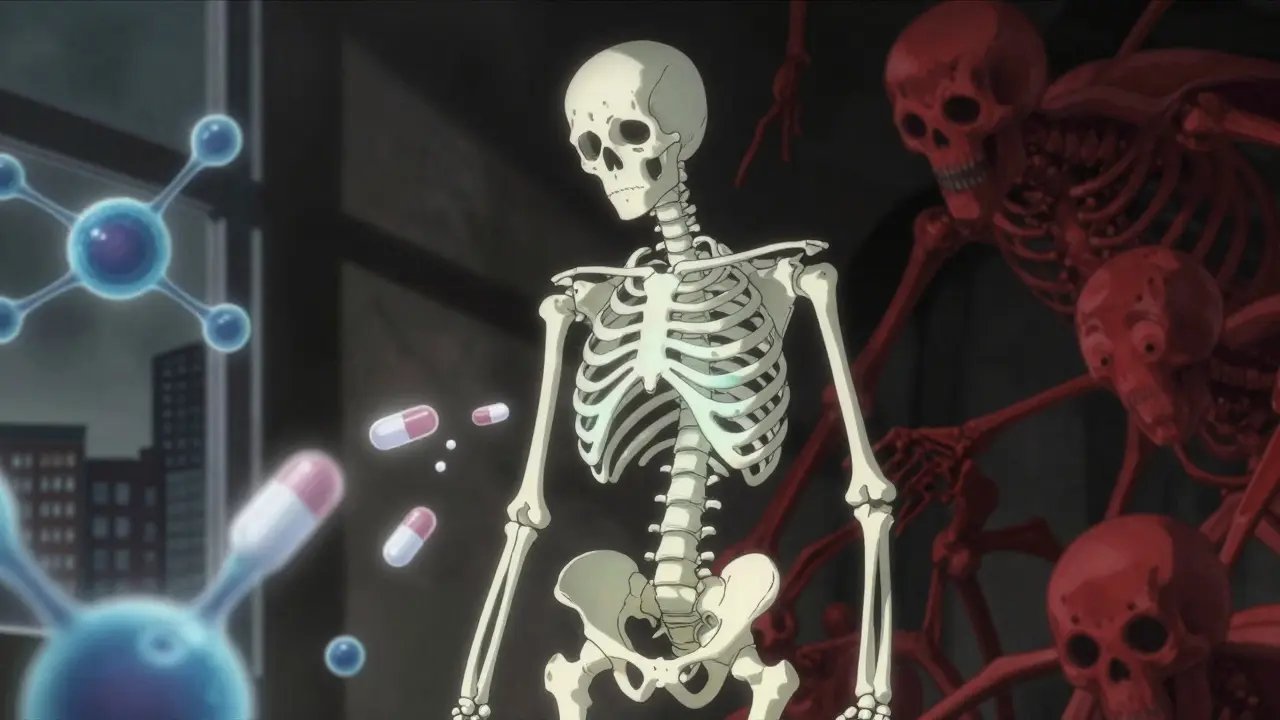
You’re on prednisone or another corticosteroid because you need it - maybe for asthma, rheumatoid arthritis, or an autoimmune condition. But if you’ve been taking it for more than three months, your bones are quietly weakening. This isn’t a myth. It’s called glucocorticoid-induced osteoporosis (GIOP), and it’s the most common type of secondary osteoporosis. Within just three to six months of starting daily steroids, your fracture risk jumps by 70 to 100%. That’s faster than most people realize. By the end of the first year, you could lose 5 to 15% of your bone density, especially in your spine. And unlike regular osteoporosis, this one hits hard and fast.
How Steroids Attack Your Bones
Steroids don’t just reduce inflammation - they mess with your body’s bone-building system. They shut down osteoblasts, the cells that make new bone, and make them die off faster. At the same time, they keep osteoclasts - the cells that break down bone - alive longer. It’s like turning off the construction crew while hiring more demolition workers. Your body also absorbs less calcium from food, leaks more through your kidneys, and stops responding properly to physical activity. Even walking or light lifting becomes less effective at strengthening bones. Studies show weight-bearing exercise loses about 25% of its bone-protecting power when you’re on long-term steroids.
Who’s at Risk - And When It Starts
If you’re taking 2.5 mg or more of prednisone (or its equivalent) every day for three months or longer, you’re in the high-risk group. That’s not a high dose - it’s a common starting dose for many conditions. But if you’re on 7.5 mg or more daily, your fracture risk doubles. And here’s the scary part: every extra 1 mg of daily prednisone cuts your spine bone density by 1.4% each year. That’s not slow aging - that’s accelerated bone decay. Men are especially at risk because they’re less likely to get screened or treated. Only 44% of men on long-term steroids get any prevention advice, compared to 76% of women. And yet, men often have worse outcomes.
The Non-Negotiables: Diet, Movement, and Lifestyle
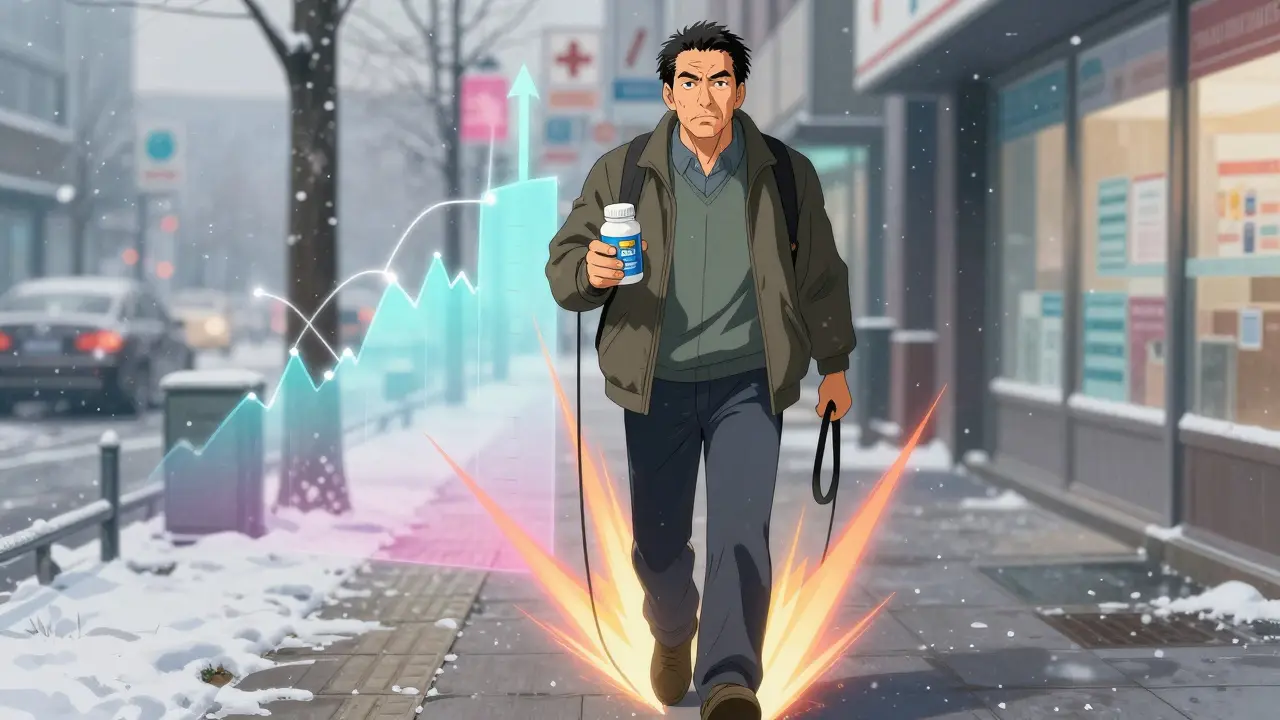
Before you even think about pills, fix the basics. You need at least 1,000 to 1,200 mg of calcium daily. That’s about three servings of dairy, or fortified plant milk, leafy greens, or almonds. If you can’t get it from food, take a supplement. Vitamin D is just as critical. Most people need 800 to 1,000 IU daily to keep blood levels above 20 ng/mL. Without enough vitamin D, your body can’t absorb calcium - no matter how much you take. Don’t rely on sunlight alone. Even in Bristol, winter sun won’t cut it.
Exercise isn’t optional. You need weight-bearing activity at least five days a week - walking, stair climbing, dancing, or resistance training with bands or light weights. Thirty minutes a day. It’s not about lifting heavy; it’s about keeping your bones under stress. And if you smoke? Quit. Smoking alone increases fracture risk by 25 to 30%. Cut alcohol to under three units a day. More than that? It directly harms bone cells.
Medications That Actually Protect Your Bones
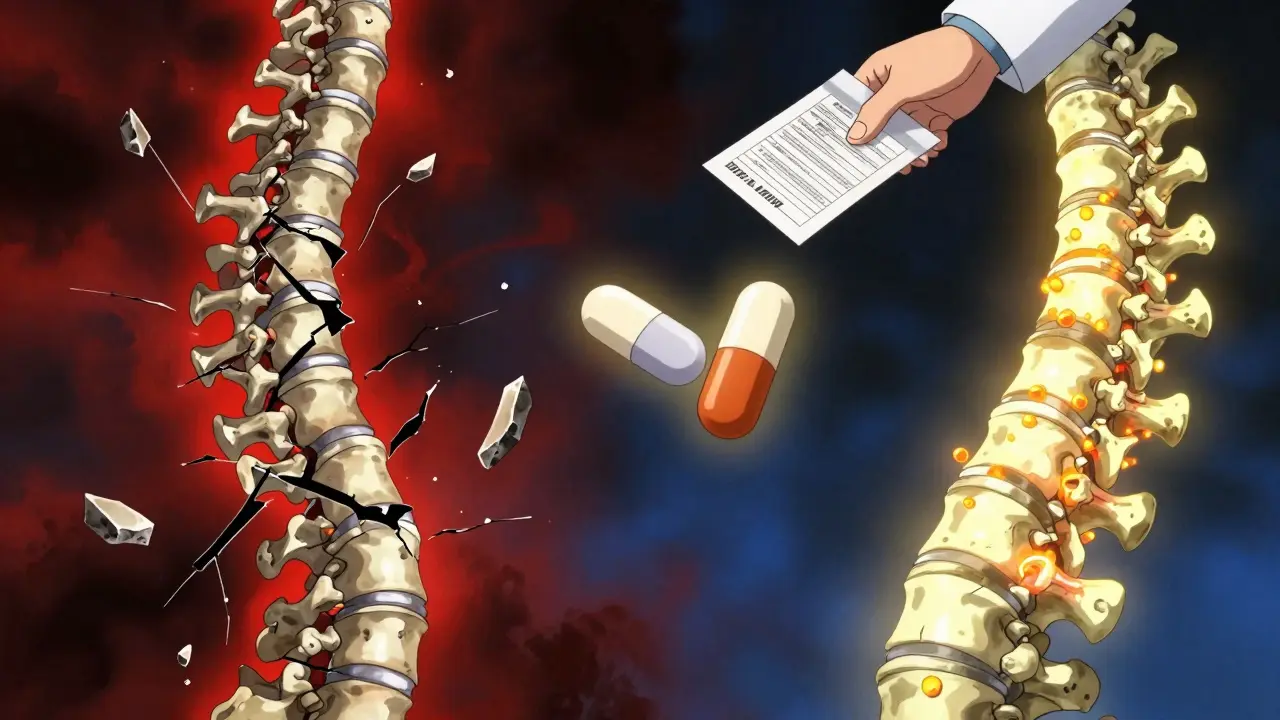
Calcium and vitamin D are the foundation, but they’re not enough alone if you’re on long-term steroids. The first-line drug is a bisphosphonate - risedronate or alendronate. Risedronate, taken daily or weekly, cuts spine fractures by 70% and other fractures by 41%. Zoledronic acid, given as a yearly IV drip, boosts spine bone density by 4.5% in a year. Denosumab, injected every six months, adds 7% to spine density. And for those with severe bone loss or prior fractures, teriparatide - a daily injection - is the strongest option. It increases spine density by 9.1% in a year, nearly double what bisphosphonates do. The Royal Osteoporosis Society says teriparatide works 2.3 times better than alendronate in high-risk steroid users.
Why So Many People Are Still Getting Fractures
Here’s the broken part: even though guidelines have existed for over 20 years, only about 15% of people on long-term steroids get care that matches what doctors know works. Why? Many don’t know they’re at risk. One study found 45% of patients think bone loss from steroids is unavoidable. Others don’t get tested. Only 31% have a bone density scan. Doctors don’t always talk about it. In the UK, only 22% of GPs feel properly informed when a rheumatologist prescribes steroids. And even when prescriptions are given, adherence drops fast. Only 40% of people keep taking calcium and vitamin D after a year. Bisphosphonate use falls to 45% by year one, mostly because of stomach upset. But here’s the good news: when systems change, outcomes improve. At one VA hospital, adding automatic EHR alerts and mandatory prevention order sets boosted guideline-concordant care from 40% to 92%.
What You Should Do Right Now
If you’re on steroids for three months or more, ask for these three things:
- A bone density scan (DXA) - now, not later.
- A prescription for calcium (1,000-1,200 mg) and vitamin D (800-1,000 IU) if you’re not already taking them.
- A discussion about bisphosphonates or another bone drug - especially if your dose is above 7.5 mg daily, or if you’ve had a fracture.
Don’t wait for symptoms. Osteoporosis doesn’t hurt until you break a bone. And once you do, recovery is harder, especially if you’re still on steroids. The best time to act is within the first three to six months of starting treatment. That’s when bone loss is fastest - and most preventable.
Real Talk: What Works in Real Life
One patient I know, a 58-year-old man from Bristol on 10 mg prednisone for lupus, skipped the bone scan because he felt fine. A year later, he fractured his spine lifting a suitcase. He didn’t realize his posture had changed - he’d lost nearly an inch in height. After starting risedronate, calcium, vitamin D, and daily walks, his spine density improved by 5% in 18 months. He still takes steroids, but now he has a plan. That’s the difference. You can’t always stop the steroids. But you can stop the bone loss.
Final Thought: It’s Not About Avoiding Steroids - It’s About Managing the Risk
Steroids save lives. The goal isn’t to quit them unless your doctor says so. The goal is to protect your bones while you’re on them. That means knowing your dose, getting tested, taking your supplements, moving your body, and asking for the right drugs. If your doctor doesn’t bring it up, bring it up yourself. Your bones can’t speak for themselves - but you can.
Can I prevent steroid-induced osteoporosis without medication?
You can reduce your risk significantly with diet, exercise, quitting smoking, and limiting alcohol - but for most people on long-term steroids, that’s not enough. Calcium and vitamin D are essential, but they only slow bone loss. If you’re on more than 2.5 mg of prednisone daily for over three months, you likely need a bone-protecting medication like a bisphosphonate to prevent fractures. Prevention isn’t optional - it’s medical.
How often should I get a bone density scan?
Get your first scan right after you start long-term steroid therapy (after three months). Then repeat it every one to two years if you’re still on steroids. If you start a bone medication, get another scan after 12 months to check if it’s working. Most people see a 3-8% improvement in spine density within a year with proper treatment.
Are bisphosphonates safe for long-term use with steroids?
Yes. Bisphosphonates like risedronate and alendronate have been studied for over 20 years in steroid users and are considered safe and effective. The main side effect is mild stomach upset, which can often be managed by taking the pill correctly - on an empty stomach with plain water, waiting 30 minutes before eating. Serious side effects like jaw bone problems or atypical femur fractures are extremely rare, especially at standard doses and durations.
I’m on low-dose steroids. Do I still need to worry?
Yes. Even 2.5 mg of prednisone daily for three months puts you in the high-risk category. Bone loss starts fast - within months. You might not feel it, but your spine and hips are losing density. That’s why guidelines say everyone on long-term steroids needs prevention, regardless of dose. Low dose doesn’t mean low risk.
Can I stop taking steroids to protect my bones?
Never stop steroids suddenly. That can be life-threatening. If your condition allows, your doctor may slowly reduce your dose - but only if it’s safe for your primary illness. The goal is to use the lowest effective dose, not to stop unless medically possible. Bone protection works alongside your steroid treatment, not instead of it.
Author

Jamillah Rodriguez
February 4, 2026 AT 01:34Roshan Gudhe
February 4, 2026 AT 23:27Rachel Kipps
February 6, 2026 AT 04:27caroline hernandez
February 8, 2026 AT 02:39Keith Harris
February 9, 2026 AT 16:56Mandy Vodak-Marotta
February 11, 2026 AT 00:17rahulkumar maurya
February 12, 2026 AT 16:57Alec Stewart Stewart
February 13, 2026 AT 00:28Geri Rogers
February 13, 2026 AT 04:13Samuel Bradway
February 13, 2026 AT 12:58Caleb Sutton
February 13, 2026 AT 17:27pradnya paramita
February 15, 2026 AT 13:26Janice Williams
February 15, 2026 AT 20:03Ed Mackey
February 16, 2026 AT 01:15