

Many people take calcium or iron supplements without realizing they could be making their medications less effective-or even useless. If you're on antibiotics, thyroid medicine, or heartburn pills, and you're also popping a calcium tablet or iron gummy, you might be fighting a silent battle inside your body. These minerals don’t just sit there quietly. They bind to drugs, block absorption, and mess with how your body uses them. The result? An infection that won’t clear up. A thyroid level that stays out of range. A pill that costs money but does nothing.
How Calcium Stops Antibiotics from Working
Calcium doesn’t just build bones. It also binds to certain antibiotics like tetracycline, doxycycline, and ciprofloxacin, forming a hard, insoluble lump in your gut that your body can’t absorb. This isn’t a small issue. Research shows calcium carbonate can cut the absorption of ciprofloxacin by 40%. That means if you take a calcium supplement two hours before your antibiotic, you might as well have skipped the dose entirely.Doctors don’t usually warn patients about this because they assume you’ll read the label. But most people don’t. A 2004 study in U.S. Pharmacist found that 67% of women and 25% of men take calcium supplements regularly. Many of them are also on antibiotics for sinus infections, urinary tract infections, or acne. When these two meet, the antibiotic loses its punch. The infection lingers. Then comes the next round of antibiotics. And the next. It’s a cycle that could’ve been avoided with simple timing.
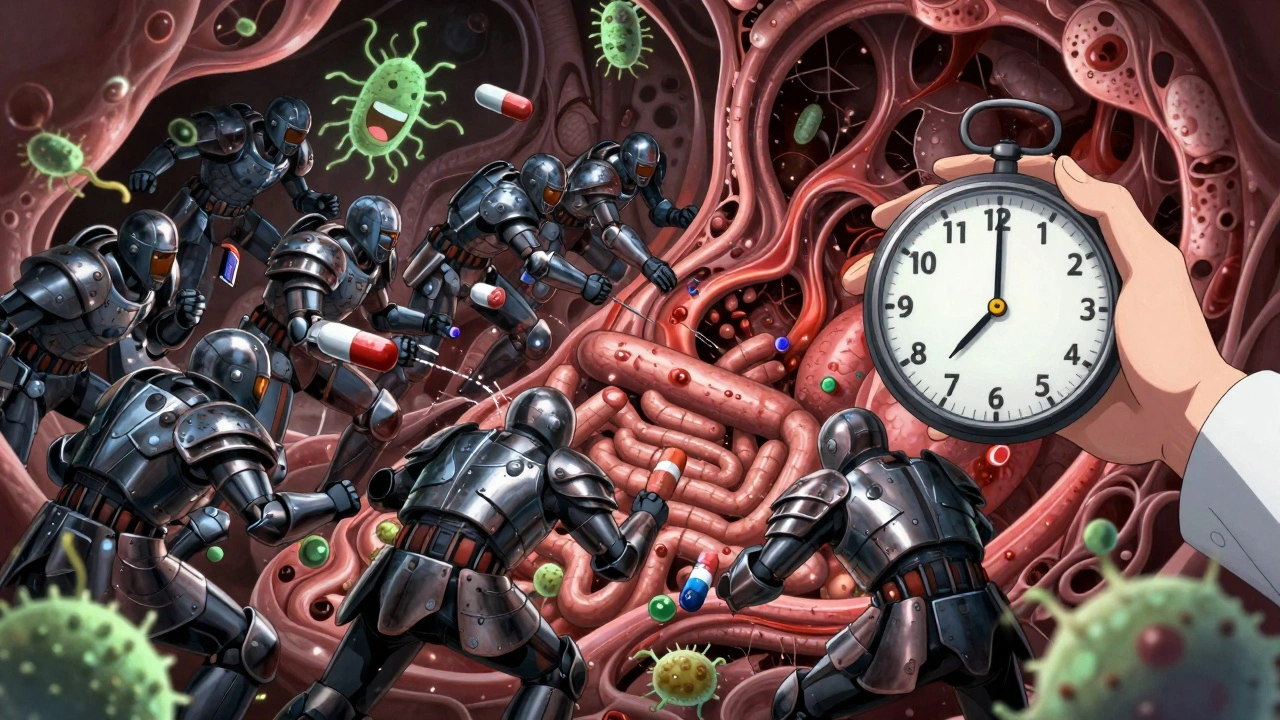
The fix? Don’t take calcium within four hours of these antibiotics. If you take your antibiotic at 8 a.m., wait until noon or later for your calcium pill. Same goes for dairy. A glass of milk with breakfast? That’s calcium too. Skip it for a few hours around your antibiotic dose.
Iron and Antibiotics: A Similar Fight
Iron supplements like ferrous fumarate do the same thing to tetracycline and fluoroquinolone antibiotics. Iron binds to them just like calcium does. The result? The antibiotic can’t get into your bloodstream. Your body doesn’t get the full dose. The infection doesn’t clear.GoodRx recommends spacing iron and these antibiotics by at least two hours before or four hours after. So if you take iron at 7 a.m., wait until 11 a.m. or later for your antibiotic. Or take the antibiotic at 7 a.m. and wait until 3 p.m. for the iron. It’s not ideal, but it’s necessary.
And here’s the kicker: iron needs stomach acid to be absorbed. That’s why heartburn meds like omeprazole, pantoprazole, and famotidine make iron less effective. These drugs reduce acid in your stomach, which means less iron gets absorbed-even if you space them out properly. So if you’re taking iron for anemia and also taking a daily heartburn pill, you might not be getting the full benefit of either.
Thyroid Medicine and Calcium: The Silent Saboteur
Levothyroxine, the most common thyroid hormone replacement, is especially sensitive to calcium. Even a single calcium supplement can cut its absorption by up to 30%. That’s enough to throw your TSH levels off, making you feel tired, gain weight, or get depressed-even if you’re taking the right dose.A 2004 study in the South Medical Journal showed that taking calcium within four hours of levothyroxine significantly lowers hormone levels in the blood. The fix? Take your thyroid pill first thing in the morning on an empty stomach, then wait at least four hours before taking calcium, iron, or even a multivitamin with minerals.
Many people take their thyroid pill with coffee or breakfast. That’s already a problem. Now add a calcium tablet? It’s a double hit. Stick to water. Wait. Then eat. And don’t touch your minerals until later in the day.

Iron and Milk: Why Your Child’s Anemia Isn’t Improving
Parents often give iron supplements to kids with anemia. They think yogurt or milk will help the child take it better. But milk contains calcium-and calcium binds to iron. The iron can’t be absorbed. The anemia doesn’t get better. The child stays pale and tired.HealthyChildren.org recommends giving iron with orange juice instead. The vitamin C in orange juice helps iron absorb better. It’s a simple swap. No pills. No fuss. Just a glass of juice with the supplement.
Same goes for tea and coffee. Tannins in these drinks block iron absorption. If your child takes iron with tea at lunch, it’s basically wasted. Water or orange juice is the way to go.
Timing Is Everything-Here’s the Simple Plan
You don’t need to stop taking your supplements. You just need to time them right. Here’s a clear, practical schedule based on the best evidence:- Thyroid medicine (levothyroxine): Take on empty stomach, first thing in the morning. Wait 4 hours before taking calcium, iron, or multivitamins.
- Antibiotics (tetracycline, doxycycline, ciprofloxacin): Take 2 hours before or 4 hours after calcium or iron. Avoid dairy during this window.
- Iron supplements: Take on empty stomach if possible. If you have stomach upset, take with food-but avoid calcium-rich foods. Pair with orange juice or vitamin C.
- Heartburn meds (omeprazole, famotidine): Take iron at least 2 hours before these drugs. If you take heartburn meds daily, talk to your doctor about adjusting your iron dose.
- Calcium supplements: Take with food to reduce stomach upset, but avoid taking within 4 hours of antibiotics or thyroid meds.
Many people think they’re doing everything right-taking pills on time, eating healthy, staying on schedule. But if they’re stacking calcium with their thyroid pill or iron with their antibiotic, they’re sabotaging their own treatment.
What You Should Ask Your Pharmacist
You don’t have to guess. Ask your pharmacist these questions:- “Does my calcium or iron supplement interact with any of my medications?”
- “How long should I wait between taking my thyroid pill and my multivitamin?”
- “Can I take my iron with my morning coffee or tea?”
- “Should I switch my calcium supplement to a different time of day?”
Pharmacists see these interactions every day. They know which combinations are dangerous. But they can’t help you unless you tell them what you’re taking. Don’t assume they know you’re on calcium. Many people don’t think of supplements as “medications.” But they are.
Why This Matters More Than You Think
This isn’t just about feeling better. It’s about safety. If your antibiotic doesn’t work because of calcium, you could develop a resistant infection. If your thyroid levels stay low, you risk heart problems or depression. If your iron doesn’t absorb, you could end up needing IV iron or blood transfusions.The NHS updated its guidance in 2023 to stress personalized spacing for ferrous fumarate. The U.S. Food and Drug Administration now requires interaction warnings on supplement labels. But warnings don’t help if you don’t read them. You need to know what’s happening in your body.
As people live longer and take more medications, these interactions will only become more common. A 70-year-old might be on five pills a day-plus calcium, iron, and a multivitamin. That’s 10+ substances in the gut at once. The chances of a bad interaction skyrocket.
Simple timing changes can prevent all of that. No new drugs. No expensive tests. Just better habits.
What to Do Today
1. Check your meds. Look at your pill bottles. Do any say “take on empty stomach” or “avoid dairy”? That’s a red flag. 2. Write down everything. Include vitamins, supplements, herbal products-even the ones you take “just because.” 3. Call your pharmacist. Ask them to review your list. Most pharmacies offer free med reviews. 4. Adjust your schedule. Move calcium or iron to dinner time if you take thyroid medicine in the morning. Move iron to before lunch if you take heartburn meds at night. 5. Use orange juice. For iron, swap milk for orange juice. It’s easier than you think.Minerals are good. Medications are important. But when they collide, one of them loses. You don’t want that to be your health.
Author

Jay Everett
December 3, 2025 AT 17:11Bro, this is the kind of info that saves lives but no one talks about it 😅 I took my levothyroxine with my morning smoothie (spinach, banana, calcium-fortified almond milk) for YEARS thinking I was being healthy. Turned out my TSH was stuck at 6.8 because of it. Switched to water + 4-hour wait? My energy came back like I’d been sleep-deprived for a decade. Thank you for this. 🙏
मनोज कुमार
December 4, 2025 AT 05:00Calcium chelates tetracyclines via divalent cation binding inhibiting intestinal absorption. Simple pharmacokinetic principle. Why are people surprised?
Joel Deang
December 5, 2025 AT 15:00wait so like… i’ve been taking my iron gummies with my coffee?? 😳 and my mom gives my lil sis calcium gummies with her milk every morning?? we’re all basically just wasting money and making ourselves sicker?? 😭
Roger Leiton
December 6, 2025 AT 03:27This is so important. I didn’t realize my multivitamin was sabotaging my antibiotics. I’ve had the same UTI three times this year. Now I’m spacing everything out. Also, orange juice with iron? Genius. I’m trying it tomorrow. 🍊💪
Laura Baur
December 6, 2025 AT 07:11It’s frankly irresponsible that pharmacies don’t print these warnings in bold on every supplement bottle. People are not pharmacists. They don’t know that ‘calcium carbonate’ is a drug antagonist. They see ‘bone health’ and think it’s just a vitamin. This isn’t negligence-it’s systemic failure. And now you’re telling people to ‘just wait four hours’? What if they work two jobs? What if they’re elderly and on ten medications? This isn’t a life hack. It’s a public health crisis disguised as personal responsibility.
Jack Dao
December 6, 2025 AT 19:58Wow. So you’re saying people who take supplements are dumb? 🤡 I’ve been taking iron with my coffee for 15 years. I’m fine. My doctor didn’t say anything. Maybe you’re the problem.
dave nevogt
December 7, 2025 AT 06:31I’ve watched my mother struggle with hypothyroidism for over a decade. She took her levothyroxine with breakfast, with her calcium, with her tea… and nobody ever told her why she was always exhausted. It took a random pharmacist at a Walmart to point it out. I cried. This post brought me back to that moment. Thank you for writing this. Not everyone needs to be yelled at to learn. Sometimes they just need someone to say it plainly.
Arun kumar
December 8, 2025 AT 15:28in india we take iron with milk because its traditional… now i feel bad for my aunt who is still anemic after 3 years
Zed theMartian
December 10, 2025 AT 01:37Oh wow. So the entire supplement industry is just a giant scam built on people’s ignorance? I’m shocked. 🤯 Next you’ll tell me that ‘detox teas’ don’t detox and ‘gluten-free’ cookies still have carbs. I feel so naive. Like I’ve been living in a Matrix of marketing hype and placebo pills. Who do I sue?
Ella van Rij
December 10, 2025 AT 18:50So… you’re telling me I can’t have my fancy oat milk latte with my calcium pill? 😔 I mean… I guess I’ll just… die? Or maybe I’ll just ignore this and keep pretending I’m a wellness influencer. #SacrificeForTheAesthetic
ATUL BHARDWAJ
December 12, 2025 AT 08:29Iron with orange juice works. My village used this trick for generations. No need for fancy science.
Steve Enck
December 14, 2025 AT 04:36While your empirical observations are valid, the underlying epistemological framework assumes a Cartesian separation between pharmacological agents and physiological systems, which fails to account for the entangled biosemiotic feedback loops inherent in human metabolic ecology. The temporal spacing protocol you propose is a symptomatic intervention, not a systemic solution. One must question: is the body’s capacity to absorb minerals and pharmaceuticals a defect to be corrected, or a signal of deeper dysregulation in our modern nutritional paradigm? The real issue is not timing-it’s the commodification of health into discrete, isolated variables, divorced from ecological context. Your schedule is a bandage on a severed artery.