
Palliative Care Balance & Safety Estimator
Patient Profile
Assessment Ready
Select a patient profile and symptoms above to begin.
Overall Clinical Priority
Recommended Approaches
The Difficult Choice Between Comfort and Safety
When a loved one is facing a serious illness, the hardest part isn’t always the diagnosis. It is often the treatment plan itself. You want them to feel better, but you are terrified of making them drowsy or confusing. This tension sits at the heart of modern care. It is not just about giving medicine; it is about walking a fine line where too little help means suffering, and too much medicine creates new problems.
This balancing act is the defining challenge of Palliative Care. Unlike general hospital work that focuses purely on curing disease, this approach prioritizes relief from suffering in every form-physical, emotional, and spiritual. For patients in their final months, the goal shifts completely. We stop trying to fix the unfixable and start focusing entirely on quality of life. Dame Cicely Saunders established this model decades ago, yet we still struggle with the practical details of how to deliver comfort without causing harm.
Defining the Line Between Care Types
People often use the terms interchangeably, but there is a distinct difference. Hospice Care is specifically for patients with a prognosis of six months or less who have chosen to stop curative treatments. It falls under the broader umbrella of palliative services. In contrast, palliative care can begin at any stage of a serious illness and works alongside chemotherapy or surgery. This distinction matters because your options change depending on which path you are on.
In the UK, frameworks like the NHS guidelines provide strict protocols for these situations. They mandate that every pain complaint gets detailed documentation. You cannot simply write “pain” on a chart. You need to map the site, the radiation, the character, and the timing. These specifics allow doctors to pick the right drug for the specific type of pain rather than guessing. If you skip these details, you end up treating symptoms blindly, which often leads to overmedication and unnecessary side effects.
Navigating Common Symptoms and Their Risks
Treating pain is the most visible part of this care, but it is not the only symptom that requires careful management. Shortness of breath, known medically as dyspnea, is another major source of distress. Clinical evidence rates opiates as highly effective for this issue even when the cause isn’t cancer-related. However, the dose required for breathing problems can sometimes overlap dangerously with doses used for pain control.
Then there is the issue of agitation and confusion, often called delirium. When a patient becomes restless, the instinct is to calm them down quickly. Protocols from institutions like UPenn specify using tools like the RASS scoring system every four hours to measure exactly how agitated someone is before adding medication. If you treat every instance of confusion with strong sedatives, you risk pushing the patient into a coma they never wake from. The guidelines suggest that once comfort is established, monitoring like EKGs for certain medications should stop to reduce burden.
| Symptom | First-Line Intervention | Evidence Rating | Key Risk Factor |
|---|---|---|---|
| Pain | Opioids | A (Strong) | Constipation, Sedation |
| Dyspnea (Breathing) | Opioids | B (Moderate) | Respiratory Depression |
| Anxiety/Delirium | Lorazepam/Haloperidol | C (Limited/Moderate) | Over-sedation, Falls |
| Nausea/Vomiting | Ondansetron/Antiemetics | A (Strong) | QT Prolongation |
The Challenge of Special Populations
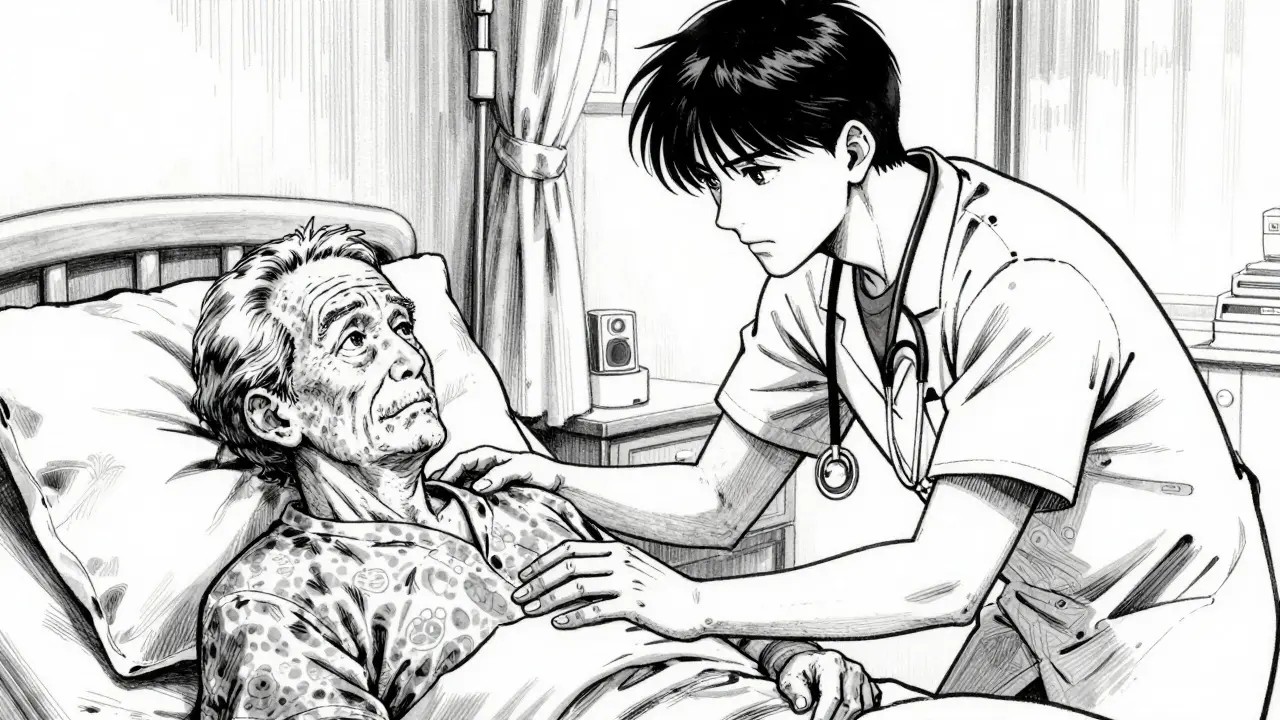
Fairly treating everyone is impossible when biology varies so much. Special populations like the elderly or those with kidney failure require a different playbook. Older adults process medications differently due to slower metabolism and reduced muscle mass. A standard dose of pain relief for a fifty-year-old could knock an eighty-five-year-old out cold. Studies show that up to 87% of general practitioners find pharmacokinetics in renal impairment difficult to master, leading to accidental toxicity.
Kidney function is the silent killer here. Many drugs rely on the kidneys to filter out waste products. If the kidneys are failing, those drugs build up in the blood. The Dana-Farber guidelines explicitly warn against assuming all patients metabolize drugs the same way. You must check liver and kidney markers before starting high-dose regimens. For frail patients, the mantra changes from “manage at all costs” to “start low and go slow.” This prevents the dreaded accumulation effect where a patient slowly slips into confusion days after starting a safe-seeming prescription.
Protocols vs. Human Judgment
We live in an era of standardized guidelines. Organizations like the National Coalition for Hospice and Palliative Care publish comprehensive manuals updated every few years. The 4th edition of their clinical practice guidelines set eight domains for quality care, covering everything from spiritual support to physical exams. These documents are vital because they prevent wild experimentation.
However, protocols are static, and patients are dynamic. User feedback from clinics shows that while staff love having a checklist, they hate when the checklist takes all day. In one survey, 68% of nurses reported insufficient time to complete all recommended assessments. This pressure to tick boxes can lead to superficial care. The Fraser Health guidelines in Canada acknowledge this gap, admitting their lists are not all-inclusive. They stress that individual assessment trumps any written rule. If a patient says they are comfortable, but the chart says they aren’t, you listen to the patient, not the software.
Technology and Future Directions
We are moving toward more precise ways of tracking symptoms. The upcoming 2025 update to national guidelines predicts the integration of digital symptom tracking tools. These apps allow patients to report their pain levels in real-time, giving doctors a picture of the entire day instead of just the moment of the visit. Early pilots showed an 18% improvement in symptom control with this technology.
Tele-palliative care is also expanding rapidly. By 2027, experts predict it will reach 40% of rural patients. This is crucial because nearly half of rural counties currently lack access to specialists. Through video calls, a doctor in Bristol can monitor a patient in a remote village, ensuring consistent advice without requiring travel. Additionally, research is exploring genetic biomarkers. A study in 2022 identified genetic variants that predict 63% of variability in how people respond to opioids. One day, we might test a patient’s DNA to know exactly which drug will work without trial and error.
Managing the Invisible Burden
Medication isn’t the only factor in balancing care. Family expectations play a massive role. Families often interpret medication drowsiness as “letting go” and may ask clinicians to lower doses to keep the patient awake longer. This causes pain to return. The right approach involves clear communication about goals. The NCHPC emphasizes the right to die free of pain with dignity. Explaining that heavy sleep is often a sign of effective pain management helps families trust the team. Without this dialogue, the family’s fear becomes the patient’s suffering.
Finally, the workforce reality cannot be ignored. There is a shortage of certified specialists. Currently, there are only about 7,000 certified palliative physicians globally against a need for 22,000. This gap means generalists often handle complex cases. While training is improving, it still takes 6 to 12 months of supervised practice to master these skills. Until then, we must rely on the available tools to bridge the gap between safety and comfort.
Author

Calvin H
April 1, 2026 AT 05:34Everyone argues about safety but ignores that doing nothing is still a treatment choice.
Victor Ortiz
April 1, 2026 AT 06:55The table shows evidence ratings but fails to mention the specific renal clearance rates for fentanyl patches in elderly populations.
Clinical studies often omit the variables related to concurrent liver toxicity which is rampant in this demographic.
A rigid adherence to the RASS scoring system misses subtle cognitive changes that manifest early in organ failure stages.
Protocols suggest stopping EKG monitoring once comfort is established which is negligent regarding arrhythmia risks from anticholinergic effects.
You have to acknowledge that the gap between theory and practice remains unbridgeable without better biomarkers available.
Most practitioners lack the training to distinguish between opioid-induced neurotoxicity and terminal restlessness effectively.
Without specific genetic testing for CYP450 polymorphisms we are largely guessing on dosing strategies for complex cases.
This approach leads to preventable suffering because staff rely on averages rather than individualized pharmacokinetics.
The reliance on documentation boxes creates administrative bloat that takes away time from actual patient assessment duties.
Metric systems work fine when biology behaves like a spreadsheet but humans rarely follow linear paths toward recovery.
Amber Armstrong
April 2, 2026 AT 09:10When my mother was in hospice I remember watching her try to speak while struggling to swallow the morphine.
The doctors kept telling us that sedation was necessary to stop the panic.
But seeing her slip away behind a curtain of drugs felt like losing her twice.
I hated how fast the confusion set in after the dosage adjustment.
They said it was delirium but it looked exactly like fear to me.
Every family member had a different idea about what the right amount of comfort actually meant.
My brother wanted her awake so we could finish our goodbyes properly.
My sister wanted the pain gone regardless of how much she slept during the day.
Nurses tried to explain the physiological reasons for the cloudiness in her eyes.
We nodded politely while knowing that logic didn't fix the heartbreak of silence.
There were nights where the monitors beeped louder than anyone in the room spoke.
It creates a burden on the caregivers to carry the knowledge of what is happening chemically.
You feel responsible for letting someone go into that fog when they ask you questions.
These medical protocols help standardize things but they cannot measure love.
That is why reading about new tracking tools gives me a tiny bit of hope for the next generation.
Sometimes the best medicine is just holding a hand without needing a prescription pad nearby.
We need to respect that boundary between clinical success and human loss.
It breaks my heart to think about how many people suffer needlessly because nobody checks their kidneys properly.
William Rhodes
April 3, 2026 AT 14:37We must never allow fear of complications to rob a person of their final peace with dignity.
There is no greater tragedy than leaving pain unmanaged simply because the risk profile looks scary on paper.
Aggressive comfort measures are the ultimate expression of love in the face of mortality today.
We need to trust the science enough to push boundaries when the alternative is prolonged agony.
Hesitation kills more patients slowly than overtreatment ever does.
Dan Stoof
April 4, 2026 AT 20:24Technology IS going to change everything!!!
Imagine genetic testing for pain thresholds before even starting chemo!!!!
Apps giving realtime feedback means no more guesswork!!!!
We will have a world where every dose is perfect!!!
Science is amazing!!!!!
Carolyn Kask
April 5, 2026 AT 15:01American families expect results that these passive European frameworks simply cannot deliver efficiently.
Why do we tolerate six month prognoses that wait forever for approval on basic narcotics?
Our private sector moves at light speed compared to public bureaucratic slowdowns seen overseas.
Safety comes first only if you ignore the reality of cost delaying immediate relief.
You cannot solve systemic failures with wishful thinking about digital symptom trackers alone.
People deserve the option to choose faster relief regardless of international guidelines.
Katie Riston
April 6, 2026 AT 02:42The distinction between managing a symptom and erasing a consciousness is a philosophical cliff we walk daily.
Comfort is subjective and yet the medical charts demand objective numbers that cannot capture the soul.
We prioritize biological stability while ignoring the spiritual erosion caused by isolation in hospitals.
Every guideline suggests a path but none account for the cultural rituals surrounding death itself.
To truly balance care we must understand that safety includes honoring fears of dependency on machines.
Modern protocols strip away the mystery of the end making it sterile instead of sacred.
I wonder if we will ever learn to die naturally without pharmaceutical intervention again.
The silence of a ward is often louder than the shouting of medication orders given out loud.
Patient autonomy means letting them decide what dignity looks like for their own bodies.
This separation creates distance between healer and healed that no technology can bridge effectively.
We must listen to the whispers of tradition alongside the shouts of modern medicine.
Brian Yap
April 8, 2026 AT 01:04Out here the telehealth setup works surprisingly well for people stuck on farms far from specialists.
It helps that video calls are becoming more common in rural regions lately.
Access shouldn't depend on zip codes anymore honestly.