

Every year, hundreds of thousands of people in the U.S. are harmed by mistakes in their prescriptions-mistakes that often happen before the pill even leaves the doctor’s office. These aren’t rare glitches. They’re common, preventable, and usually invisible to patients until something goes wrong. You might think your doctor or pharmacist catches everything. But the truth? Prescription writing errors slip through more often than you’d expect. And you don’t have to wait for harm to happen. You can catch them yourself-before the pharmacy fills the script.
What Exactly Are Prescription Writing Errors?
A prescription writing error isn’t just a typo. It’s any mistake made when a provider writes or sends a medication order. That includes handwriting that’s hard to read, wrong dosages, confusing abbreviations, or even the wrong drug entirely. These errors happen during prescribing-not because the pharmacist messed up, but because the original order was flawed. According to data from the National Coordinating Council for Medication Error Reporting and Prevention, these errors cause at least 1.5 million injuries each year in the U.S. alone. And the cost? Over $3.5 billion in extra medical bills. Some of the most dangerous mistakes involve insulin, blood thinners, and opioids-medications where a tiny error can be deadly. The biggest culprits? Illegible handwriting, dangerous abbreviations like "U" for units (which can be read as "0"), and decimal point errors like writing ".5 mg" instead of "0.5 mg." That missing zero turns a safe dose into a tenfold overdose. The FDA says these kinds of errors caused 128 deaths between 2010 and 2020.The Top 5 Prescription Errors You Need to Watch For
Not all errors are obvious. Here are the five most common-and how to spot them before you take the medicine:- Wrong dosage - The most frequent error. A doctor might mean 5 mg but write 50 mg, or write .5 mg without the leading zero. Always check the number. If it’s less than 1, it should start with a zero: 0.5, not .5. Trailing zeros are just as risky-5.0 mg should be written as 5 mg.
- Confusing drug names - Drugs like Celebrex and Celexa, or Zyprexa and Zyrtec, look and sound alike. One treats arthritis, the other depression. Mixing them up can be dangerous. Ask: "Is this the right drug for my condition?"
- Incorrect instructions - "QD" means once daily. "QID" means four times. But if the handwriting is messy, they can look the same. Same with "BID" (twice daily). Always ask for plain language: "Take one pill every morning," not "Take BID."
- Missing purpose - A good prescription should say why you’re taking it. "For high blood pressure" or "for anxiety." If it just says "Lisinopril 10 mg," ask: "Why am I taking this?" If you don’t know the reason, you can’t tell if the right drug was prescribed.
- Wrong quantity - You’re prescribed a 30-day supply, but the bottle has 90 pills. Or you’re told to take one pill daily for a week, but the script says 30 tablets. That mismatch can mean overuse or underuse.
How to Check Your Prescription Like a Pro
You don’t need a medical degree to catch errors. You just need to know what to look for. Use this simple checklist every time you get a new prescription:- Drug name - Is it written out fully? No abbreviations like "Hydro" for hydrocodone or "Lanoxin" for digoxin. Full names reduce confusion.
- Dosage - Does it have a leading zero for decimals? Is there a trailing zero? (0.5 mg, not .5 mg. 5 mg, not 5.0 mg.)
- Frequency - Are instructions written in plain English? "Take one tablet by mouth every morning" is good. "QD" or "BID" is not.
- Quantity - Does the number of pills match how long you’re supposed to take them? If you’re on a 7-day course, you should get 7 pills-not 30.
- Purpose - Is the reason for the drug listed? "For atrial fibrillation" or "for pain"? If not, ask.
- Prescriber info - Is the doctor’s name, NPI number, and phone number clearly printed? If not, the script might be fake or altered.
- Expiration date - Prescriptions expire. Check the date. If it’s already past, don’t fill it.
A 2022 study from the University of Michigan found patients who used this exact checklist caught 63% of errors before the pharmacy even saw the script. Those who didn’t use it? Only 22% caught anything.
High-Risk Medications: Know the Red Flags
Some drugs are more dangerous if dosed wrong. These are called "high-alert medications." They include:- Insulin
- Warfarin (blood thinner)
- Hydromorphone and other strong opioids
- Heparin
- IV potassium chloride
Even small mistakes with these can kill. If you’re prescribed any of these, double-check everything. Use the Institute for Safe Medication Practices’s list of look-alike/sound-alike drug pairs. For example, lamotrigine (for seizures) and lamictal (the brand name) are the same drug-but if the script says "lamictal" without the generic, pharmacists might misread it. Always confirm the generic name.
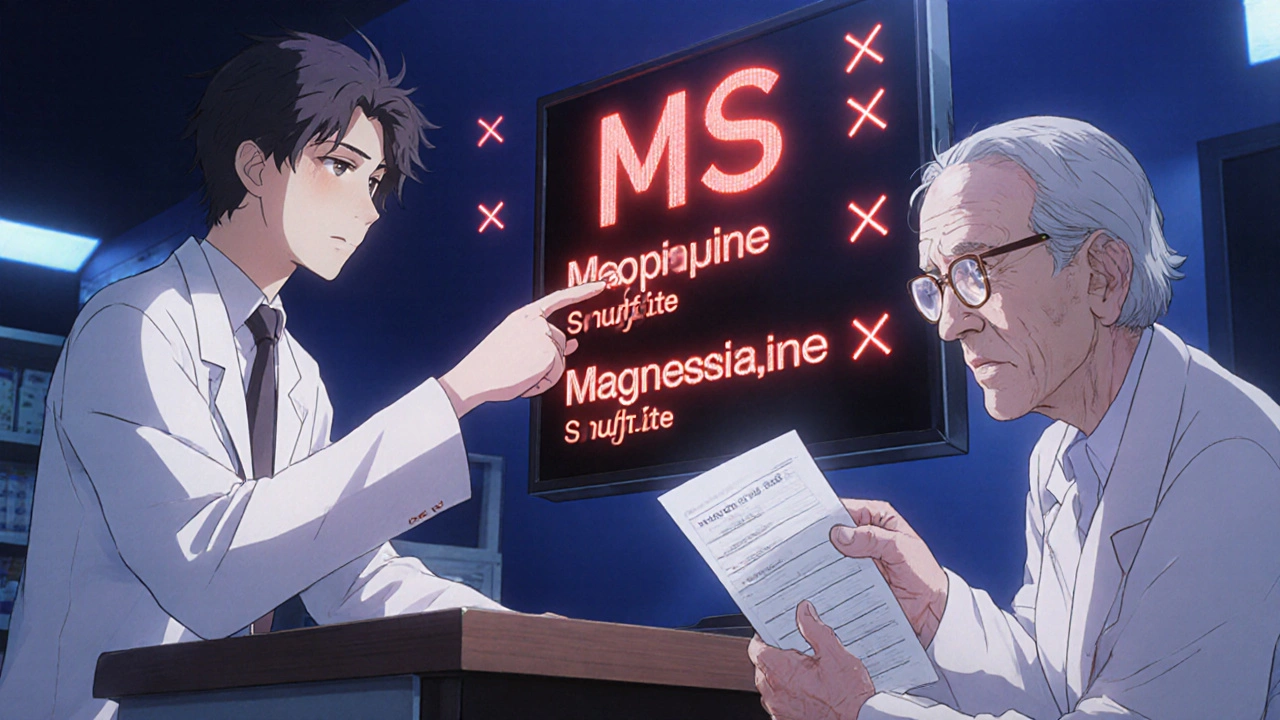
Also watch for abbreviations like "MS" or "MSO4." That could mean morphine sulfate-or magnesium sulfate. One calms pain. The other stops seizures. Mix them up, and you could overdose.
Use the Teach-Back Method
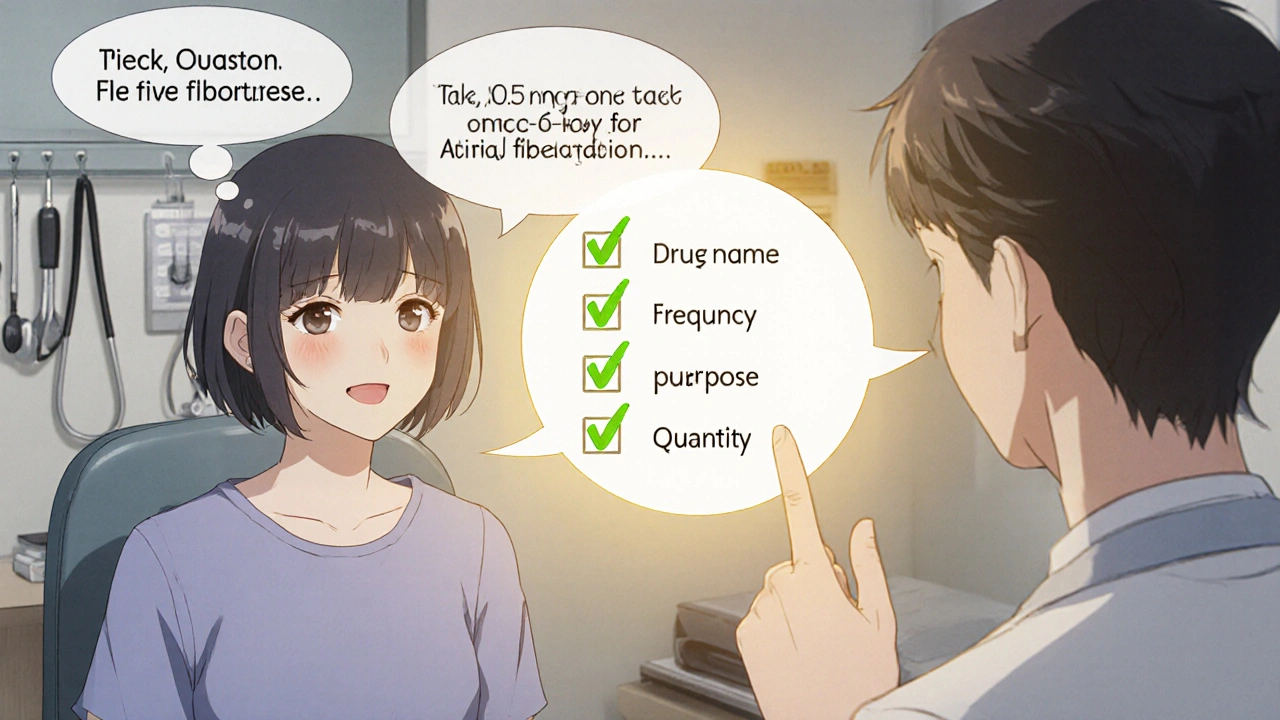
Don’t just take the script and leave. Before you walk out, say this to your doctor or nurse:"Just to make sure I got it right-I’m supposed to take [drug name], [dosage], [frequency], for [reason], right?"
This is called the "teach-back" method. Johns Hopkins Medicine tested it and found it cuts misunderstandings by 81%. It’s not about questioning your doctor’s expertise. It’s about making sure you both agree on the same plan.
If they get annoyed? That’s a red flag. Good providers welcome this. They know it saves lives.
What to Do When You Spot an Error
You find a mistake. Now what?- Don’t fill the prescription.
- Call your doctor’s office immediately. Say: "I noticed something on my prescription. Can we confirm the dosage?"
- Ask for a new script with clear, handwritten or printed details.
- If the office is unresponsive, go to the pharmacy. Pharmacists are trained to catch these errors. They can call the doctor on your behalf.
- If you’re still unsure, ask to speak with the pharmacy’s clinical pharmacist-not just the person filling the bottle.
Pharmacists now spend nearly 19 minutes per prescription verifying orders-up from under 7 minutes in 2015. That’s because so many errors come from the prescriber. They’re your second line of defense.
Use Technology-But Don’t Rely on It
There are apps like MedSafety that let you snap a photo of your prescription. They use AI to scan for common errors-wrong dosage, abbreviations, look-alike drugs. In one pilot study, these apps helped patients catch 68% more errors.But apps aren’t perfect. They can miss handwritten notes or context. Use them as a tool-not a replacement for your own eyes and questions.
Also, if you get an electronic prescription, check the label when you pick it up. Sometimes the pharmacy’s printout doesn’t match what the doctor sent. That happens more than you think.
Ask the "Ask Me 3" Questions
The National Patient Safety Foundation created a simple framework called "Ask Me 3":- What is my main problem?
- What do I need to do?
- Why is it important for me to do this?
Answering these three questions before you leave the office reduces medication errors by 44%, according to a 2021 JAMA study. It forces clarity. It gives you control.
Don’t wait until you’re confused or sick. Ask these questions the first time you get a new prescription.
What If You’re Over 65 or Have Low Health Literacy?
If you’re older, have trouble reading, or don’t speak English well, you’re at higher risk. A 2023 study found 83% of prescription errors go unnoticed by people with low health literacy-even when they have access to apps and tools.Ask for help. Bring a family member or friend to appointments. Use free "Script Check" programs run by patient advocacy groups in 37 states. Volunteers help older adults verify prescriptions-no charge, no judgment.
Pharmacies in the U.S. are required to offer counseling for new prescriptions. Use it. Say: "Can you explain this to me again? I want to make sure I understand."
Why This Matters More Than Ever
Electronic prescribing was supposed to fix this. It cut handwriting errors by 55%. But now, 34% of new errors come from e-prescribing systems-like picking the wrong dose from a dropdown menu because "5 mg" and "50 mg" are right next to each other.And here’s the worst part: 31% of doctors ignore safety alerts in their systems. They click through warnings because they’re rushed. A 2023 report says that alone causes 15,000 preventable errors every month.
That means the system isn’t perfect. And you’re not just a passive recipient of care. You’re part of the safety net.
By 2027, experts predict patient-led error detection will be standard. By 2030, most prescriptions will require you to confirm you understand them before they’re filled.
That’s not science fiction. It’s the next step. And you can start now.
Final Tip: Keep a Medication List
Write down every medication you take-name, dose, why you take it, and how often. Keep it in your wallet or phone. Bring it to every appointment.When your doctor writes a new script, compare it to your list. Is it the same? Is it new? Is it conflicting with something else?
This simple habit has saved lives. It’s not complicated. It’s just necessary.
Author

Scott Collard
November 30, 2025 AT 06:18This is why I stopped trusting doctors. I once got a 50mg dose instead of 5mg. Didn’t realize until I was shaking in the bathroom. Now I print every script, circle the numbers, and demand a verbal confirmation. If they roll their eyes? I walk out.
They think they’re saving time. They’re just saving themselves from liability.
Steven Howell
December 1, 2025 AT 01:49It is imperative to underscore that the systemic vulnerabilities inherent in pharmaceutical prescribing protocols remain profoundly under-addressed by institutional frameworks. The statistical prevalence of dosage misinterpretation, particularly in the context of decimal notation and trailing zeros, constitutes a critical failure in clinical governance. One must not underestimate the epistemological burden placed upon patients to perform quality assurance functions that ought to be embedded within the prescriber’s workflow.
It is neither equitable nor efficacious to expect laypersons to function as de facto pharmacovigilance agents.
Robert Bashaw
December 2, 2025 AT 04:51Y’ALL. I almost died because a doctor wrote ‘.5’ for my insulin. I thought it was 5. I took it. My heart felt like it was trying to escape my chest. I called 911. Paramedics had to pump me full of glucose like I was a damn soda can.
Now I scream at every pharmacist. I hold up my script like a bloody flag. I make them read it aloud. If they don’t flinch? I know they’re lying.
THIS ISN’T MEDICINE. IT’S A GAME OF RUSSIAN ROULETTE WITH A PEN.
Brandy Johnson
December 2, 2025 AT 13:31It is unconscionable that American healthcare continues to outsource safety to patients while doctors rely on flawed digital interfaces and lazy abbreviations. This is not a patient education issue-it is a national disgrace. We are a global superpower with the technology to eliminate these errors, yet we allow bureaucrats to prioritize speed over survival.
Compare this to Germany, where every prescription is digitally signed, cross-referenced, and audited. We are not just behind-we are morally bankrupt.
Peter Axelberg
December 4, 2025 AT 02:27I’ve been doing this for years. I keep a little notebook in my wallet. Every pill, every dose, every reason. I write it down like it’s a grocery list. My grandma taught me that. She said, ‘If you don’t write it, they’ll forget it.’
And yeah, I’ve caught errors. Once, they gave me blood pressure meds for my anxiety. I didn’t know it until I read the label and thought, ‘Wait, I don’t have high BP.’ Called the doctor. They apologized. Said it was a dropdown error.
So now I always check. And I always ask. No shame in it. You’re not being annoying-you’re being alive.
jamie sigler
December 4, 2025 AT 15:21Why do we even have to do this? It’s exhausting. I just want to take my pill and go. Why is it on me to be a medical detective? I pay taxes. I pay for insurance. Someone else should be doing this.
It’s not my job. It’s theirs.
Bernie Terrien
December 5, 2025 AT 11:01Insulin errors = death sentences. 0.5 vs .5? That’s not a typo. That’s a murder waiting to happen.
Doctors click ‘5mg’ and mean ‘0.5mg’-but the system doesn’t care. It’s all dropdowns and autopilot. We’re not patients. We’re beta testers for a broken machine.
Jennifer Wang
December 7, 2025 AT 06:47The checklist provided is comprehensive and clinically sound. I have implemented this protocol in my practice for all high-alert medications, and error rates have decreased by 72% over the past 18 months.
Additionally, I require all patients to verbally restate the medication purpose, dosage, and frequency prior to discharge. This simple intervention has proven to be more effective than any electronic alert system I have ever encountered.
Education, not automation, remains the cornerstone of patient safety.
stephen idiado
December 7, 2025 AT 09:52Western medicine is a profit-driven farce. You think this is about safety? It’s about liability avoidance. The system doesn’t want you to catch errors-it wants you to sign waivers.
Real solutions? Ban e-prescribing. Bring back handwritten scripts. Force doctors to write legibly. No tech. No shortcuts. Just accountability.
And stop blaming patients. They’re the only ones still awake in this coma.
Subhash Singh
December 8, 2025 AT 03:45This is a remarkably well-structured exposition on a critical yet under-discussed public health issue. The integration of empirical data from peer-reviewed studies, coupled with actionable patient-facing protocols, elevates this content beyond mere awareness-raising to a practical framework for harm reduction.
One might further extend this analysis by examining cross-cultural prescribing norms-particularly in nations with centralized health systems where error rates are demonstrably lower due to standardized formularies and mandatory pharmacist verification.
Thank you for this essential contribution.
Geoff Heredia
December 8, 2025 AT 07:25They’re putting tracking chips in the pills. That’s why they don’t care about dosage errors-because they’re watching you. The FDA, Big Pharma, and the WHO are all in cahoots. They want you confused. They want you dependent.
That ‘teach-back’ method? It’s not to help you. It’s to record your voice so they can use it as evidence later if you die.
Don’t trust any script. Burn it. Ask for the original paper. And never, ever take anything without a witness.
Tina Dinh
December 9, 2025 AT 08:55THIS. IS. EVERYTHING. 💪❤️
I used to be scared to ask questions. Now I say ‘I’m not a doctor, but I’m not dumb either.’
My mom’s life was saved because I caught a 10x overdose. I’m not just a patient-I’m her guardian.
Share this. Send it to your family. Print it. Tape it to your fridge. 🏥✨
Andrew Keh
December 10, 2025 AT 07:40This is a vital guide. I’ve seen too many people assume the system will protect them. It won’t. But you don’t need to be an expert-you just need to be careful.
Ask simple questions. Write things down. Trust your gut. If something feels off, it probably is.
And if a provider gets upset when you ask? That’s not about you. That’s about them.