
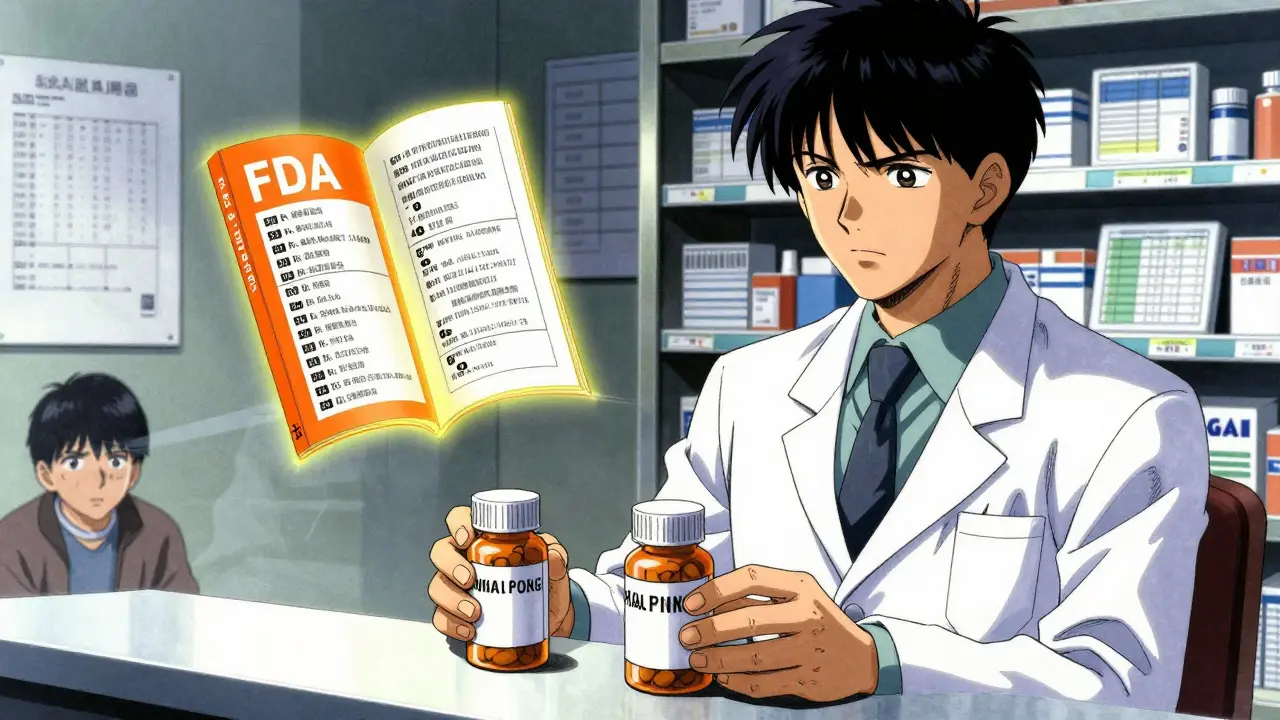
When a pharmacist hands a patient a bottle of generic medication, it might look like a simple swap. But behind that moment lies a complex web of federal rules, state laws, and professional duties that can make or break patient safety. In 2025, over 90% of prescriptions filled in the U.S. are for generic drugs. That’s not just cost-saving-it’s a legal system that puts pharmacists on the front line of compliance. Get it wrong, and you could be violating state law, risking disciplinary action, or worse-putting someone at risk of a dangerous therapeutic failure.
What Makes a Generic Drug Legal to Substitute?
The FDA doesn’t just approve any generic drug as equal to the brand. To be listed in the Orange Book, a generic must meet strict criteria: same active ingredient, same strength, same dosage form, same route of administration, and, most critically, proven bioequivalence. That means it must enter the bloodstream at the same rate and amount as the brand-name version. The FDA’s Abbreviated New Drug Application (ANDA) process ensures this-not through new clinical trials, but through rigorous lab and pharmacokinetic testing.
But here’s the catch: not all generics are created equal in the eyes of the law. Only A-rated drugs are considered interchangeable without additional approval. You’ll see these ratings on the Orange Book-A means bioequivalent. B means not interchangeable. If a patient’s prescription says levothyroxine and you dispense a B-rated generic? That’s a violation, even if the bottle says “generic thyroid medicine.”
State Laws Vary-A Lot
There’s no single federal rule forcing pharmacists to substitute generics. Instead, 51 different systems exist: 50 states plus D.C. Each one has its own rules on when you can substitute, when you must, and whether the patient needs to say yes.
In mandatory substitution states like New York and California, you’re required to swap a brand for a generic unless the prescriber writes “dispense as written” or “do not substitute.” In permissive states like Texas and Florida, you can choose to substitute-but you don’t have to. That gives you more professional discretion, but also more responsibility to justify your decision.
Then there’s consent. In explicit consent states-which include 32 states-you must get the patient to agree before swapping. That means verbal confirmation, a signed form, or a checkbox in the electronic system. In presumed consent states like Illinois and Ohio, you can substitute without asking, unless the patient says no upfront. But even then, you’re still required to notify them after the fact.
Some states go further. Tennessee bans substitution for antiepileptic drugs-even if they’re A-rated-because of the risk of breakthrough seizures. Hawaii requires both prescriber and patient consent for the same drugs. Florida excludes narrow therapeutic index drugs like warfarin, digoxin, and lithium from automatic substitution. These aren’t suggestions. They’re legal requirements.
The “Medically Necessary” Rule
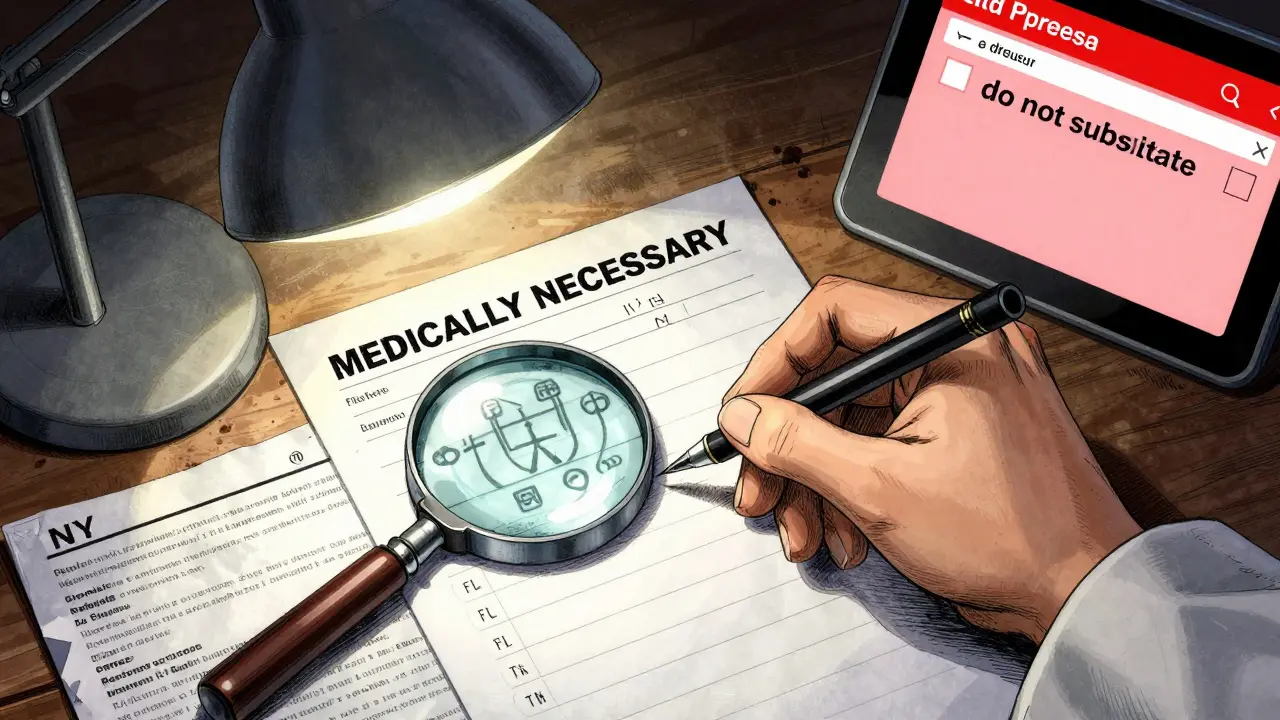
One of the most common points of confusion for pharmacists is how prescribers block substitution. In many states, a doctor can prevent a generic from being dispensed by writing “MEDICALLY NECESSARY” on the prescription. But here’s what most pharmacists don’t realize: in states like Florida, that phrase must be written in the prescriber’s own handwriting. Typed or electronic notes won’t cut it.
Electronic prescriptions are even trickier. In states with digital requirements, the prescriber must use a specific code or checkbox in the e-prescribing system to indicate medical necessity. If you miss it? You’re legally obligated to substitute-even if you know the patient has had a bad reaction to a generic before. That’s why many pharmacists now double-check e-prescription flags before filling.
What You Can’t Substitute-Even If It’s A-Rated
Just because a drug is FDA-approved as bioequivalent doesn’t mean you can swap it. Certain classes are off-limits in many states:
- Antiepileptic drugs (phenytoin, carbamazepine, valproate)
- Anticoagulants (warfarin)
- Cardiac glycosides (digoxin)
- Thyroid medications (levothyroxine)
- Anti-asthmatics (especially extended-release forms)
- Insulin (in some states)
Why? Because these drugs have a narrow therapeutic index-meaning the difference between an effective dose and a toxic one is tiny. A 10% variation in absorption might be fine for an antibiotic. For warfarin? That could mean a stroke or internal bleeding. Studies, including one in JAMA Internal Medicine in 2019, found a 12.7% higher rate of adverse events when switching generic versions of digoxin, even when labeled A-rated.
So even if the Orange Book says it’s interchangeable, your state law might say no. And if you ignore it? You’re not just breaking policy-you’re breaking the law.
Documentation Is Your Shield
Most disciplinary actions against pharmacists aren’t for giving the wrong drug. They’re for failing to document correctly.
In 2022, 68% of state pharmacy board violations involved missing or incorrect records on substitutions. That includes:
- No patient consent form signed
- No note that the prescriber wrote “dispense as written”
- No record of notifying the patient after substitution
- Incorrectly marking a drug as A-rated in your system
Every substitution you make should be logged: the original brand, the generic you dispensed, the date, whether consent was obtained, and any state-specific notes. Many pharmacies now use automated systems that flag high-risk drugs or missing consents-but you still have to review them. Relying on software alone is a recipe for trouble.
What Happens When You Get It Wrong?
Penalties vary by state, but they’re serious. A first offense might mean a warning or fine. Repeat offenses can lead to license suspension or revocation. In extreme cases-like substituting an antiepileptic drug in Tennessee and causing a seizure-you could face civil liability or even criminal charges.
And it’s not just legal risk. Patient trust evaporates fast. A 2023 survey found that 63% of negative reviews about pharmacies cited “not being told about the switch” as the main complaint. Patients don’t care if it’s FDA-approved. They care if they felt informed.
How to Stay Compliant
Keeping up with 51 sets of rules sounds impossible. But here’s how the best pharmacists do it:
- Check your state’s pharmacy board website monthly. Laws change. In 2022 alone, 17 states updated substitution rules.
- Use the FDA Orange Book daily. It’s free, updated monthly, and shows you exactly which generics are A-rated.
- Train your staff. Every new hire needs a 2-hour session on substitution laws-not just the basics, but the exceptions.
- Know your EHR system. Make sure it flags “dispense as written,” blocks substitution for restricted drugs, and logs consents properly.
- When in doubt, ask. Call the prescriber. Call your state board. Call your pharmacy association. It’s better to delay a fill than to violate the law.
And never assume a generic is safe just because it’s cheap. The goal isn’t just to save money-it’s to save lives. And that starts with knowing the law, respecting the science, and putting the patient first.
What About Biosimilars?
Biosimilars are a new frontier. Unlike traditional generics, they’re made from living cells, not chemicals. The FDA has approved over 40 since 2015, and 32 states now have specific laws for their substitution. But here’s the key: unlike generics, biosimilars can’t be automatically substituted unless they’re labeled “interchangeable.” That’s a higher bar. You must check the label and your state’s rules before swapping.
Many pharmacists treat biosimilars like brand-name drugs until they’re sure. That’s the safest approach.
Final Thought: You’re the Gatekeeper
Doctors write the prescription. Insurance companies push for generics. Patients expect savings. But you’re the one who holds the bottle and decides whether to hand it over. That’s not just a job. It’s a legal duty. And in a system where 90% of prescriptions are generic, your knowledge of the law isn’t optional-it’s the only thing standing between a patient and a preventable error.
Can a pharmacist substitute a generic without telling the patient?
It depends on the state. In 32 states, pharmacists must get explicit consent from the patient before substituting a generic. In the other 19 states, substitution is allowed without prior consent, but the patient must be notified afterward. Always check your state’s specific rules-failure to notify when required is one of the most common legal violations.
Are all generic drugs interchangeable with brand-name versions?
No. Only generics with an “A” rating in the FDA’s Orange Book are considered therapeutically equivalent and legally interchangeable. Some generics carry a “B” rating, meaning they are not interchangeable. Even with an “A” rating, certain drugs-like antiepileptics, warfarin, and levothyroxine-are restricted from substitution in many states due to narrow therapeutic index risks.
What happens if a pharmacist substitutes a drug that’s prohibited by state law?
The pharmacist can face disciplinary action from the state board of pharmacy, including fines, mandatory retraining, license suspension, or even revocation. In cases where substitution leads to patient harm-such as a seizure from an improperly swapped antiepileptic drug-civil liability or criminal charges may also apply. Documentation errors are the most common reason for violations, not the substitution itself.
Can a prescriber prevent generic substitution?
Yes. In every state, a prescriber can write “dispense as written,” “do not substitute,” or “medically necessary” on the prescription. In some states, like Florida, this must be handwritten. In electronic systems, the prescriber must select a specific code. Pharmacists are legally required to honor these directives-even if the generic is cheaper or more convenient.
Do I need to check the Orange Book every time I fill a prescription?
Yes. The FDA updates the Orange Book monthly. A drug that was A-rated last month could be downgraded due to new bioequivalence data. Relying on memory or outdated software is risky. Best practice is to verify the rating at the time of dispensing-especially for high-risk drugs like thyroid meds, anticoagulants, or seizure medications.
Are biosimilars treated the same as generic drugs?
No. Biosimilars are biologic drugs, not small-molecule generics. They can only be substituted if they’re labeled “interchangeable” by the FDA and if your state allows substitution for biosimilars. Even then, many states require patient consent and prescriber notification. Never assume a biosimilar can be swapped like a regular generic.
Next Steps for Pharmacists
If you’re unsure about your state’s rules, start here: Visit your state board of pharmacy’s website. Look for the section on generic substitution. Download their official policy document. Print it. Keep it next to your computer.
Then, schedule a team meeting. Go through your top 10 most prescribed generic drugs. Check each one against the Orange Book. Flag any that are restricted in your state. Update your pharmacy’s internal checklist.
And if you’re ever uncertain-don’t guess. Call the prescriber. Call your state board. Call your professional association. One wrong substitution can change a life. Your job isn’t just to fill prescriptions. It’s to protect people. That’s the real legal obligation.
Author

Hadi Santoso
December 16, 2025 AT 23:39man i just found out my thyroid med switched generics last month and i felt like a zombie for two weeks. didn’t even know they could do that without telling me. now i check the bottle every time like it’s a lottery ticket.
Billy Poling
December 17, 2025 AT 08:34It is of paramount importance to underscore that the substitution of pharmaceutical agents, particularly those possessing a narrow therapeutic index, constitutes a matter of profound legal and ethical consequence. The absence of explicit patient consent, coupled with the failure to verify the FDA Orange Book’s current A-rating status, may precipitate a cascade of regulatory infractions, including but not limited to licensure suspension, civil liability, and, in extremis, criminal prosecution under state statutes governing pharmacy practice.
Randolph Rickman
December 18, 2025 AT 13:14Big shoutout to all the pharmacists grinding through this stuff daily. You’re the unsung heroes keeping people safe when insurance companies are pushing for the cheapest option. I’ve seen pharmacists call doctors at 7pm just to confirm a substitution - that’s dedication. Keep doing what you’re doing, and if you’re ever unsure? Stop. Ask. Double-check. It’s not a delay - it’s a duty.
Tiffany Machelski
December 19, 2025 AT 14:43so i just realized i’ve been getting generic levothyroxine for years and never knew about the a-rated thing… oops. my bad. gonna print that orange book page and tape it to my mirror.
Souhardya Paul
December 19, 2025 AT 20:34Just want to add - if you’re a new grad pharmacist, don’t panic. Most pharmacies have checklists and EHR flags for this stuff. But yeah, you gotta learn the state rules like you learned pharmacokinetics. I made the mistake of assuming ‘generic = safe’ until a patient came back with a seizure after a switch. Never again. Always verify. Always document. Always ask.
Josias Ariel Mahlangu
December 21, 2025 AT 19:31This is what happens when profit overrides principle. The FDA lets companies make knockoffs and calls them ‘equivalent.’ But if you’re diabetic and your insulin changes, you don’t get a second chance. This system is broken, and pharmacists are just the pawns getting blamed.
anthony epps
December 22, 2025 AT 19:10wait so if my doc writes ‘do not substitute’ but it’s typed, not handwritten, you still have to give the generic? that’s wild.
Andrew Sychev
December 23, 2025 AT 07:24THEY LET YOU SWITCH MY WARFARIN WITHOUT TELLING ME AND I ALMOST DIED. I’M STILL TERRIFIED TO TAKE ANYTHING THAT’S NOT BRAND. THIS ISN’T JUST LAW - IT’S A NIGHTMARE. SOMEONE NEEDS TO SUE EVERYONE.
Dave Alponvyr
December 24, 2025 AT 10:02So you’re telling me I need to check the FDA’s website every time I fill a script… and I thought pharmacy school was hard.
Ron Williams
December 26, 2025 AT 08:47Had a guy in here last week ask why his generic seizure med made him feel ‘off.’ Turned out it was a B-rated swap from a different manufacturer. We called the doc, switched it back, and he cried. That’s why this stuff matters. Not the money. Not the policy. The person holding the bottle.
Aditya Kumar
December 27, 2025 AT 10:20too much reading. just tell me if i can get the cheap one.
James Rayner
December 27, 2025 AT 12:00It’s not just about compliance… it’s about trust. Every time we hand over a bottle, we’re holding someone’s life in our hands - not just the pills. And when we skip the consent, skip the check, skip the call… we’re not just breaking rules. We’re breaking faith. I’ve seen what happens when that faith cracks. And I won’t let it happen on my watch. 🙏