

| Approach | Primary Goal | Common Examples | Typical Timeline for Effect |
|---|---|---|---|
| Medication | Balance Brain Chemistry | SSRIs, SNRIs | 4-8 Weeks |
| Psychotherapy | Change Thought Patterns | CBT, IPT | 8-28 Sessions |
| Lifestyle | Support Brain Health | Exercise, Sleep Hygiene | Ongoing/Immediate |
Understanding Your Treatment Options
When you first see a doctor, they'll likely use a tool like the PHQ-9 (a standard questionnaire) to see where you land on the severity scale. This is crucial because the "right" treatment depends entirely on where you are. For someone with mild symptoms, a prescription might be overkill. For someone with severe depression, relying only on a morning jog isn't enough. The gold standard today is a "matched care model," meaning the intensity of the treatment matches the severity of the symptoms.If you're in the mild-to-moderate range, you might start with guided self-help or a few therapy sessions. But for moderate-to-severe cases, a combination of meds and therapy usually yields the best results-often pushing response rates up to 60-70%, compared to only 40-50% when using just one method.
The Role of Medications in Mental Health
For many, Antidepressants medications used to treat depression by balancing neurotransmitters in the brain provide the stability needed to even engage in therapy. Most doctors start with SSRIs (Selective Serotonin Reuptake Inhibitors) a class of drugs that increase serotonin levels in the brain to improve mood . You've likely heard of names like Sertraline, Citalopram, or Fluoxetine. They're the first choice because they generally have fewer side effects than older drugs.However, meds aren't a "one-size-fits-all" pill. While SSRIs are great for many, they can cause sexual dysfunction in 30-50% of users. If those are a dealbreaker, a doctor might suggest Bupropion an antidepressant that focuses on dopamine and norepinephrine, often with fewer sexual side effects . On the flip side, SNRIs (Serotonin-Norepinephrine Reuptake Inhibitors) are powerful but can occasionally bump up blood pressure in 10-15% of patients.
What happens if the first pill doesn't work? It's common. The STAR*D trial showed that while the first medication might not do the trick, switching or adding a second treatment (like lithium or a low-dose antipsychotic) can eventually lead to remission for about 67% of people. The key is patience; most antidepressants need 4 to 8 weeks at a full dose before you can tell if they're actually working.
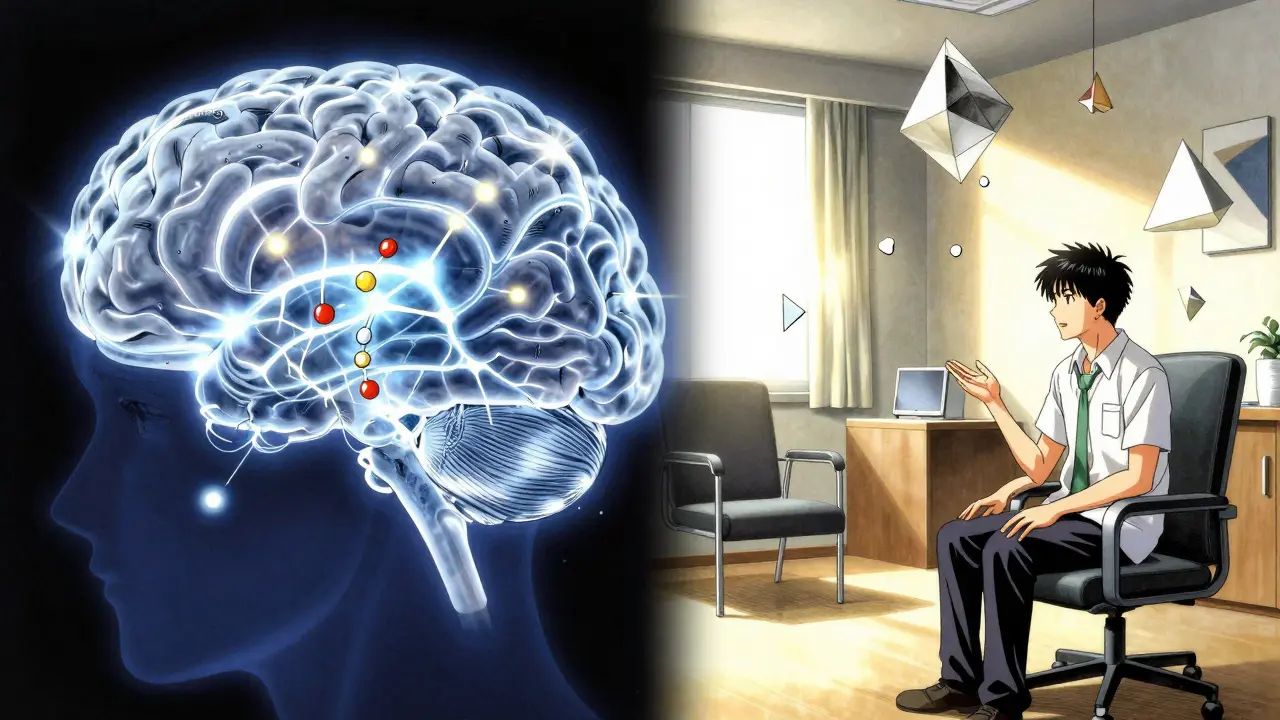
Psychotherapy: Rewiring the Mind
While meds handle the chemistry, therapy handles the patterns. Cognitive Behavioral Therapy (CBT) a structured therapy that helps patients identify and change negative thought patterns and behaviors is essentially the heavyweight champion of depression treatment. It's a practical, goal-oriented approach. Instead of just talking about your childhood, you're learning tools to challenge the voice in your head that says "nothing will ever get better."If your depression is tied to a specific life event or a crumbling relationship, Interpersonal Therapy (IPT) a short-term therapy focusing on improving the quality of a person's interpersonal relationships might be a better fit. It focuses on the here-and-now-how to communicate better and resolve conflicts that are fueling your sadness.
For those who struggle with recurrent depression-meaning it keeps coming back every few years- Mindfulness-Based Cognitive Therapy (MBCT) a group program combining CBT and mindfulness to prevent depressive relapses is a lifesaver. By learning to observe your thoughts without judging them, you can stop a "dip" in mood from becoming a full-blown episode. In fact, one study showed it could cut the risk of relapse by 31%.
Lifestyle Changes That Actually Work
We've all heard "just exercise more," but there's actual science behind it. For mild depression, structured exercise can be as effective as medication. We're talking about moderate-intensity movement-like brisk walking for 30-45 minutes-three to five times a week. It's not about running a marathon; it's about consistent movement that triggers the release of endorphins.Then there's the "invisible" pillar: sleep. Insomnia hits about 75% of people with depression, creating a vicious cycle where poor sleep makes depression worse, and depression makes it impossible to sleep. A strict sleep hygiene routine can improve severity scores by 30-40%. This means keeping a consistent wake time (within 30 minutes) and ditching your phone an hour before bed. The blue light from screens tricks your brain into thinking it's daytime, killing your melatonin production.
Diet also plays a surprising role. The SMILES trial proved that a Mediterranean-style diet-heavy on vegetables, fruits, whole grains, and lean proteins-can lead to remission in a significant number of people. It's not a cure on its own, but feeding your brain the right nutrients makes every other treatment more effective.

Advanced Options for Resistant Cases
Sometimes, the standard toolkit isn't enough. About 30% of people deal with treatment-resistant depression. In these cases, doctors look toward more intensive interventions. Electroconvulsive Therapy (ECT) a medical treatment involving brief electrical stimulation of the brain while under anesthesia remains one of the most effective tools for severe or psychotic depression, with remission rates between 70-90%. While the idea of ECT scares people because of old movies, modern ECT is safe and highly controlled, though it can cause temporary memory gaps in about 60% of patients.For those who want something less invasive, repetitive Transcranial Magnetic Stimulation (rTMS) a non-invasive procedure that uses magnetic fields to stimulate nerve cells in the brain is a great alternative. It involves a magnetic coil placed against the scalp, and it's shown a 50-55% response rate after a few weeks of treatment. It's a way to "wake up" parts of the brain that have gone dormant during depression.
How long does it take for depression medication to work?
Most antidepressants, especially SSRIs, take about 4 to 8 weeks to reach their full effect. You might notice small improvements in sleep or energy in the first two weeks, but the significant lift in mood usually takes longer. It is critical not to stop taking them early just because you don't feel a change immediately.
Can I treat depression with only lifestyle changes?
For mild depression, a combination of structured exercise, a healthy diet, and improved sleep hygiene can be very effective and is often recommended as a first step. However, for moderate to severe depression, lifestyle changes are typically used to support-not replace-therapy or medication.
What is the difference between CBT and other therapies?
Cognitive Behavioral Therapy (CBT) focuses on the relationship between your thoughts, feelings, and behaviors. Unlike traditional "talk therapy" that may focus heavily on the past, CBT is present-focused and provides concrete tools to dismantle negative thought loops in real-time.
Are antidepressants addictive?
Antidepressants are not addictive in the way that opioids or benzodiazepines are; they don't cause cravings or "drug-seeking" behavior. However, they can cause physical dependence, meaning you may experience withdrawal symptoms (discontinuation syndrome) if you stop them abruptly. Always taper off under a doctor's guidance.
What should I do if my medication isn't working?
If you've been on a target dose for 8 weeks with no improvement, talk to your provider about a "treatment sequence." This could involve switching to a different class of medication, augmenting your current dose with another drug (like lithium), or adding a psychotherapy component if you aren't already in one.
Next Steps for Your Recovery
If you're feeling overwhelmed, don't try to do everything at once. Start by booking a simple appointment with a primary care doctor to get a baseline assessment. If you have a high PHQ-9 score, ask about a combination of a first-line SSRI and a referral for CBT.For those who find traditional therapy too expensive or hard to access, look into FDA-cleared digital therapeutics or telehealth services. While not as personalized as a face-to-face session, they provide a critical bridge to care. Remember that recovery isn't a straight line; there will be good weeks and bad ones, but the evidence shows that with a personalized, multimodal approach, the vast majority of people can find a way back to a functioning, fulfilling life.
Author

Clint Humphreys
April 17, 2026 AT 07:13It's funny how they push these SSRIs so hard when you realize that the pharmaceutical industry basically owns the regulatory boards, and honestly, the way these drugs alter your brain chemistry is just a way for the system to keep us docile and compliant while they ignore the fact that our modern environments are designed to be depressing in the first place, but hey, I'm just a guy who looks at the data they don't want us to see, so take it with a grain of salt while you're paying your monthly subscription for "wellness" from a company that profits from your sadness.
Kenzie Evans
April 18, 2026 AT 01:46This is way too basic. Anyone with half a brain knows that the PHQ-9 is practically useless for identifying complex comorbidities. It's a lazy tool for doctors who want to spend five minutes with a patient instead of actually doing a diagnostic deep dive. Also, the section on diet is a joke because it doesn't even mention gut microbiome health, which is where most of the serotonin is actually produced. Totally missed the mark on the biological reality here.
Haley Moore
April 19, 2026 AT 23:21Ugh, the formatting of that table is so mid 🙄 and this whole "guide" feels like it was written by a textbook from 2005. Like, please tell me something I don't already know? The drama of acting like ECT is "scary" is such a cliché move. I've seen better advice on a random wellness blog. Truly exhausted by the lack of nuance here 💅
Olivia Lo
April 21, 2026 AT 05:29The ontological tension between the biochemical model and the phenomenological experience of suffering is quite profound. We often treat the symptom as the pathology itself, neglecting the existential crisis that often underlies these affective disorders. By framing recovery as "remission," we risk reducing the human spirit to a mere chemical equation, though the synthesis of CBT and mindfulness does offer a commendable bridge toward a more holistic integration of the self.
john chiong
April 22, 2026 AT 04:06imagining people actually think a mediterranean diet fixes a chemical imbalance is just peak delusion honestly. we are talking about a void in the soul and you guys are suggesting olive oil and salmon. it is a moral failing of a society that thinks a brisk walk cures the crushing weight of existence
melissa mac
April 23, 2026 AT 16:34It's really important to remember that everyone's journey is different. If you're feeling stuck, just know that it's okay to start small, maybe just by focusing on that sleep hygiene part first. We're all in this together and finding the right combination of support just takes a bit of time and a lot of patience with yourself.
Catherine Mailum
April 25, 2026 AT 00:23oh wow i just love how we pretend a 30 minute walk is the magic cure for a brain that literally refuses to produce joy lol. truly revolutionary stuff here. i'm sure the void just disappears once you eat some kale and go to bed at 10pm. absolutely groundbreaking
mimi clouet
April 26, 2026 AT 09:48Actually, the STAR*D trial is super well known in the psych community! 🌟 It's so cool how switching meds can work for so many people. Just remember to always track your moods in a journal so your doctor has a clear map of what's working! ✨😊
Anurag Moitra
April 26, 2026 AT 13:21The emphasis on the matched care model is quite prudent. It ensures that the clinical intervention is proportionate to the patient's distress, thereby avoiding unnecessary pharmacological exposure for those with mild symptoms. This systematic approach is essential for the ethical practice of psychiatry.
Tabatha Pugh
April 27, 2026 AT 01:28The PHQ-9 is actually flawed because it doesn't account for cultural differences in how sadness is expressed, but I'm sure the author thinks it's the gold standard because that's what the insurance companies prefer. It's basically just a checklist to get you on a pill as fast as possible.