
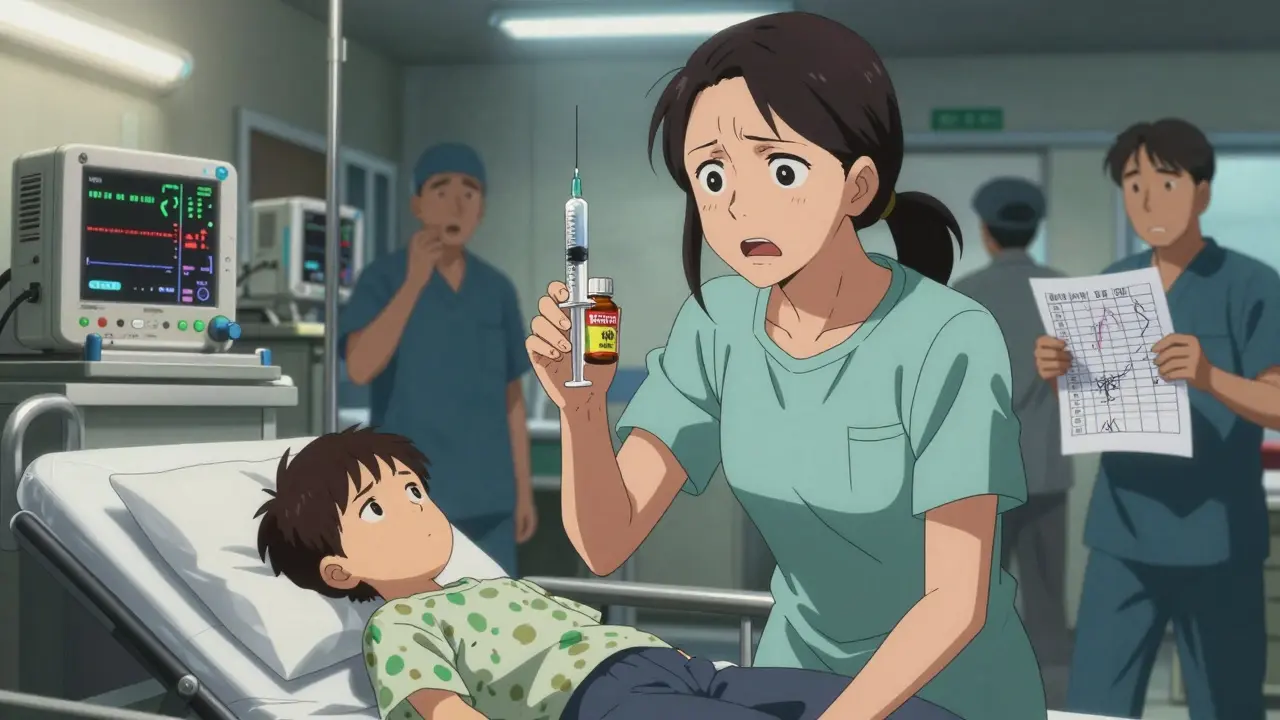
Every year, tens of thousands of children end up in emergency rooms because of a simple mistake: someone gave them the wrong amount of medicine. Not because the doctor messed up. Not because the pharmacy sent the wrong bottle. But because a parent, a nurse, or even a well-meaning caregiver misread a label, mixed up milligrams with milliliters, or guessed the child’s weight. In pediatric emergencies, these errors aren’t rare. They’re terrifyingly common.
Why Kids Are So Vulnerable
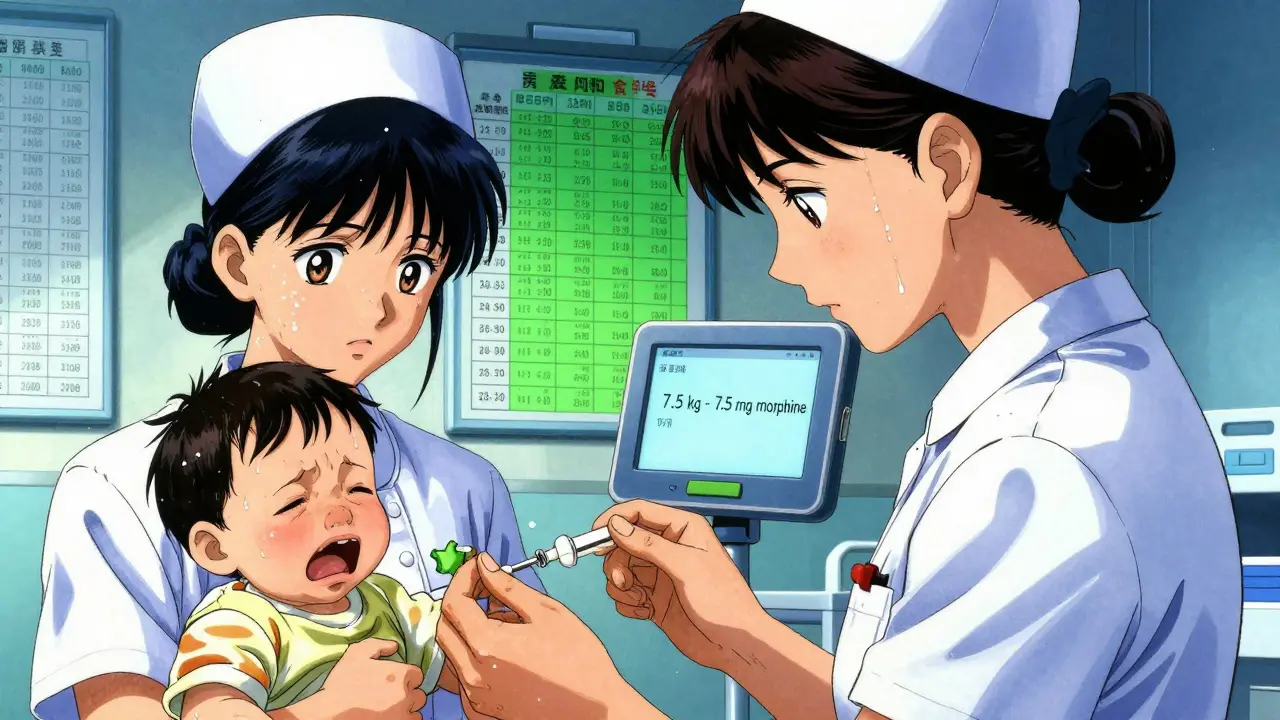
Adults get pills. Kids get liquids. And that’s where things get dangerous. A child’s dose isn’t just smaller-it’s calculated by weight, in milligrams per kilogram. One wrong decimal point, one misread syringe, one confused concentration, and you’re giving ten times the right dose. Take acetaminophen, for example. Infant Tylenol is 160 mg per 5 mL. Children’s Tylenol is 160 mg per 5 mL too-but the dropper is different. One parent gave their 2-year-old 5 mL of children’s Tylenol thinking it was the same as infant concentrate. They didn’t realize the concentration was different. The child ended up in the ER with liver damage. This isn’t a one-off. A 2024 study in JAMA Network Open found that 60-80% of outpatient dosing errors involve liquid medications. And 40% of children with chronic illnesses make at least one dosing mistake at home. Weight is another silent killer. In emergency settings, time is tight. A child is crying, the parents are panicked, and the nurse has to guess the weight because the scale is broken or the child won’t stay still. Studies show inaccurate weight measurement plays a role in 10-31% of pediatric medication errors. One child, estimated at 15 kg, was given 15 mg of morphine. The actual weight? 7.5 kg. That’s a 200% overdose. The child stopped breathing.The Most Common Mistakes (And What They Look Like)
The Child Health Patient Safety Organization tracked over 10,000 safety events in children’s hospitals between 2009 and 2022. Here’s what they found:- Wrong dose (13%) - Most common. Often from miscalculating mg/kg or confusing concentration.
- Wrong medication (4%) - Like giving amoxicillin instead of cefdinir. Sounds simple, but in a fast-paced ED, labels blur.
- Wrong rate or time (3%) - A drip meant to run over 30 minutes is cranked up to 5 minutes. Result: cardiac arrest.
- Wrong route (1%) - Oral liquid given IV. Fatal.
Why Errors Keep Happening
It’s not just human error. It’s system failure. In adult ERs, most drugs come in standard doses: 500 mg, 1 g, 10 mg. Easy. Pediatric drugs? They’re all custom. Every child needs a unique calculation. And in busy emergency departments, staff are rushing. Verbal orders fly. No time to double-check. Add to that: families with low health literacy make errors 2.3 times more often. Non-English speakers? 45% dosing error rate vs. 28% for English speakers. Parents who don’t understand “mg” vs. “mL” are at high risk. And many discharge instructions are printed in tiny font, with no pictures. Even hospitals aren’t immune. A 2023 study found that only 68% of children’s hospitals use pediatric-specific dosing calculators in their electronic records. Community hospitals? Often none. That means a kid brought to a general ER might get an adult dose because the system doesn’t have a pediatric option.What Works: Real Solutions That Saved Lives
There’s hope. And it’s not about hiring more staff or buying expensive tech. It’s about small, smart changes. At Nationwide Children’s Hospital, they cut harmful medication errors by 85% in five years. How? Three things:- Standardized weight-based protocols - Every drug has a pre-calculated dose chart by weight range. No math needed at the bedside.
- Double-checks for high-alert drugs - Morphine, insulin, sedatives - two staff members verify before giving.
- Real-time pharmacy review - Every pediatric order goes to a pharmacist before it’s given. No exceptions.
What Parents Can Do Right Now
You don’t need a medical degree to keep your child safe. Here’s what works:- Always ask: “Is this in mg or mL?” - If the answer is “mL,” ask what concentration it is.
- Use the syringe that came with the bottle. - Never use a teaspoon or shot glass.
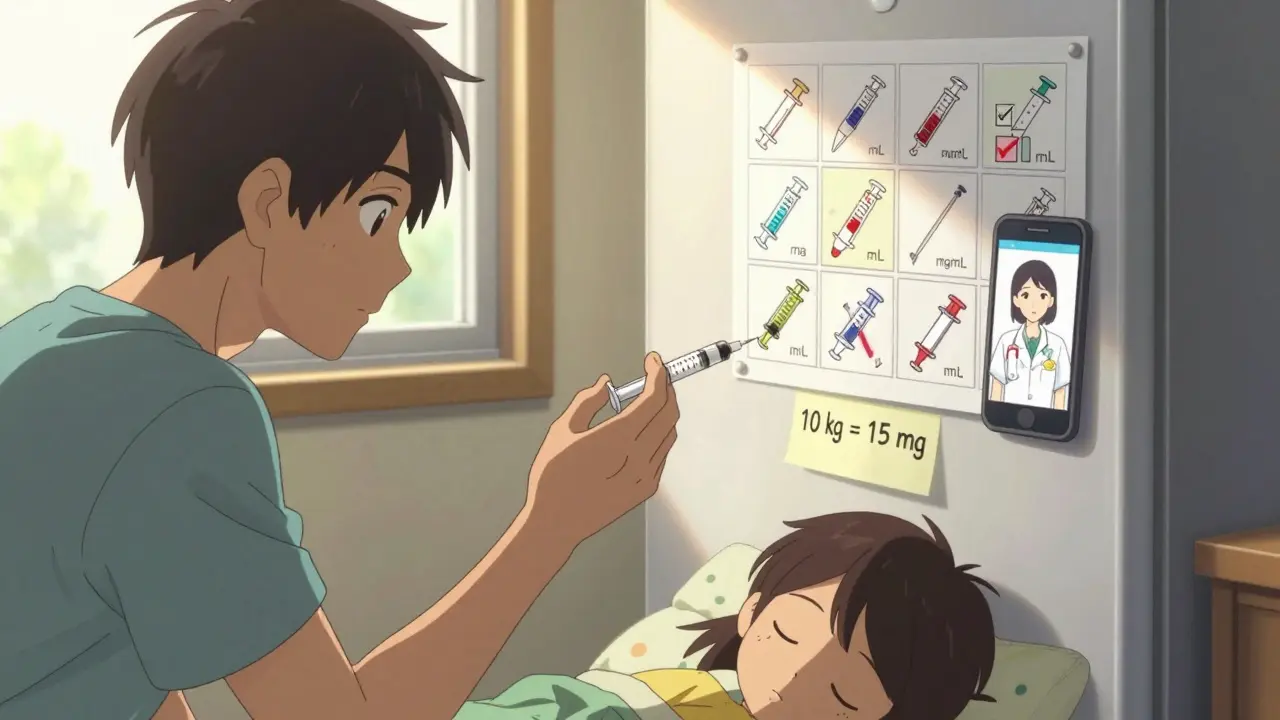
- Write down the dose. - “10 kg = 15 mg.” Keep it on your phone or a sticky note.
- Ask the nurse or doctor: “Can you show me how to give this?” - Watch them measure it. Then do it yourself in front of them.
- If you’re unsure, call your pediatrician before giving it. - Better safe than sorry.
The Bigger Picture
This isn’t just about one child. It’s about a system that still treats pediatric medication safety as an afterthought. In 2022, medication errors at home sent 63,000 children to the ER. That’s $28 million in avoidable costs. And yet, there’s no national standard for measuring outpatient dosing errors. No mandatory training for ER staff on pediatric calculations. No federal requirement for pictograms on children’s medicine labels. The American Academy of Pediatrics says medication safety is one of their top five priorities. But until hospitals, pharmacies, and drug makers make pediatric dosing as simple as adult dosing-until every bottle comes with a clear, visual guide-these mistakes will keep happening. The good news? We know what fixes work. Standardized charts. Pharmacy checks. Parent education. Simple tools. They’re not expensive. They’re not fancy. They just require willpower. The next time you’re handed a syringe of liquid medicine for your child, don’t assume you know what to do. Ask. Double-check. Show someone. That one extra step could save their life.What’s the most common pediatric medication error in emergencies?
The most common error is giving the wrong dose-usually because of miscalculating weight-based amounts or confusing milligrams (mg) with milliliters (mL). Liquid medications are involved in 60-80% of these mistakes, especially when parents use kitchen spoons or misread concentration labels.
Why are kids more at risk than adults for medication errors?
Kids need doses based on weight (mg/kg), not fixed amounts. Their bodies process drugs differently, and most medications come in liquid form, which increases the chance of measurement mistakes. Adults usually get pills with standard doses, while pediatric doses are custom-made for each child.
How can parents prevent dosing mistakes at home?
Use only the syringe or dosing cup that comes with the medicine. Never use a kitchen spoon. Always confirm the concentration (e.g., 160 mg per 5 mL). Write down the dose based on your child’s weight. Ask the provider to show you how to measure it. And if you’re unsure, call before giving it.
Do hospitals have systems to prevent these errors?
Leading children’s hospitals use standardized weight-based dosing charts, double-checks for high-risk drugs, and real-time pharmacy reviews. But many community ERs still lack these tools. Only 68% of children’s hospitals have pediatric-specific dosing calculators in their electronic records-far fewer in general ERs.
Are language barriers a factor in medication errors?
Yes. Parents with limited English proficiency have a 45% dosing error rate compared to 28% for English-speaking parents. Clear, visual instructions and trained interpreters reduce this gap. Simple pictograms showing how to use a syringe can cut errors by nearly half.
What should I do if I think I gave my child too much medicine?
Call Poison Control at 1-800-222-1222 immediately. Don’t wait for symptoms. Even if your child seems fine, some overdoses (like acetaminophen) don’t show signs for hours. Bring the medicine bottle with you. Time matters.
Author

Mark Able
December 20, 2025 AT 02:06Man I once gave my kid ibuprofen with a kitchen spoon because I was tired and thought 'how bad could it be?' Turns out super bad. She puked for hours. Never again. Always use the damn syringe.
William Storrs
December 21, 2025 AT 22:32This is so important. I work in a clinic and see this over and over. Parents aren't stupid-they're exhausted, scared, and overwhelmed. The system needs to meet them where they are. Simple pictograms on bottles? Yes. Tiny print and medical jargon? No. We can fix this without blaming anyone.
Nina Stacey
December 22, 2025 AT 00:03I just want to say thank you for writing this because I was one of those parents who thought I knew what I was doing until I almost messed up my daughter's dose because I confused mg and mL and didn't even know the difference between infant and children's Tylenol until the pharmacist pulled me aside and said honey you're giving her twice what she needs and I started crying right there in the aisle because I felt so stupid but also so grateful she didn't let me walk out with that error
Also please make the labels bigger and put pictures of syringes on them and maybe put a little note that says 'this is not a teaspoon' because I swear half the time I think the bottle is lying to me
And can we please have one standard concentration for everything so I don't have to Google every time I buy a new bottle because my brain is already full of diaper changes and bedtime routines and why is the dog barking again
Kevin Motta Top
December 23, 2025 AT 21:08Standardized dosing charts save lives. Simple. No tech needed. Just clarity.
Chris porto
December 23, 2025 AT 22:27It's weird how we treat kids like tiny adults in medicine. We don't do that with cars or toys, but we do it with pills. Maybe because we assume they're just small versions of us. But their bodies aren't. Their brains aren't. Their metabolism isn't. So why do we expect the same rules to apply? It's not negligence-it's just that we never learned how different they really are.
And honestly, if a hospital can't figure out how to make a liquid medicine label easy to read for a tired parent at 2 a.m., then maybe they're not ready to be trusted with a child's life.
William Liu
December 24, 2025 AT 08:32My sister gave her toddler the wrong dose of antibiotics last year. Took three days to get her to the hospital. She was fine, but it scared the hell out of us. Now we take pictures of every label and write the dose on our phone. It's a habit now. Simple, but it works.
Isabel Rábago
December 25, 2025 AT 00:40People need to stop being lazy. If you can't read a medicine label, maybe you shouldn't be giving your kid medicine. This isn't rocket science. It's a syringe. It's a number. It's not that hard. Stop making excuses and take responsibility.
Matt Davies
December 26, 2025 AT 23:11Brilliant piece. Feels like we’re living in a world where the system keeps asking parents to be pharmacists while giving them zero tools to do it right. Imagine if every medicine bottle came with a QR code that played a 15-second video in your language showing exactly how to measure it. No jargon. Just visuals. That’s not futuristic-that’s basic human decency.
Mike Rengifo
December 27, 2025 AT 19:29Used to think this was just a ‘bad parent’ thing. Then I saw a nurse at the ER guess a kid’s weight by looking at them. She said ‘about 15kg’-turns out it was 7.5. That kid got double the morphine. No one laughed. No one yelled. Just silence. That’s when I realized it’s not about blame. It’s about broken systems.
Dev Sawner
December 29, 2025 AT 05:02It is imperative to note that the prevalence of medication errors in pediatric populations is not merely a function of individual negligence but rather a systemic failure rooted in inadequate standardization, insufficient training protocols, and a lack of regulatory oversight. The data presented, while compelling, fails to address the root causes: the absence of mandatory pediatric pharmacology certification for emergency personnel and the non-enforcement of labeling standards by the FDA. Until these structural deficiencies are rectified, anecdotal solutions such as pictograms will remain palliative at best.