
Head Injury Assessment for Blood Thinner Users
If you're on blood thinners and have hit your head, this tool will help you determine whether you need immediate medical attention.
Remember: any head injury in someone on anticoagulants requires an immediate non-contrast head CT scan.
Check Symptoms and Injury Details
Urgent Recommendation
When you’re on blood thinners - whether it’s warfarin, rivaroxaban, apixaban, or another anticoagulant - even a small bump on the head can become a serious medical event. It’s not just about the fall. It’s about what happens inside your skull after that impact. Many people assume that if they feel fine, they’re fine. But with blood thinners, that assumption can be deadly.
Why Even Minor Head Trauma Is Dangerous on Blood Thinners
Blood thinners don’t make you bleed more from a cut. They make it harder for your body to stop bleeding inside your body - especially in tight spaces like the brain. A tiny bleed in the brain can grow slowly over hours or days. By the time you feel dizzy, confused, or nauseous, it might already be too late. Studies show that people on anticoagulants have a 2 to 3 times higher risk of intracranial hemorrhage after head trauma than those not on these medications. This isn’t theoretical. In emergency rooms across the U.S. and Europe, about 1 in 10 head injury visits involve someone taking blood thinners. Most of them are older adults - often on these drugs for atrial fibrillation, a history of blood clots, or after a joint replacement. The problem? Symptoms can be subtle. You might not lose consciousness. You might not even remember the fall. A slight headache, mild confusion, or feeling "off" for no reason could be the first warning sign.When You Absolutely Need a CT Scan
If you’re on blood thinners and you’ve hit your head, do not wait. Don’t try to sleep it off. Don’t call a nurse line and wait for a callback. Go to the emergency room. Current guidelines from the American College of Emergency Physicians (ACEP) and state health departments like Washington State are clear: any head injury in someone on anticoagulants requires an immediate non-contrast head CT scan. You don’t need to be knocked out. You don’t need to vomit. You don’t need to have a visible bump. Here’s when you should get scanned:- You lost consciousness - even for a few seconds
- You feel confused, dazed, or can’t remember what happened
- You had any direct blow to the head or neck
- You fell from standing height or higher - even if you landed on your side
- You have nausea, vomiting, or unusual drowsiness
- You’re over 65 years old
- You have a history of falls or balance problems
What the CT Scan Looks For
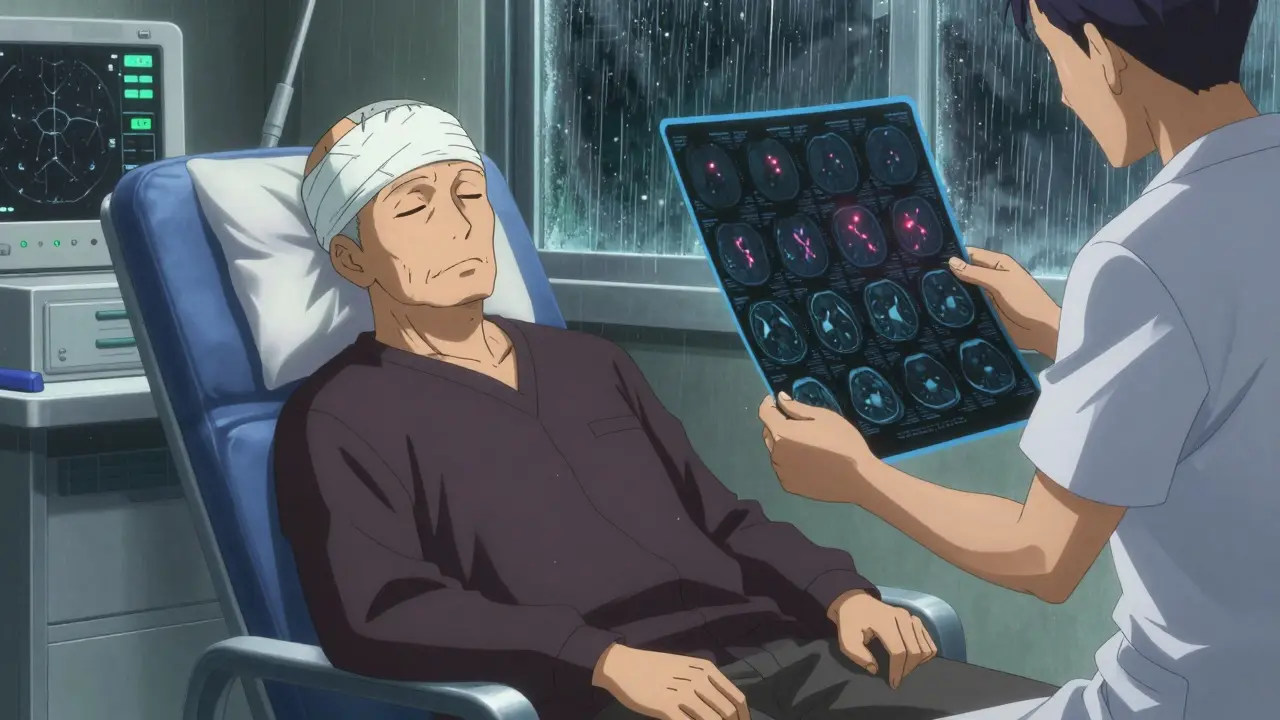
A head CT scan isn’t just checking for a big bleed. It’s looking for tiny cracks in the skull, small collections of blood between the brain and skull (subdural or epidural hematomas), or even microscopic bleeding in the brain tissue itself. These can be invisible on physical exam but deadly if left untreated. The scan uses a special "bone algorithm" setting - thin slices (0.5 mm to 1.25 mm) - to catch fractures that might otherwise be missed. That’s especially important because skull fractures can be hard to spot in older adults, whose bones are more brittle. Doctors also check your coagulation status. They’ll run a quick blood test: Prothrombin Time (PT), INR (for warfarin users), and sometimes anti-Xa levels (for DOACs like rivaroxaban). If your INR is above 3.5, your risk of bleeding skyrockets. If you’re on a DOAC, they need to know which one and when you last took it.
What Happens If the CT Is Normal?
A normal CT scan is reassuring - but not a green light to walk away. Even with a clean scan, you’re not off the hook. A 2024 study found that 0.5% to 1% of anticoagulated patients with initially normal CT scans developed delayed bleeding within 72 hours. That’s rare - but not rare enough to ignore. That’s why most hospitals still recommend observation. Here’s what you can expect:- You’ll be monitored for at least 6 hours after the injury
- Nurses will check your alertness, speech, balance, and pupil response
- If you’re stable, your INR is under 3.5, and you have no other injuries - you may be discharged
- If you’re over 65, had a high-speed fall, or have other risk factors - you’ll likely stay overnight
The Big Mistake: Stopping Your Blood Thinners
Here’s where things get dangerous - and counterintuitive. Some patients, after a head injury, are told to stop their blood thinners "just to be safe." But stopping anticoagulants can be just as risky as the bleed itself. A 2024 study in PMC11063395 documented a case where a patient on rivaroxaban had a negative CT scan. His doctor told him to stop the medication. Three days later, he had a massive stroke. Why? Because the blood thinner wasn’t there to prevent clots - it was there to prevent clots from forming in your heart or veins. Stopping it suddenly can trigger a clot that leads to stroke, heart attack, or pulmonary embolism. Never stop your blood thinner without talking to your doctor or a hematologist. The decision to reverse or resume anticoagulation must be made with care - weighing bleeding risk against clotting risk.What to Do After You Leave the Hospital
Even if you’re discharged, you’re not done. Go home with clear instructions:- Call 999 or go straight to A&E if you develop: worsening headache, vomiting, confusion, slurred speech, weakness on one side, or seizure
- Have someone stay with you for the next 24-48 hours - someone who can notice subtle changes
- Avoid alcohol, aspirin, ibuprofen, or any NSAIDs - they can increase bleeding risk
- Don’t drive, operate machinery, or make major decisions for at least 24 hours
- Follow up with your GP or anticoagulation clinic within 48 hours
What’s Changing in 2026
New research is underway. A team led by Dr. Ian Stiell - the same doctor who created the Canadian CT Head Rule - is testing a modified version specifically for DOAC users. It’s expected to be ready by late 2025. Some hospitals are now using blood tests like the Banyan Brain Trauma Indicator, which measures proteins released by brain injury. It’s not perfect - but it might one day help avoid unnecessary CT scans in low-risk patients. For now, though, the safest rule remains: if you’re on blood thinners and you hit your head, get a CT scan. No ifs, ands, or buts.Real-Life Example: What Went Wrong
A 78-year-old woman in Bristol fell in her kitchen, hit her head on the sink, and didn’t lose consciousness. She felt fine. She didn’t call anyone. The next morning, she was confused. Her daughter took her to the hospital. The CT scan showed a slow-growing subdural hematoma. She needed emergency surgery. She survived - but lost some memory and mobility. She didn’t know the risk. Neither did her GP. That’s why this matters.Bottom Line
You don’t need a dramatic fall. You don’t need to be unconscious. You don’t need to have a bump. If you’re on blood thinners and you’ve had any head impact - go to the ER. Get the CT scan. Get the blood tests. Get observed. It’s not about being paranoid. It’s about being smart. Your brain doesn’t have room for mistakes. And blood thinners don’t give you a safety net - they make the stakes higher. Don’t wait. Don’t hope. Don’t guess. Get checked.Do I need a CT scan if I only bumped my head lightly while on blood thinners?
Yes. Even a light bump can cause internal bleeding in someone on blood thinners. The risk isn’t about how hard you hit your head - it’s about what happens inside your skull. A small bleed can grow slowly over hours. A CT scan is the only way to know for sure. Don’t assume you’re fine just because you feel okay.
Can I wait a few hours to see if I feel worse?
No. Delaying imaging increases your risk. Bleeding in the brain can worsen without obvious symptoms. By the time you feel dizzy, nauseous, or confused, the bleed may already be large enough to require surgery. Emergency departments are trained to act fast - go in immediately.
What if my CT scan is normal? Can I go home?
You may be able to go home - but only after being monitored for at least 6 hours. You’ll need to have no signs of worsening, a stable INR (under 3.5 if on warfarin), and no other injuries. Even then, you must have someone stay with you for 24-48 hours and know the warning signs of delayed bleeding.
Should I stop taking my blood thinner after a head injury?
Never stop your blood thinner without talking to your doctor or a specialist. Stopping it suddenly can cause a stroke or heart attack. The risk of a clot from stopping the medication is often higher than the risk of bleeding from the injury. Your medical team will decide whether to reverse, pause, or continue based on your specific situation.
How long should I be watched after a head injury on blood thinners?
Most hospitals observe patients for 6 hours. If you’re over 65, had a significant fall, or have other risk factors, you may be kept for 23-24 hours. Some hospitals keep everyone for 24 hours as a safety measure. Delayed bleeding can happen up to 48 hours after the injury - so don’t rush home.
What symptoms should I watch for after being discharged?
Call 999 or go to A&E immediately if you develop: worsening headache, repeated vomiting, confusion, slurred speech, weakness or numbness on one side of your body, seizures, extreme drowsiness, or difficulty waking up. These are signs of increasing pressure in the brain - and they need emergency treatment.
Is MRI better than CT for follow-up after a head injury?
MRI can show more detail and doesn’t use radiation, but it’s not used for initial evaluation. CT scans are faster, more available, and better at spotting fresh bleeding. MRI may be used later if there’s ongoing concern or if the patient is young and needs to avoid radiation. But the first scan should always be a CT.
Are there any blood tests that can replace a CT scan?
Not yet. Blood tests like the Banyan Brain Trauma Indicator can help rule out brain injury in low-risk patients, but they’re not approved for use in people on blood thinners. Right now, CT scan remains the gold standard. Don’t rely on a blood test to avoid imaging if you’re on anticoagulants.
Can I use ibuprofen or aspirin for a headache after the injury?
No. Avoid all NSAIDs - including ibuprofen, naproxen, and aspirin - after a head injury while on blood thinners. These drugs increase bleeding risk. Use paracetamol (acetaminophen) only, and only if approved by your doctor. Never self-medicate.
Author

Alfred Noble
February 21, 2026 AT 21:41Man i got hit in the head last year on warfarin and just brushed it off 😅 thought i was fine. Turns out i had a tiny bleed that showed up on a scan 3 days later. Scared the crap outta me. Don't be like me. Just go get checked. No shame in being extra careful.
Matthew Brooker
February 22, 2026 AT 21:50Bro this is life saving info right here 🙌 I'm telling all my elderly aunts and uncles about this. If you're on blood thinners and you so much as stub your toe into a coffee table head first - GO TO THE ER. No excuses. Your brain doesn't get a do over.
Emily Wolff
February 24, 2026 AT 18:16It's astonishing how many people treat head trauma like a minor inconvenience. This isn't a movie. You don't get to wake up five minutes later with a funny hat.
Jacob Carthy
February 25, 2026 AT 20:51Why are we even having this conversation? If you're on meds that make you bleed easier then you better not be tripping over your own feet. Maybe stop being so clumsy. America's falling down too much.
Lisandra Lautert
February 26, 2026 AT 10:06Stop. Breathe. Go. Now.
Cory L
February 27, 2026 AT 12:19So here's the thing - your brain's got zero chill. It's not a balloon you can just poke and laugh it off. When you're on blood thinners, that little bump? It's like dropping a lit match into a gas can. You don't wait to see if it explodes. You run. And you call 911. That's not paranoia. That's survival instinct with a PhD.
Bhaskar Anand
February 27, 2026 AT 15:15Why do Americans overreact so much? In India, we just take paracetamol and rest. Why do you need a CT scan for every little bump? It's expensive. It's unnecessary. You people are too scared of everything.
Stephen Archbold
February 27, 2026 AT 21:59Hey I just wanna say real quick - I'm a paramedic in Dublin and we've had way too many cases where someone says "oh it was just a slip" and then 12 hours later they're in neurosurgery. It's heartbreaking. Don't be that guy. Don't be that grandma. Just go. It takes 20 minutes. Your family will thank you later. Seriously. Just go.
Nick Hamby
February 28, 2026 AT 10:03The underlying ethical tension here is not merely clinical, but existential: we are asked to confront the fragility of our own biology, and yet our cultural conditioning often compels us toward denial. The act of seeking imaging is not an admission of weakness-it is an assertion of agency. In a world where we are told to "tough it out," choosing to be examined is perhaps one of the most courageous acts of self-preservation available to us. One might argue that the true pathology lies not in the hematoma, but in the societal narrative that equates vulnerability with failure. To go for the scan is to reject that narrative. And in doing so, we reclaim not just our health-but our dignity.